Updated every Monday!   Subscribe to free weekly newsletter.

Do These Products Really Give You 40-50% More?

Grocery product manufacturers love to hide when they are giving you less for your money, but proclaim loudly when they are giving you more even if they really are providing nothing extra.

Example 1:

Clorox Clean-up spray bottles are adorned with a new claim that the product “cleans 40% more per spray*.”

Clorox 40% more

It took a while to find where that asterisked claim was explained, but there it was in tiny print on the back of the bottle.

*MOUSE PRINT:
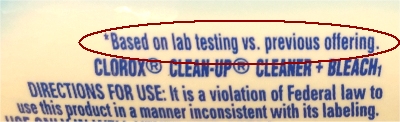
Clorox fine print

Well that explains everything… NOT. What in the world does that claim mean? Has the product been reformulated so it is 40% stronger than before and thus cleans 40% better?

We asked the company’s PR folks multiple times for an explanation, but they did not respond. Our guess is that the spray nozzle and feeder tube have been redesigned and now 40% more cleaner comes out with every spritz. That’s sort of like making the hole bigger on the toothpaste tube so you’ll use more.

Examples 2 and 3:

The most common type of “percent more” claim is designed to catch your eye and make you think you are getting a bonus — some extra amount free — because you picked up this particular promotional package.

French's Mustard - Mrs. Butterworth's

When you look more closely at these two bottles, they are not giving you anything extra free. They are merely providing a mathematics lesson.

*MOUSE PRINT:

mustard and syrup disclosures

Both products are just larger size bottles than smaller ones. A 20-ounce bottle is (approx.) 40% more than a 14-ounce bottle, and a 36-ounce is 50% more than 24-ounces. Nothing more. Nothing free.

Updated every Monday!   Subscribe to free weekly newsletter.

Are CVS Customers Better Than Most at Taking Their Pills?

Prescription adherence, as it is called, is a real problem. About half of prescriptions issued each year are either not filled or the medicine is not taken correctly. (See report.) So if someone has come up with a more effective method to ensure that patients take their drugs properly, that would be good news.

Along these lines, a curious new claim has recently adorned CVS circulars that asserts that “CVS customers are better than most at staying on their prescriptions*.”

CVS better than most

That asterisk goes to a small footnote on the front page of their advertisement.

*MOUSE PRINT:

“Based on 2019 study of national retain chain customer prescription adherence for diabetes, hypertension and hyperlipidemia medications.”

Checking the CVS website for further details, the following is displayed:

CVS better reasons

So, out of curiosity, we asked the CVS PR folks for a copy of the study, who did it and paid for it, how competitors fared, and whether the study explicitly cited the three elements above as reasons for CVS customers’ superior adherence record. The company only responded with this statement:

CVS Pharmacy worked with an independent third-party firm to study data for the top dispensed prescriptions in the U.S. across different pharmacy competitors. That data was used to create a campaign educating our customers on the benefits of filling prescriptions at CVS Pharmacy.

All this seems to say is that CVS paid for the study. We are left guessing as to which competitors did better than CVS, and which did worse. But without seeing the actual study, we simply don’t know if the conclusions that CVS drew are substantiated by it.

Updated every Monday!   Subscribe to free weekly newsletter.

Surprise: Stuff You Buy With Your Credit Card Could Be Repossessed!

MrConsumer recently applied for a new credit card and was shocked to see a particular clause in the credit card agreement. [See identical clause from a different credit union.] It said the credit union was taking a security interest in any goods I purchased with the card.

*MOUSE PRINT:

security interest

That means if I don’t pay my credit card bill, they could theoretically come to my house and repossess that big screen TV set I might have bought to watch the Super Bowl, or deduct the delinquent part of my unpaid balance from any savings accounts I have at the credit union.

We normally think of a security interest arising when taking out a mortgage on a house or buying a new car, but not when buying a refrigerator. Nonetheless, if your credit card issuer tucked a security interest clause in your credit card agreement, and depending on the wording they used, they could repossess that still unpaid for big-ticket item.

They will have to follow state law, which might impose restrictions such as the security interest does not apply to items under $200, or they can’t disturb the peace in the repossession process, or they have to get a court order first, etc. See some rules that apply in New York State, for example.

We’ve reported on various unexpected and sometimes funny clauses that have been secretly tucked into various contracts (see, for example, story one, story two), but this one raises potentially serious issues for those who fall behind in their credit card payments.

Does your credit issuer use one of these security interest clauses? To check, see if the Consumer Financial Protection Bureau has your bank’s credit card disclosure form in their database.