Updated every Monday!   Subscribe to free weekly newsletter.

CPSC Slow to Issue Product Safety Warnings

We expect state and federal agencies charged with protecting public safety to warn and protect us from dangerous products and defects in a timely way.

That is particularly the role of the U.S. Consumer Product Safety Commission (CPSC). In the story below, grieving parents of a baby who died by suffocation in a Fisher-Price Rock ‘n Play sleeper in 2017 say the agency knew about previous deaths and injuries but the product was still on the market.

The baby sleeper in this case was eventually recalled by Fisher-Price but only after information about its safety issues and reported deaths was obtained by Consumer Reports and made public. Here is some history.

*MOUSE PRINT:

The federal law being called into question here, section 6(b) of the Consumer Product Safety Act, has been controversial for years. It basically requires the CPSC to give manufacturers at least 15 days advance warning before it goes public with news of a safety defect from which the public could learn the name of the manufacturer and product involved. The manufacturer can then respond to the CPSC with its position, and object to the release of the information.

Since the CPSC is surprisingly not empowered to order a product recall without going into court to sue for one, the agency and manufacturer are often at loggerheads for years over the issue. This is why when you hear about a recall, it is typically the manufacturer “voluntarily” doing it and not the CPSC. Additionally, some say if manufacturers know that the product defect and injury reports they file with the CPSC are not going to be easily made public that incentivizes them to continue to make such important disclosures.

While the TV report above asserts that section 6(b) is a gag order being placed on the CPSC, a former assistant general counsel at the agency says it is not. He asserts the real problem at the agency is that it fails to understand and use its existing authority.

No matter, in the current Congress, the Sunshine in Product Safety Act was filed to abolish section 6(b), but it has gone to committee and not likely to pass.

Whether section 6(b) is preventing the CPSC from naming names and alerting the public early to safety hazards, or they are not effectively using their own rules and tools, the result is the same. We deserve better protection.
Updated every Monday!   Subscribe to free weekly newsletter.

Ratings for American Home Shield Higher on Sites That Earn Commissions From Them

American Home Shield is a company that advertises a variety of home warranties to cover major appliances and systems in your home if they need repair or replacement. Here is a recent commercial:


Certain trusted websites like BobVilla.com, ThisOldHouse.com, ConsumerAffairs.com, and Forbes.com give the company good to great reviews.

ThisOldHouse.com

“American Home Shield is a veteran in the home warranty industry and one of the best home warranty companies available to homeowners. … We rated American Home Shield a 94 out of 100 [emphasis added] and named it the best overall home warranty company. …”

Cons listed: ” ✘ Charges slightly higher monthly premiums than some providers: ✘ Guarantees repairs for only 30 days.”

“In general, American Home Shield home warranty reviews from existing customers are a mix of positive and negative reviews. Some customers are happy with quick fixes and an easy claims process, while some complain about denied claims and negative experiences with on-site technicians.”

BobVila.com

“Our Verdict: American Home Shield offers well-rounded home warranty policies that will likely appeal to a wide variety of homeowners. … Every facet of the customer experience is competently executed, and there are no glaring drawbacks with its services that might raise a red flag for potential customers.” [emphasis added]

ConsumerAffairs.com

“Overall, we find that American Home Shield offers good coverage at a fair rate. Prices are on the higher end of average for the industry but still pretty competitive, considering the level of coverage provided. It’s an especially smart fit if you like the idea of managing everything online.”

Based on over 11,000 customer reviews, the company was given 4.2 stars out of five . Under “cons,” the site said “some customer service complaints.”

Forbes Home

“Our Verdict: With decades of experience and multiple exceptionally comprehensive home warranty plans, American Home Shield is one of the top home warranty providers in the industry.”

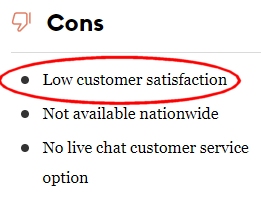
Their editorial team gave the company 4.7 out of five stars but at the same time mentioned these CONS:

Cons for American Home Shield

*MOUSE PRINT:

It should be noted that all the above sites earn a commission on the sale of American Home Shield policies, and have disclosures like this:

Affiliate Disclosure: This Old House‘s Reviews Team is committed to delivering honest, objective, and independent reviews on home products and services. To support this business model, This Old House may be compensated if you purchase through links on our website.

However, the “reviews” on their websites look more like detailed marketing material about the company and its warranty plans rather than objective evaluations.

On the other hand, if you look at websites that collect reviews, ratings, and complaints by customers, and don’t earn a commission on sales about the companies they list, a very different picture emerges.

The Better Business Bureau has closed 27,120 complaints against the company in just the past three years. The complaints are what you would expect: delays in getting repairs, repairs that did not fix the problem, delays in getting reimbursements, and difficulty getting refunds for contract cancellation, etc.

The BBB has over 11,000 customer reviews on its website that give the company an average of 2.25 stars out of five. Despite this, the BBB has given the company a “B” rating presumably because the company responds to 100-percent of BBB complaints and many consumers accept the settlements offered.

Reviews posted on other sites that don’t earn a commission from American Home Shield are similarly low. Trustpilot gives the company 1.8 stars. Those on ComplaintsBoard average one-star. Yelp reviews average one-star.

So, it appears on sites that make money by posting their own reviews, ratings of the company are significantly higher than on complaint and review sites that don’t earn revenue in that way. Which would you believe?

Updated every Monday!   Subscribe to free weekly newsletter.

Carnation Breakfast: Where’s the Promised Protein?

Earlier this month, a class action lawsuit was filed against Carnation about the allegedly misleading label on some of its Breakfast products.

The product, which comes in packets, boasts on the front of the package that it has 13 grams of protein, 21 vitamins and minerals, 3 times the vitamin D of milk, and three times the calcium of Greek yogurt.

Carnation breakfast

On the far right of the package, in tiny type, is a key disclosure:

*MOUSE PRINT:

Carnation - add milk

Most shoppers are not likely to see that, and it certainly isn’t remotely close to the protein claim. On the back, the ingredients statement has powdered nonfat milk as the primary ingredient. That might lead one to believe all you have to do is add water.

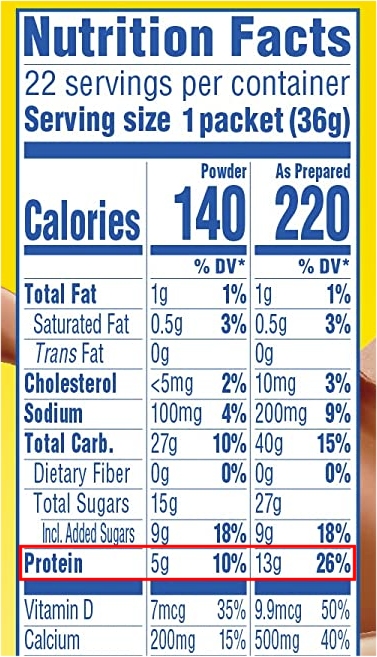
However, when checking the nutrition facts label, it becomes clear that the protein content of each packet is only 5 grams, and only magically becomes 13 grams as represented on the front of the package when consumed “as prepared” when adding milk.

*MOUSE PRINT:

Carnation nutrition label

So, what do you think? If you picked up this product and saw the 13 grams of protein claim on the front of the package, would you understand that that amount is only the result of adding milk to the product? There are no instructions on how much to add.