Updated every Monday!   Subscribe to free weekly newsletter.

Thanks for Nothing – Fall 2022

We continue our series of little annoyances about ads, offers, and practices that are often real head-scratchers, might make you grind your teeth, or even chuckle.

Example #1 — Air Conditioners – $50

The Craiglist ad offered a giveaway price for air conditioners — only $50.

air conditioners

In the description, a small detail is disclosed along with a “generous” offer.

*MOUSE PRINT:

air conditioner cardboard

Thanks for nothing, Craigslister.


Example #2 — Kitchen Appreciation Fee

It is not just hotels that are adding junk fees to your bill. Now some restaurants are doing it too and they call it a “kitchen appreciation fee.” This tip goes to employees who don’t generally get tipped, and is automatically added to your bill. While there is a fine print disclosure on the menu in many places about the fee, most diners won’t notice it there, and may not even notice it on their bill until after they leave the restaurant. Of course, you can tell the server to take the charge off your bill, but that puts diners in an awkward position.

*MOUSE PRINT:
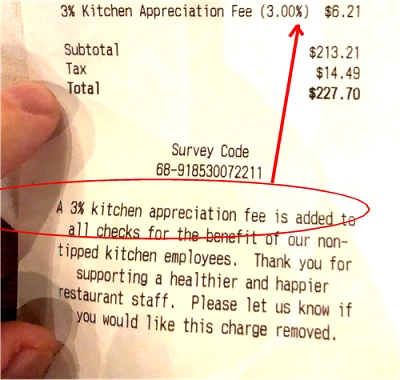
Kitchen appreciation fee

So, thanks for nothing to all the restaurants that tack these fees onto your restaurant tab without asking.


Example #3 — Not So Easy Returns

An online women’s clothing site advertises on Facebook and its website that its garments are all made in and shipped from the USA. It certainly is unusual to see clothing made here particularly at the low prices this shop charges.
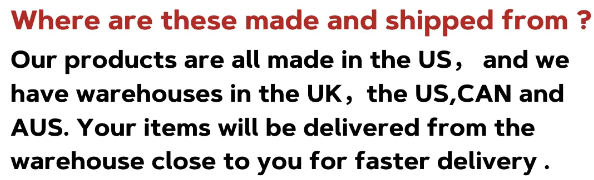
Ryabe - made in USA

When a friend contacted them about how to make a return, she was offered a partial refund but told it probably wasn’t worth doing for a full refund because of the high cost of return shipping that she would have to pay. Why was shipping so expensive?

*MOUSE PRINT:

Ryabe response

There is no disclosure on their website that returns must be sent to Dubai. Thanks for nothing, Ryabe.


Example #4 — $5 a Month Cell Plan

TwigbyMrConsumer got very excited when he saw this banner ad for a $5 a month cell plan with unlimited calls and texts and one gig of data. He’s paying that for only half a gig of data now.

Upon checking their website for the offer, the truth came out:

*MOUSE PRINT:

Twigby 3 months only

Hey, Twigby, at least you could have disclosed that the $5 plan was only an introductory offer in your ad, but you omitted that fact. Thanks for nothing, Twigby.


Example #5 — Macy’s Sale Exclusions

Macy’s is already advertising discounts good through Black Friday, sending 25% off shopping passes to customers. These cards, approximately 3.5 inches wide and two inches high, have a ton of exclusions from the sale listed on the back of the card. The trouble, according to the ConsumerMan, is that the excluded brands are in such small type as to be unreadable. Thanks for nothing, Macy’s.

*MOUSE PRINT:

Macy's exclusions

Updated every Monday!   Subscribe to free weekly newsletter.

Melt: Is It Really Butter?

Recently, Melt, a vegetable oil spread, seems to have changed its packaging perhaps in an effort to boost sales. Best we can tell, this was the old package:

Melt old

The new packaging is dramatically different, and no longer emphasizes the product name, Melt, but rather shouts one other thing — butter. It even seems to call the product “butter” or “butter sticks.”

Melt new

Only in much smaller type beneath the big butter representation are the words “Made from Plants.”

Our concern is that a hurried or distracted shopper could easily pick up this product, seeing the huge word “butter” on it, and think that’s what they were buying.

“Butter” is not a generic term that can simply be applied to any kind of spread. There is a 99-year-old federal law — a standard of identity — for butter.

“butter” shall be understood to mean the food product usually known as butter, and which is made exclusively from milk or cream, or both, with or without common salt, and with or without additional coloring matter, and containing not less than 80 per centum by weight of milk fat…

So butter has to be made only from milk or cream and contain at least 80% milk fat.

*MOUSE PRINT:

Melt is made from a combination of coconut, palm fruit, sunflower and flaxseed oils, and is only 62% fat.

The FDA has jurisdiction over butter labeling, and over the misbranding of food products if they have a label with a “false or misleading representation with respect to another food.” Apparently, however, the agency has not been particularly motivated to take action against companies that arguably try to mislead customers into thinking their spread is real butter.

The outgoing executive director of the The Butter Institute told Consumer World that “it is fairly obvious that marketers of these products are looking to hitchhike on the highly regarded taste and performance of real butter and its popularity with consumers. …the improper labeling of food products claiming to be butter, but not meeting the standard could be in violation of not only federal labeling regulations, but also an act of Congress.” That organization says it is not aware of any regulatory action taken by the FDA as a result of its complaints.

The state of California tried to stop another company from using the term “butter” on its package for a vegan spread, but did not succeed in its lawsuit.

We asked the company that makes Melt some very pointed questions about why they changed their packaging, why it made the word “butter” the most prominent word on the display panel, and whether it was an attempt to potentially mislead shoppers.

The company has not responded despite two inquiries.

Updated every Monday!   Subscribe to free weekly newsletter.

More Groceries Hit by “Skimpflation” – Part 2

We continue reporting on products this week that have been reformulated in some way, usually with less of the expensive components and often by substituting cheaper ingredients (“skimpflation”).

Scott 1000-Sheet Toilet Paper

Virtually every brand of toilet paper has been downsized over the years, but Scott still has 1000 sheets. Of course, they reduced the size of each sheet multiple times as we have reported, but the current size has remained the same since 2010. So besides raising the price, Kimberly-Clark has also tinkered with the paper itself. According to purchasers, it is getting thinner and rougher. (See recent shoppers’ reviews.)

The sheets are so thin they’re transparent. I don’t even think they are a full ply.

Won’t be buying again … Would rather use a leaf then this crap again. Couldn’t be more disappointed!!!

It’s thin like the cheap paper in public restrooms and you have to use twice as much. I will never buy again.

If you enjoy picking out little globs of paper from your body parts because it is so thin it disintegrates from getting wet with the slightest friction – this is the toilet paper for you!

To try to quantify the change, we compared the weight of a four-pack of Scott from around 2006 to today’s version, while accounting for the sheets size change. Though not perfect, this method demonstrates how much less paper fiber or pulp goes into today’s sheets. And the difference is dramatic.

*MOUSE PRINT:

Scott Weight Comparison

The current version has about 20-percent less paper by weight than the 2006 version. So if purchasers are perceiving it has gotten thinner, it is not their imagination. This a perfect example of a company reformulating the product to cut costs — the essence of skimpflation.

We don’t know if Kimberly-Clark made small changes over time or all at once. The company did not reply to multiple requests for comment.


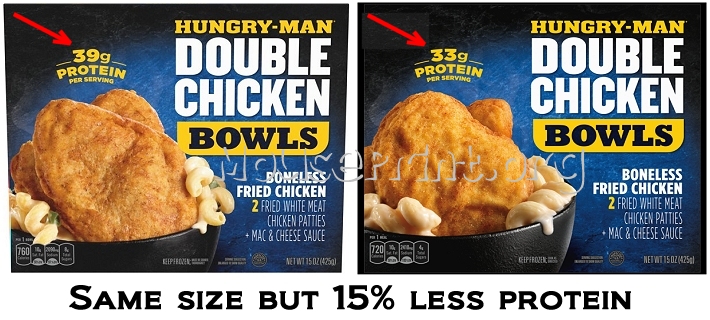
Hungry Man Double Chicken Bowls

An eagle-eyed shopper named Random Keith found that this TV dinner had changed. Hungry Man Double Chicken Bowls fried chicken used to pack 39 grams of protein. Now it has 33 grams — 15% less protein — but it still comes in a 15-ounce box. This could suggest a reduction in the chicken or cheese content — the two most dominant proteins.

*MOUSE PRINT:

Hungry Man Double Chicken Bowl

But, a check of the ingredients statement and nutrition label offers a clue to their recipe sleight-of-hand. The new version is missing “textured soy protein concentrate” which was part of the breading. Does that solely account for the reduction in protein? We asked Conagra, the maker of Hungry Man, what had actually changed, but didn’t get an answer.


If you spot a product that has been reformulated with cheaper ingredients, please send a sharp before and after picture of the primary labels and the ingredients statements to Edgar (at symbol) ConsumerWorld.org . Thanks.