
A Colorado consumer who parked in an LAZ lot in Denver is suing that company (and others associated with enforcing parking lot rules at that facility) over a billing dispute. [See complaint.]
In the lawsuit, the consumer claimed that the parking companies involved illegally obtained his name and home address contrary to the federal Drivers Privacy Protection Act (DPPA) which limits who can access official motor vehicle department records. (Presumably those companies captured his license plate and obtained his registration information from the DMV.)
The parking companies told the judge that this matter needed to go to arbitration because there were supposedly conspicuous signs in the lot that told customers that any parking disputes had to be handled through arbitration.
Can merely having a sign hanging in a facility bind a customer to mandatory arbitration in case of a dispute?
*MOUSE PRINT:
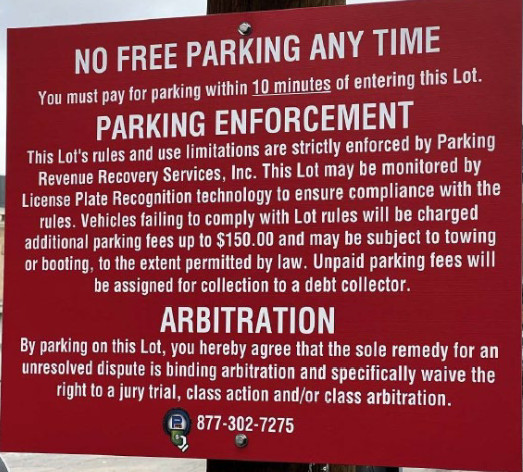
The judge recently ruled that a contract was formed:
… a reasonable driver knows that when they park in a parking lot, they agree to an implied contract with the lot owner: the lot owner allows the driver to park on their property, and the driver agrees to follow the rules laid out by the lot owner, including paying the required rates. If the driver does not follow the rules or does not pay, they may be subject to a ticket or their car being towed. The driver is free to leave the lot without parking if he does not want to agree to these implied terms …
But, with respect to arbitration, only one of the three companies who were being sued by consumer, can get out of the lawsuit. And that is the company named on the sign responsible for enforcing nonpayment issues. The other two companies, Laz and the company that provides the license plate reading technology that snagged this consumer, still have to face charges in court.
The judge did not accept the consumer’s argument that he failed to see the signs since it was dark. She found them to be conspicuous and in multiple locations, and the consumer chose not to learn the terms of this implied contract with the parking lot, that was his fault.
One has to wonder if this could lead to stores putting mandatory arbitration notices on their entrance doors (e.g., “If you enter the store, you agree to resolve any disputes with X retailer via arbitration”)?
The message on that parking sign was drafted by some lawyer, which brings this one to mind —
Q. What do you call 50 lawyers lying on the bottom of the ocean?
A. A pretty good start.*
*Like you I’m a lawyer (recovering), Mr. Consumer, so I can get away with it.
There’s a common sense answer to the question in your final paragraph,
It’s common practice for parking lots to post their rates and rules. Most drivers routinely check for signs. Hence, the arbitration statement is part of the implicit contract.
Stores do NOT normally post their rates and rules at each entrance. Hence, there is no implicit contract.
A somewhat similar case played-out in Pennsylvania, where a private parking lot owner placed signs about parking rules and enforcement, and later applied boots to cars suspected of violating the rules. Since PA law allows only police and licensed municipal officials and entities to immobilize a vehicle, the court found the booting illegal. In MA, only law enforcement and authorized municipal parking enforcement agents are permitted to immobilize a vehicle.
As for defendants’ alleged unlawful access to Colorado DMV records, the Colorado DPPA law places narrow limits on which individuals and entities may lawfully access DMV records. If the defendants were authorized by the State of Colorado to access and possess such records, plaintiff’s claim of unlawful access falls. If the defendants were not authorized to access the records, plaintiff has a cause of action not only against the currently-named defendants, but also against the State of Colorado for failing to protect the records from unauthorized access.
As for forced arbitration by virtue of purchasing and/or using a product or service, whereby the purchaser or user does not consent by means of a written and signed contract, this is common practice across nearly-every product and service consumers purchase. Forced arbitration is, however, subject to challenge in a court of law, on foundational claims including unconscionability, fraud, and/or statutory limitation.
Can a Parking Lot Sign Mandating Arbitration Be Enforced?
If this is the question we’re answering, I think the answer must be yes. If the signs are found to be conspicuous and the driver is given the opportunity to leave without penalty once they notice the sign and disagree, how can noticing the sign and then leaving your car in the lot be considered anything besides a voluntary agreement to the terms stipulated on the sign?
I would be more cautious if it was buried in some kind of, “Scan this QR code for full details”, but it’s right there on the sign for anyone to see.
I would say the same thing with a grocery store, not that I think any would do it, if the sign is clear and conspicuous how can going into the store and making a purchase be considered anything else except agreement to the terms posted on the sign?
Even if the person paying for the groceries is blind?
“The driver is free to leave the lot without parking if he does not want to agree to these implied terms”
This is ridiculous statement, especially in an urban environment where parking lots fill up early and there may not be a reasonable alternative. Also, it’s likely many lots are under the same ownership so they will all require arbitration, so leaving without parking is pointless. Either way, you have no choice; you can’t stick your car in your pocket and carry it around. It’s beyond belief that a sign can override a constitutional right to a trial.
You don’t have a constitutional right to trial in civil cases. If you did every single arbitration agreement would be unconstitutional.
The state isn’t taking action against a person another private entity is.
You are free to leave the parking lot, just like you are free to refuse to shop at Walmart if you don’t like their labor practices, and you’re free to make your voice heard about your disapproval of the terms the parking lot is offering to park there. At the end of the day, supply is not a justification for changing the law. If I’m the only person selling ice cream anywhere in a five-mile radius, you don’t have a right to buy my ice cream at what you consider “fair terms” as long as my terms are legal you can buy my ice cream under my terms or you can decide not to buy my ice cream.
If I saw a sign like that, I wouldn’t go to that business
sounds like they dont want to pay someone. to sit in a booth all day and collect the money.
Disregard my previous comment.
I read through the complaint and it’s more about the billing and collections practices of the entire operation.
Seems to be a scam operation. Double billing, lost payments (alhtough a credit card dispute could have helped the plaintiff.
Hard (impossible) to reach a live human to possibly resolve the issue.
Stay a way from lots operated by these organizations.