
This week we spotlight some of the various products that have been reduced in size — otherwise known as shrinkflation.
| Hershey’s Kisses |
|---|
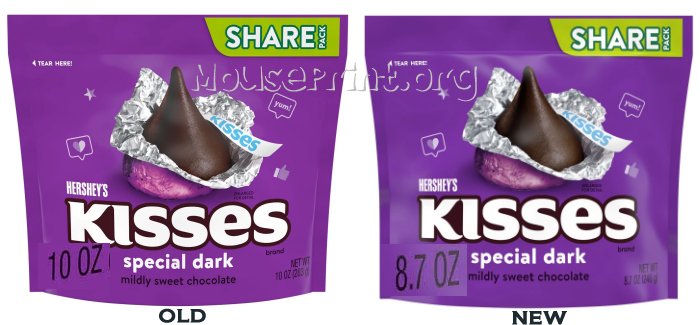
Snack foods like candy keep getting smaller. Here, Hershey’s Kisses share size have gone from 10 ounces down to just 8.7. I guess everyone will just have to share less.
*MOUSE PRINT:
| Ziploc Freezer Bags |
|---|
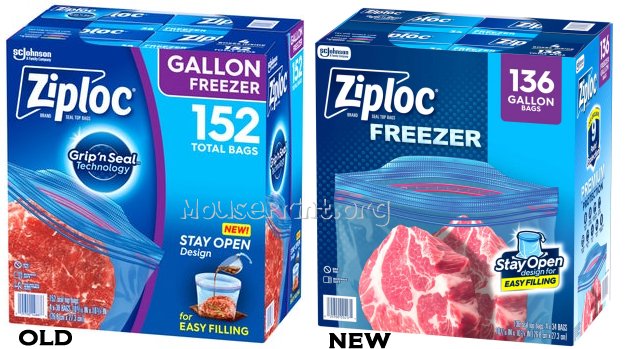
Boxes of plastic bags seem to always be shrinking whether they are sandwich bags or storage bags. Here, Ziploc gallon-size freezer bags lost 16 bags in every box.
*MOUSE PRINT:
| Stop & Shop Instant Oatmeal |
|---|
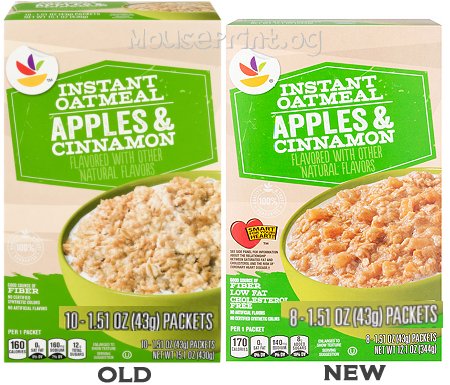
Just like the name brands, store brand products eventually downsize too. Here, boxes of instant oatmeal from Stop & Shop which used to have 10 packets now only have eight.
*MOUSE PRINT:
| Laughing Cow Cheese |
|---|
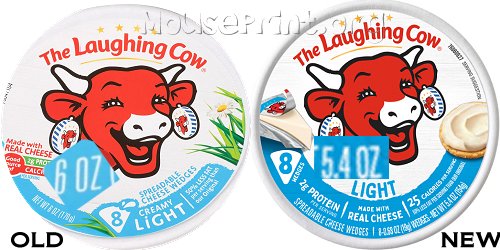
This popular cheese brand lost 10-percent of its contents. This is why customers are not laughing, but the cow will soon be chuckling all the way to the bank.
*MOUSE PRINT:
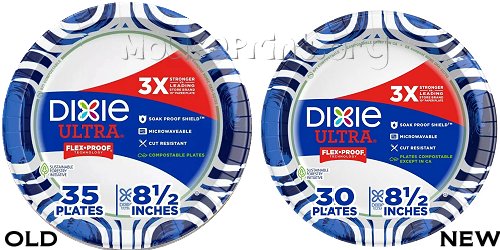
| Dixie Ultra Paper Plates |
|---|
Like most paper goods, paper plate packages now have fewer plates than before. Here, Dixie cut five plates from its package of 35.
*MOUSE PRINT:
| Eight O’Clock Coffee |
|---|
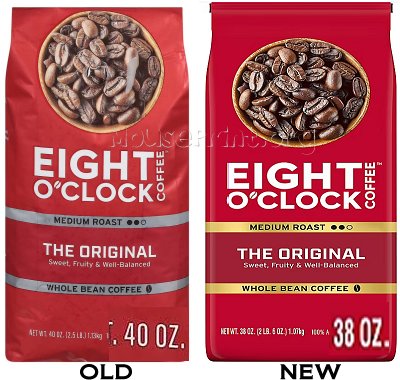
Remember when cans of coffee used to be a pound? Those days are long gone. Today, with coffee prices so high, manufacturers are making their largest bags smaller. Eight O’Clock dropped two ounces from their 40-ounce bags. Thanks to Richard G. for this submission.
*MOUSE PRINT:
Defending Stop & Shop a little bit, but I’d MUCH rather have a reduction in total quantity then a reduction in size. At least I can tell how much I’m paying per package and compare that over time. It is the ones like the Babybel that annoy me the most.
I’m waiting for coffee to shrink down to one bean but for the same one pound price.
Given the Government uses prices in calculating the rate of inflation, and given prices do not reflect shrinkage in amount or volume or products purchased, where the real and true rate-of-rise in consumer costs is not reflected, this would seem to corrupt the meaning and accuracy of inflation numbers reported by the Government.
Glenn…. My understanding is that the Bureau of Labor Statistics takes into account net weight changes and factors that into their findings of price changes.
Interesting! Essentially, the govt. is using unit pricing!— validation for the point I make in comments below.
Edgar
I think that each shrinking article should at least have a passing mention and explanation of unit pricing. I think many people do not know what it is, but as you know, it’s the solution for shoppers.
There will continue to be an infinite supply of these shrinking examples. Literally every packaged item in your basket needs to be scrutinized every time you shop. The manufacturers know that’s just too exhausting for the average shopper; there’s no way to beat them at the game. EXCEPT for the smartest shoppers who purchase by unit pricing.
Matt… Unit pricing is absolutely a great tool for consumers (in states where available) to find the best deal of the various sizes/brands on the store shelf of the same commodity. Unless you memorize the unit price of the stuff you buy regularly, I don’t consider it a good tool to alert you to a product that has downsized and thus costs more per ounce.
Shoppers are ALREADY memorizing the prices of their favored products. They be come confounded when they are getting less for the same price.
My point is , instead of memorizing the scan price, they learn the unit price for their favored packaged products. Problem solved.
Firm believer that when manufacturers make changes like this, it should be required by law that they have to label the reduction in big enough font that shows that the product was reduced and the price wasn’t. Edgar, I agree with your response to Matt that unless you know every unit price of most items you buy regularly and/or know that…hey, didn’t that used to come with 10 packets instead of 8, you wouldn’t know. I also found it interesting that on the Instant Oatmeal, the calories per serving increased from 160 to 170.
In this example, you already know the box of 10 packs of oatmeal is $3.29. Instead of knowing it’s $3.29, just read the unit price (located right next to the 3.29 shelf price tag), and ‘memorize’ THAT price. In this case, .329 per pack (or 3.48/lb)
Now , when they cut it to 8 packets, that unit price tag has climbed to .411– (or 4.35/lb) instantly letting you know the price has jumped.
You already do this with potatoes, apples, gasoline, etc. They can instantly know if they want to buy by looking at the pound or gallon price.
Hey Matt, I understand how unit pricing works, however, not all stores have unit prices listed on the price tag.
Many major supermarket chains display unit pricing nationwide even in states that do not legally require it, as a standard customer service.
At this point I think the question is whether there are any companies selling consumer products whose packages, in say the last ten years, have NOT shrunk. If there are, maybe they should get an award, the “Mr. Consumer Award.”* What do you think, Mr. Consumer?
*Or maybe the “Ms. Consumer award.”
Dave… I am afraid a MrConsumer award would be no incentive for any manufacturer to make a decade-long commitment. Maybe a Consumer Reports award would!
Blue Bell Ice Cream is still sold in half gallons! They’re very proud of that fact as well.
This is so common, it’s hardly worth mentioning anymore.
Yes it continues to happen quite often (which makes my wallet very sad), but I enjoy seeing these occasional posts so that I can be aware of what products are being impacted, and which conglomerates are actively seeking to screw consumers out of the little money that they have!!
We have to continue to name and shame. These companies hardly come out and say they are shrinking the products.
The Kisses has no mention of a package change. At least they didn’t add (fun size) to it. Nothing fun about fun sized anything.
The laughing Cow product is no longer laughing if you saw the update before. Seems like a general political statement from the company.
I think grocery stores are partially to blame for issues related to shrinkage. Many grocery store chains are very large corporations that can pressure manufacturers to package food items a certain way. Why don’t they refuse to allow shrinkage? If you ask me, grocery stores benefit because now I have to visit the store more often to refill my fridge and cupboards. That means more impulse shopping and more $$ for the grocery stores. I might buy prepared dinner items or cupcakes that are made on-site that the grocery store has a high profit margin on. 10x extra visits a year = 10x more packages of cupcakes sold to me! Maybe I have a cupcake problem, but the way I see it, grocery stores are making extra money because of shrinkage, not just food manufacturers.
The worst downsized items are those used in baking. Evaporated milk, chocolate chips etc. To follow old recipes, I have to buy two of the items and only use part of the second one. I would rather they just raise the price of the original size!