A Colorado consumer who parked in an LAZ lot in Denver is suing that company (and others associated with enforcing parking lot rules at that facility) over a billing dispute. [See complaint.]
In the lawsuit, the consumer claimed that the parking companies involved illegally obtained his name and home address contrary to the federal Drivers Privacy Protection Act (DPPA) which limits who can access official motor vehicle department records. (Presumably those companies captured his license plate and obtained his registration information from the DMV.)
The parking companies told the judge that this matter needed to go to arbitration because there were supposedly conspicuous signs in the lot that told customers that any parking disputes had to be handled through arbitration.
Can merely having a sign hanging in a facility bind a customer to mandatory arbitration in case of a dispute?
*MOUSE PRINT:
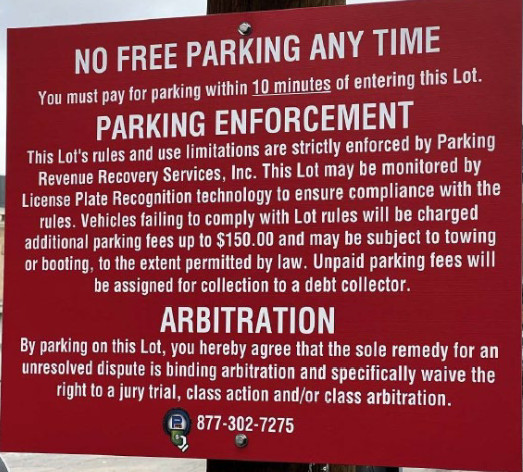
The judge recently ruled that a contract was formed:
… a reasonable driver knows that when they park in a parking lot, they agree to an implied contract with the lot owner: the lot owner allows the driver to park on their property, and the driver agrees to follow the rules laid out by the lot owner, including paying the required rates. If the driver does not follow the rules or does not pay, they may be subject to a ticket or their car being towed. The driver is free to leave the lot without parking if he does not want to agree to these implied terms …
But, with respect to arbitration, only one of the three companies who were being sued by consumer, can get out of the lawsuit. And that is the company named on the sign responsible for enforcing nonpayment issues. The other two companies, Laz and the company that provides the license plate reading technology that snagged this consumer, still have to face charges in court.
The judge did not accept the consumer’s argument that he failed to see the signs since it was dark. She found them to be conspicuous and in multiple locations, and the consumer chose not to learn the terms of this implied contract with the parking lot, that was his fault.
One has to wonder if this could lead to stores putting mandatory arbitration notices on their entrance doors (e.g., “If you enter the store, you agree to resolve any disputes with X retailer via arbitration”)?