
Have you looked at the fine print on your prescription drug bottle lately?

MrConsumer decided to check his bottles and made a surprising discovery.
*MOUSE PRINT:
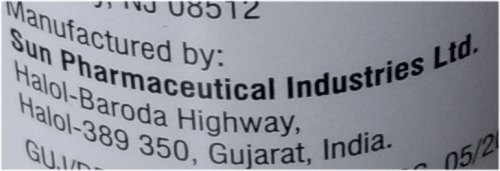
What? These pills purchased from CVS/Caremark mail order came from India? Yep. And apparently this is not an isolated case. For many generic drugs today, either the main ingredient or the finished pills themselves come from either India or China. Who knew? (You knew if you saw the story about the book, China Rx, a few weeks ago in Consumer World. The book describes lax inspection of pharmaceutical factories in foreign countries, including inadequate inspections by the FDA.)
While this particular manufacturer put its full address on the bottle as the law seems to require, some others just list the manufacturer’s name leaving you, the customer, to guess what the country of origin really is.
Don’t you want to know where the pills you take come from?
For more on the hiding of the origin of foreign-manufactured drugs, see David Lazarus’ column in the LA Times.
Mine come from the VA: One manufactured by ScieGen in Hauppauge, NY and the other mfgd in Slovenia by Lek Pharm for Sandoz in Princeton NJ.
My bp pills are from China! What’s the solution to this problem!?
I don’t take any kind of pills with regularity, but it does concern me the apparent lower testing standards. Perhaps there should be different testing rules for pills sourced internationally where the manufacturing facilities cannot, as easily, be monitored. Though, I am hesitant for more government oversight on an industry that is already practically ran by three letter agencies whose employees are not elected.
New England Compounding Center, who was responsible for 60+ deaths and 732 sickened, was located right here in Framingham Massachusetts. Automatically assuming that ALL medications made in India and/or China are bad, and that USA-made medications are good, is plain-and-simple racism. I would take medications made by Cipla or Ranaxby (among India’s lerger pharma companies) any day. Furthermore, the statistics of reported fakes ALWAYS mixes in Viagra and Cialis in their statistics. As far as I know, there have been no fake heart or blood pressure medications. So who is behind the effort to discredit imported pharmaceuticals? Could it be “Big Pharma,” our friends who brought us Oxycontin? With 42,000 opioid deaths last year, do have any credibility? (note that almost ALL opioids are made in the USA).
I think this is why most of “our” prescriptions come in the orangish/transparent bottles from the pharmacy. So that we really don’t know where they are coming from…
Not saying imported is bad just that we don’t have a clue.
It is amazing how much medication is made outside the US and imported and repackaged by US manufacturers/distributors. Many times there are only a few different manufactures making the drugs for many different resellers. It gets even worse when you look at the manufacture of over the counter drugs. As an example look at the acetaminophen recall from 2006 when over 11 million bottles were recalled. Many ingredients are imported. As long as manufactures and distributors look for all mighty dollar profit, this will go on. Many times there is nothing wrong with drugs. ingredients manufactures in some foreign countries. But this blows away the biggest argument that is used by big manufactures and big pharmacies about cheaper imports.
There are varying degrees of product quality in every country so I wouldn’t judge by the country alone.
Although, you’re statistically more likely to receive low quality products from east Asia because of the manufacturing density and lax regulation in those areas.
Every prescription label has the supplier’s name somewhere in the label. It might be abbreviated and is customarily in the lower left part of the label. You can then refer to the FDA’s “Orange Book” website (link below) and see if the manufacturer’s medication is pharmaceutically equivalent, a pharmaceutical alternative, or a therapeutic equivalent. Consult the introduction of the Orange Book for the distinctions.
https://www.fda.gov/Drugs/InformationOnDrugs/ucm129662.htm
Wow! The government says ordering online from Canadian pharmacies is too dangerous, but they’ll happily let American companies overcharge me to import Chinese drugs.
The question is MarcK1024, what countries are the drugs from Canadian pharmacies made in?
Frankie, that’s a good point. They’re probably the same countries as the ones being sold in the United States! They’re probably identical, just a lot less expensive in Canada.
Virtually every medication dispensed by US pharmacies seems to be made in India. Pharmacies large and small all seem to get their medications from Indian pharmaceutical companies. I recently had to have a prescription filled for an antibiotic. I called every pharmacy in my city of 235,000 people. Not one had a medication made anywhere other than India. The quality is definitely not the same. I had been taking a maintenance medication for years without incident. When my pharmacy substituted an Indian-made brand without my consent or knowledge, I had terrible side effects. I now refuse all medications made in India unless it’s something I need urgently.
Sanitation, or the lack thereof, is a big problem in Indian pharmaceutical companies. Here is an interesting article from the New York Times:
https://www.nytimes.com/2014/02/15/world/asia/medicines-made-in-india-set-off-safety-worries.html
Years ago, 60 Minutes on CBS had a startling report on the lack of sanitation in Indian drug manufacturing facilities. If people have no means to wash their hands after using the toilet, do you really want to take medications that they have made?
Now,now, you don’t want to be labeled as a racist! 😉