
We are used to seeing airline ads that promise a roundtrip fare of say, $199, but have come to understand (unfortunately) that we really don’t pay $199. Rather, we are charged some higher price like $249 after all fees and taxes are added on. Rental car firms are also guilty of advertising an artificially low price that is boosted significantly by junk fees and taxes. And let’s not forget your cable, Internet and telephone bills — you never pay the advertised $99 triple play package price.
Can you image if other types of sellers, like retailers, did that too? Stop imagining. A couple of years ago, a midwest supermarket chain that caters to a primarily Hispanic audience did just that. They advertised one price on the shelf, but customers had to pay a higher price at cash register!
*MOUSE PRINT:
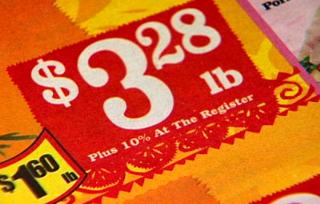
Huh? Pay 10% more than the advertised price? The company called this “shelf plus pricing”. Sometime after introducing this concept, the chain became the subject of a local TV news exposé. The store made all the usual arguments: our advertising and pricing is clear, customers are not being deceived, etc.
What a crock.
They did eventually drop the surcharge.
Avanza is owned by the Nash Finch Company. Like many companies, they subscribe to set a corporate values, the first one of which says:
Integrity:
We are honest and open with one another and with our customers.
UPDATE: Mouse Print* reader Bryan A. says a supermarket in his area uses the same technique of adding a 10% surcharge. Here is a sample ad from Food Depot (“a new way to save”).
What a crock! But there’s a reason, just like I avoid gas stations that charge more for using my credit card, to avoid them. It all goes to my mantra that Retailers HAVE to play retail games. It’s their payback for being so stupid
We have a grocery store like that here – its the same gimmick. Stupid, but deceitful? I think not. Its blasted EVERYWHERE in the store you pay an extra 10 percent. You would have to be really stupid not to get it.
Again, I think its a dumb gimmick, but to call it deceitful is pushing it in my opinion.
I noticed this story aired in 2008. Have they changed their practices since then?
@ Dave, mmm, it is illegal, at least in Wisconsin, to charge anyone more for using a credit card. On the other hand it is not illegal to give a discount to those buying with cash.
@Bryan, why not just make it one price then, if everything is going to cost 10% more? Are there items that don’t cost 10% more? If there are that just causes confusion. I would not support that at all, even though it is not deceitful and clearly printed. It makes grocery shopping that much more of a hassle. If I have to add 10% to everything that I buy, so that I can make sure I have enough cash to buy everything, I’d just go to another store.
I think obfuscation of the price is deceitful. Requiring you to do math to figure out the price of the item is obfuscation. Sure, people could carry around calculators (and most do, whether they realize it or not), and 10% isn’t hard to figure out (except now you have to add two fractional numbers together), but what’s next, having to apply a derivative calculation to “store points” to figure out the cost of an item?
Why stop at adding 10%? Why not advertise a price of a few pennies and then add 99% at the register? Or would that be too obvious? I wonder if these sorts of shenanigans take place in other countries or is the USA unique in allowing companies to undertake any sort of deceitful practice in order to scam the less astute members of society? To my mind, this sort of practice is symptomatic of a ‘sick’ society.
I looked at the ad in the update from Edgar, and was shocked to see a $4.95/lb price for country style pork ribs! You can get those on sale for about $1-2 a pound around here, as they aren’t really ribs, but come off the cheapest cut, which is the shoulder.
And I really don’t understand why they can’t just add the 10% “stocking fee” or whatever to the price already advertised, unless they’re counting on people coming in for the low prices and not paying attention (which of course they are) to the “10% added at register”.
The fact of the matter is that this provides no benefit to the customer. The only benefit is to the store, which makes extra profit off of customers that lack the ability or the will to do the price comparison.
@John – We’ve been doing this in the United States for years with sales tax. Other countries *already* can’t fathom how we can go shopping without knowing the exact price before we hit the register
Looking at bryan’s updated link, I understand that type of practice. that is more like a wholesaler, our cost+10%, which I have dealt with before (although not with a grocery store). As it was explained originally that it was just a random 10%, then yes it would be weird, but the wholesale example makes sense, and not really deceitful but confusing, and like its always been said, buyer beware.
Not seen this in the UK. We have a form of sales tax called VAT- Value Added Tax (just gone up to 20%- the alternative would be taxing the rich people). It is usual to quote the shelf price including this- If I buy a £300 TV, they don’t ring up £360, the price is £250+VAT. Some places will give a quote with out VAT- mechanics, builders, because of what they can claim, or their customers can claim, but usually they say ‘£1000 plus vat’. However high street shops what you see is what you pay.
(As an aside, a common held myth about UK prices is the retailer has to sell at what it says on the ticket – they don’t. It is perfectly legal for them to say at the till – ‘Actually this is £15, not £13 AS LONG AS THEY TELL YOU BEFORE YOU MAKE THE TRANSACTION. The ticket price is called legally ‘Offer to Treat’. The converse is you can haggle with them. One place it doesn’t apply is self serve petrol stations – recent legal opinion said as you fill up before making the transaction, they can’t realise the pump is set wrong, as you can’t easily return the good at point of sale. Though no lawyer, I would imagine that this PRICE!!! (+10%) method would be easy to challenge here, as every time the till operator put something through he/she would have to tell you the price before you agreed purchase)
So if the store’s cost on say, ground chuck, goes up by 20 cents a pound, their other costs (stocking, transportation, etc.) also go up by 2 cents a pound? This is one of your best (worst!) finds, Edgar. What a bunch of BS.
As Last_Hussar said, in Europe usually the tag price is the final price. I don’t know if this is a legal requirement or just the general custom. Even the cash-and-carry stores have the price without VAT as the main (read bigger font) price, but the tag is also showing the final price (with VAT).
I get the sense that someone did a bit of research and found that a 10% mark up is about the sweet spot at which many consumers won’t notice that the price they are actually paying is actually more than the price they think they are paying (especially in a grocery store, where most consumers make a large order). With this in mind, I don’t see how this practice can be anything but deceptive. The goal is clearly to get consumers to agree to buy an item on the condition of its advertised price and then squeeze a few extra bucks out of them by jacking up the price at the checkout counter in the hopes that they don’t realize. Or if they do notice the price difference, many consumers may very well decide to buy the item anyhow given that they are already at the checkout counter and it would be more effort than it’s worth to put the item back and go buy it elsewhere. If the mark up were any higher, I imagine that more consumers would notice and fewer would be willing to go through with the transaction.
I agree this is egregious and stupid. I also wonder, however, why brick-and-mortar retailers are allowed to publish the price of products without sales tax. That would make it a lot easier to compare prices among different states/municipalities with sales taxes (if you live close enough to spread your shopping around among different states).
What has always gotten me is the price the motels advertise for their rooms. There is always a room tax which is never mentioned in the price. This tax varies between counties as the tax goes to the tourism bureau or equivalent for advertising purposes. A room advertised for example as $45 a night will cost you $54 a night when the tax is added. Why don’t they simply say $54 a night. They argue that tax is always added to everything. The sales tax is 7.5% here. You know when you buy something that you are going to pay price plus 7.5% for tax but with the room tax varying you don’t know what you will pay.