Updated every Monday!   Subscribe to free weekly newsletter.

Mercedes Promotes New Automatic Valet Parking Feature, But…

Mercedes is introducing a new high-end feature to its luxury vehicles called Intelligent Park Pilot. And just as the name suggests, when you engage the system, the car will find its way to the hotel, airport, or restaurant parking garage on its own.

To introduce the new technology, Mercedes created a commercial capturing something we have always wondered about — what do parking valets really do with your car when you hand them the keys?

This commercial shows them joyriding, speeding, and making daring moves all while you are eating a peaceful dinner somewhere and none the wiser.

The clincher in the commercial is the following disclosure about the automatic parking system.

*MOUSE PRINT:

Mercedes

So we’ll just have to wait until roads and garages get smart enough to safely guide cars with automated valet parking to a parking spot, and driving laws allow unattended systems like this.

Updated every Monday!   Subscribe to free weekly newsletter.

AAA Crams a Sneaky Optional Charge onto Some Annual Paper Bills

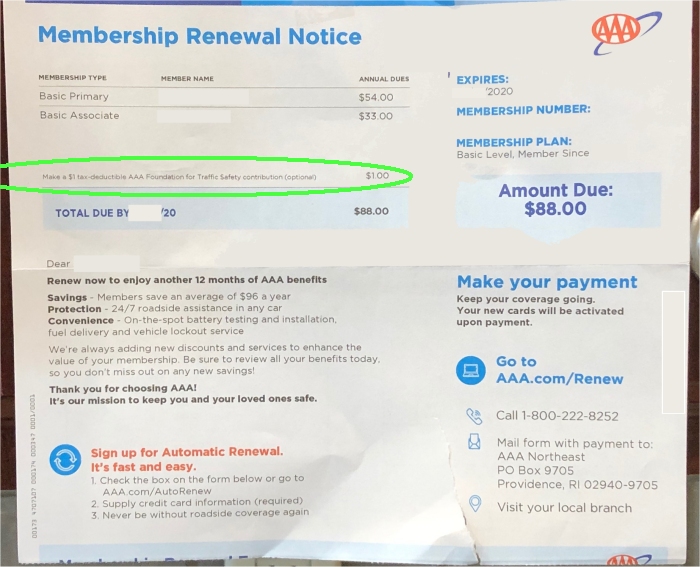
A New York reader wrote to us recently complaining about a sneaky “optional” charge that was tacked onto his annual AAA bill that he received in the mail. We then found a Massachusetts consumer with a similar problem (her bill is below):
AAA billClick to enlarge

*MOUSE PRINT:

AAA dollar disclosure

AAA added a $1 voluntary donation to their traffic safety foundation on this bill, and automatically included it in the “amount due” rather than as a separate box to check if the member wanted to donate. On this bill, the annual membership fee due should have been $87 and not $88.

The problem with this type of billing is this: Many members may simply rip off the payment stub at the bottom of the bill and send a check or enter their credit card number for the amount the stub says is due not realizing that the actual membership fee had been bumped up by an “optional” dollar.

AAA payment stubPayment stub from New York consumer

From a legal standpoint, this billing practice may well be classified as “cramming” — tacking a charge for a new item onto a bill without the customer’s affirmative consent and including it in the total due. As such, this may well be contrary to state consumer protection laws that ban deceptive practices.

We contacted AAA headquarters multiple times asking a series of questions about how extensive this billing practice was, whether it extended to those on autopay, how many people are affected, and whether they will change the practice. We received no response despite sending three email inquiries and calling twice.

Customers should not have to scrutinize every bill they get to make sure something they never ordered was tacked onto their invoice and included in the total. Just the way that the IRS includes a check box on your tax return so you can indicate if you want $3 to go to fund presidential elections, AAA should do the same thing if you want to add a dollar donation to their safety foundation.

There’s an old consumer maxim: it is easier to steal a dollar from a million people than steal a million dollars from one person.

We need your assistance to help determine how extensive this problem is since AAA operates as separate regional clubs around the country. Please look for your last bill from AAA to see if it includes an “optional” $1 charge or not. Either way, send a scan or clear photograph of it (crossing out your member number) to Edgar (at symbol) ConsumerWorld.org. In addition, use the comment section below to indicate what you think of AAA’s billing practice, and your experience with their bills. Please include your state, and whether you are on autopay or receive a paper bill in the mail. Thanks!

Updated every Monday!   Subscribe to free weekly newsletter.

Chrysler’s Lifetime Warranty Leaves Many With High Repair Bills

As Consumer World celebrates is 25th anniversary this week, we look back to 2007 when Mouse Print* published a story about a just-announced “lifetime powertrain warranty” that Chrysler was offering on its vehicles. The gist of the story was that while this warranty sounded great in their advertising, neither the local dealers checked, nor Chrysler’s website, nor their customer service department could provide us with any details about what exactly was covered. We wanted to check the fine print but could not until finally their PR department was able to provide a copy of the warranty. We then reported on a provision that could easily trip-up buyers.

Chrysler see dealer

As it turns out, over the years, scores of purchasers who brought their cars back for free repairs under the lifetime warranty were denied coverage because of that very clause we warned people about.

*MOUSE PRINT:

They failed to follow a tiny provision that was tucked into their warranty and required owners to have their car’s power train inspected by Chrysler within 60 days of each five-year anniversary of their car.

G. Inspections
In order to maintain the Lifetime Powertrain Limited Warranty, the person or entity covered by this Powertrain Limited Warranty must have a powertrain inspection performed by an authorized Chrysler, Dodge, or Jeep dealer once every 5 years. This inspection will be performed at no charge. The inspection must be made within sixty (60) days of each 5 year anniversary of the in-service date of the vehicle. You must have the inspection performed to continue this coverage.

In May 2020, more than two dozen Chrysler owners around the country filed suit against the company after being told that their warranty was void because they didn’t comply with the inspection requirement. Thus, they had to pay out of pocket for all needed repairs. Their lawyers argued that most of these car buyers had no idea that this was even a requirement, saying they never got the full language of the warranty, just as we had trouble obtaining it.

Chrysler petitioned the court to dismiss the case arguing that purchasers did not follow the requirements of the warranty to have their cars inspected every five years in order to keep the lifetime warranty in effect and therefore were not entitled to free repairs. The company also claimed that details of the warranty including the inspection requirement were contained in a press release and various news stories published at the time. (Note to Chrysler: consumers are not required to read press releases and news stories.) They also claimed that purchasers, depending on when and what model year car they purchased, received warranty information in various written documents at various times.

It may take years before there is a final decision in this case. In the meantime, if you bought a 2006-2009 Chrysler vehicle when the lifetime warranty offer was in effect but were subsequently told your warranty was void and you would therefore have to pay for repairs to the power train, save your receipts. The consumer lawyers in this case are trying to have those lifetime warranties reinstated and to collect damages for those who were improperly charged.