Updated every Monday!   Subscribe to free weekly newsletter.

Is It Live or Is It Memorex Redux?

Remember those commercials of yesteryear where Ella Fitzgerald’s voice recorded on Memorex tape could shatter a glass? Well, fast forward to the computer age where software can now synthesize your voice or anyone else’s. Sounds neat, huh? Except for one thing… this technology is now being used to scam people.

Recently, a UK energy company executive got a phone call from the CEO of its parent company in Germany requesting an urgent transfer of nearly a quarter of a million dollars to a foreign supplier. The UK executive followed the boss’ order and quickly sent the money. What that executive didn’t know was that the person on the telephone was really a scammer using a computer-generated voice to mimic the voice, tone and accent of the real CEO. Here is the full story.

How good is this technology? Here are two samples from Lyrebird, one company that is developing it.

Listen to the real recorded female voice first, and then the synthetic one.

Real female voice

Synthesized female

 
Now try the male voices:

real male voice

synthetic male voice

I think you will agree the synthesized voices sound virtually identical to the real ones. Imagine how using the reproduced voices could be coupled with artificial intelligence to make you believe you were having an actual conversation with the real person whose voice you recognize.

And if scammers use this technology, there won’t be any mouse print to warn you that the voice you are hearing is fake.

Updated every Monday!   Subscribe to free weekly newsletter.

This Smartphone is Waterproof, Right?

To tease the introduction of its new smartphone, OnePlus is running this new commercial touting how waterproof they are:


Rather than go through an expensive internationally recognized test to determine the degree to which its phones resist water and dust penetration (an “IP rating”), the company just drops its phones in a bucket of water.

There’s just one problem with their cheap method to convey that their phones are waterproof or water-resistant. It’s in the fine print that you probably can’t read in the commercial.

*MOUSE PRINT:

OnePlus fine print

With a disclaimer that small, and only on the screen for three seconds, no wonder you can’t read it. It says:

Products not IP certified. Water resistant under optimal test conditions. OnePlus makes no guarantees regarding water/liquid resistance. Water/liquid damage not covered under product warranty.

Then why the heck, OnePlus, are you representing visually that your phones can be safely dunked in water? (The company never replied to our inquiry.)

Updated every Monday!   Subscribe to free weekly newsletter.

Magellan’s GPS Takes a Shortcut on Lifetime Benefits

When Donald K. went to update his Magellan GPS with the latest map, he got a nasty surprise. Despite being advertised as coming with “FREE lifetime map updates,” he was informed that his unit did not qualify.

Magellan GPS

Seems pretty unambiguous, right? “Free lifetime map updates.” “Never worry about out-of-date maps again.”

However, farther down the page on Magellan’s website is an inconspicuous disclosure.

*MOUSE PRINT:

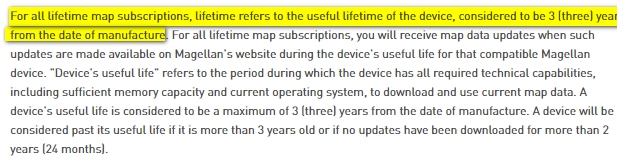
Lifetime = 3 years

Magellan astonishingly defines “lifetime” as just “three years” from the date of manufacture. That is certainly not how the average consumer would define lifetime. Nor how the Federal Trade Commission wants its definition disclosed:

§ 239.4 “Lifetime” and similar representations.
If an advertisement uses “lifetime,” “life,” or similar representations to describe the duration of a warranty or guarantee, then the advertisement should disclose, with such clarity and prominence as will be noticed and understood by prospective purchasers, the life to which the representation refers.

And the FTC also bans the deceptive advertising of guarantees.

Clearly, the disclosure that Magellan makes is not conspicuous, nor in close proximity to their “lifetime” claims. Further, their warranty is really a specified term of years — three — and not an unlimited warranty time-wise as the term “lifetime” implies.

Making the lifetime to which the warranty applies to the device’s own lifetime is circular reasoning. In essence that says the device will last only as long as it will last and then you’re out of luck. And in Magellan’s case, they are even cutting that short.

We asked a spokesperson for the company why they continue to use the misleading term “lifetime” to describe their three-year warranty, and whether they will grant access to map updates to purchasers who feel they were deceived. Here is their response:

We sincerely apologize for any confusion we may have caused to consumers about “lifetime maps” on our Magellan GPS devices. Typically with electronics, “lifetime” refers to the useful lifetime of the device, and for most GPS devices the useful life is about 3 years. Magellan honors customer requests for lifetime map updates as long as the device is still capable of being updated. For support, please visit https://service.magellangps.com/ [and fill out the “contact us” form].

One can only wonder what she meant by saying the device has to be “still capable of being updated” rather than simply saying that as long as the device was still functional they will provide map updates.

Thanks to John Matarese of WCPO-TV for the original story idea.