Updated every Monday!   Subscribe to free weekly newsletter.

ID Vault: Million Dollar Protection Policy?

With so many phishing attacks and incidents of ID theft occurring, many consumers are leery of entering into any financial transactions online.

Where there is fear, however, there is also a business opportunity to allay those concerns. Enter ID Vault. It looks like a thumbdrive that you plug into an available USB port on your computer. It stores your usernames and encyrpted passwords, and automatically transmits them securely when you log into a financial or retail website. It can also determine if you are visiting a real site, or a scammer’s copy. Bottomline: it protects you.

They are so sure of their technology that they offer a “$1,000,000 Guarantee” that promises to cover your losses if your login credentials are stolen and used fraudulently. Quoting from their press release:

Consumers can now bank, shop and invest online with total confidence, knowing that even if their personal information were stolen while using ID Vault, GuardID will reimburse them for any losses up to $1 million.

“We are so confident that ID Vault 2008 will protect consumers from online identity theft and fraud, that we put our money where our mouth is, and will refund any losses consumers incur, up to one million dollars, when using ID Vault,” said Jerry Thompson, CEO of Guard ID Systems.

And on their website, here is the big print of their $1,000,000 Guarantee:

ID Vault guarantee

Of course the devil is in the details.

*MOUSE PRINT:  The company may have led you to believe you will have more coverage than they actually will provide (depending on the circumstances). They will only cover you up to $100,000 per account, not $1,000,000 as you might have expected.

“Should we determine that the account was exclusively accessed online using ID Vault prior to the theft of your account credentials, we will reimburse any direct loss, up to $100,000 per individual account and up to a maximum of $1,000,000 over the lifetime of your ID Vault subscription and subsequent renewals.”

In a sense, that is like buying a million dollar fire insurance policy, but only being able to collect $100,000 per fire. Granted, if you are lucky enough to have a millon dollars, and spread it out over 10 different accounts, then you would indeed be qualified to be reimbursed for $1,000,000.

The restrictions in the policy also require you to be 100% faithful to ID Vault as the means of logging into your accounts. You cannot access them on your work computer, or anywhere else, unless there is an ID Vault attached. (And they will compare your financial institution’s records of your accesses with the list of accesses tucked inside your ID Vault. If they don’t match exactly, you lose the coverage.) 

So, what may seem like a simple $1,000,000 guarantee promoted in advertising, is in fact full of strings and loopholes, as any other insurance policy would be.

Updated every Monday!   Subscribe to free weekly newsletter.

CashCall: High Price for Fast Cash

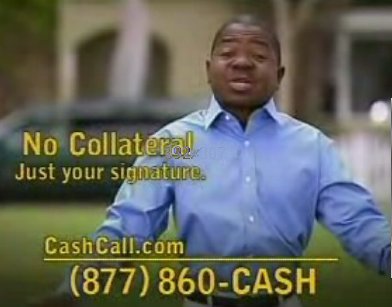
Have you seen the CashCall commercials with Gary Coleman, the little guy best known as Arnold on Different Strokes?  It promotes a fast cash loan service that is just a phone call away [click on pic to view]:

cash  call commercial

What is a loan from CashCall going to cost you?

*MOUSE PRINT:

cash call fine print

Just in case you can’t read that, it says the interest rate is 99.25%. On their website, sample interest rates are 24.58%, 59.46%, up to 99.25% depending on your state of residence and other factors.

At 99.25%, a $2600 loan would require you to pay back $9,095 over three and half years. That’s three and half times what was borrowed.

Fortunately, CashCall appears not to be able to make loans for residents of Iowa, Massachusetts, Nevada, New Jersey, New York, West Virginia and Wisconsin. What are the regulators in the other 43 states thinking?

Updated every Monday!   Subscribe to free weekly newsletter.

Chase Freedom: Unspoken Limits and Exclusions

By now, everyone has seen the Chase Freedom credit card commercial with their catchy jingle promising “triple rewards where you spend the most”. You get three points or three percent back for the three categories you spend the most on each month. The categories where you earn triple automatically change each month based on your spending habits.

Here is a portion of their website ad for the card:

Chase Freedom

So, if you spend a lot one month on car repairs, buy a ton of stuff at warehouse and discount stores, and pay for airline tickets or a cruise on your card, at three percent cash back, you will make a lot of money that month, right?  Wrong on several counts.

*MOUSE PRINT: Three percent back only applies to certain categories of purchases, in fact, only 15 particular categories qualify, and that fact is virtually invisible in the disclaimer in their commercial. The categories are:

grocery stores (that are not affiliated with or departments of superstores, warehouse clubs or discount stores), gas & convenience stores, quick service payment/fast food restaurants, telecommunications, cable/satellite TV/Internet service providers, video rentals, department stores, dry cleaners, drugstores, movie theatres, local and suburban commuter passenger transportation (including ferries, bridges, tolls, parking garages, taxis/limos), pet supply stores and veterinary services, utilities, beauty shops (salons and spas), or gym/recreation memberships.

Car repairs, warehouse and discount stores, travel, and many other big ticket potential purchases are not included according to Chase’s terms and conditions.

Okay, so it is just their 15 categories that qualify for three percent back. Let’s say in a particular month you spent $400 at the grocery store; your gas, electric and water bills total $400; and you had to spend $1000 on prescription drugs for your ailing mother. That’s $1800, and should qualify for $54 back. Not bad. But not true.

*MOUSE PRINT:

There is no maximum amount of base rebates or base points that can be earned on net purchases. Maximum bonus rebate accumulation per billing cycle on net purchases is $12 in bonus rebates or 1,200 points monthly, which equates to $600 in net purchases.

Translation: Only the first $600 in purchases in your combined three categories earns three percent back. So on that $1800 hypothetical purchase, you will receive only $18 back on the first $600, and one percent on the rest.

Chase’s concept is a great one to automatically adjust your rewards to match your purchase habits. Too bad many of your most expensive purchases do not qualify for the three percent back at all, and other purchases only qualify for a maximum bonus of $12 a month.