Updated every Monday!   Subscribe to free weekly newsletter.

More Groceries Downsize – Part 1 (2013)

Confession: the following items downsized in 2012, but we did not get a chance to feature them all on these pages last year.

*MOUSE PRINT:

Kraft BBQ sauce

The old reliable 18 ounce bottle of Kraft barbecue sauce dropped in size by one-half an ounce. Thanks to John O. for the tip on Kraft.

*MOUSE PRINT:

Old Spice

We lost a quarter of an ounce in the large size Old Spice deodorant sticks. The top of the stick says “Same Palm Tree, New Look,” but they somehow omitted that they were also giving the customer less. Should we say that stinks?

*MOUSE PRINT:

Minute Maid

Following the lead of other big brands of orange juice, Minute Maid also downsized its punch drinks by a full five ounces. Less sugar for the kids, just as well.

*MOUSE PRINT:

Hefty bags

This is not what you think. In a twist, the makers of Hefty bags UPsized their 44-count tall kitchen bags to 50-count, but only at Target (and they kept the price the same).

As we always say, downsizing is a sneaky way to raise the price of products because you are getting less for your money, and you may not realize it unless you scrutinize the fine print on the package .

Updated every Monday!   Subscribe to free weekly newsletter.

Breyers Converts Ice Creams to “Frozen Dairy Desserts”

When product manufacturers want to cut costs or increase their profits, they can do one of several things. Many don’t want to raise prices because of the consumer backlash and possible reduction in sales. So, many choose to downsize the product as we have demonstrated here. Others take a less conventional approach and reformulate their product so that it is cheaper to produce and distribute.

Breyers downsized their half-gallons of ice cream first to 56 ounces and then again to 48 ounces around 2008.

Breyers

Now they have taken a new tack. They are reformulating many of their flavors.

Take a look at “old” Breyer’s Vanilla Fudge Twirl ice cream:

*MOUSE PRINT:

Breyers Real Ice Cream

Now take a look at the new package of “Vanilla Fudge Twirl”:

Breyers dairy dessert

The new one is no longer even called “ice cream” but is now “frozen dairy dessert.” It is no longer “all natural” either. And the vanilla ice cream claim has been replaced with a “vanilla flavor claim.”

*MOUSE PRINT:

Under federal law, to be called “ice cream”, a product must meet a certain standard of identity, which in this case requires that there be at least 10% milk fat in the product. That generally would come from the cream in the product. If the product does not meet the federal “recipe” for ice cream, it has to be called something else. In this case, they are calling it frozen dairy dessert which has no federal definition (other than it does not meet the standards to be called ice cream.)

Here are the ingredients statements from both vanilla fudge twirl packages:

*MOUSE PRINT:

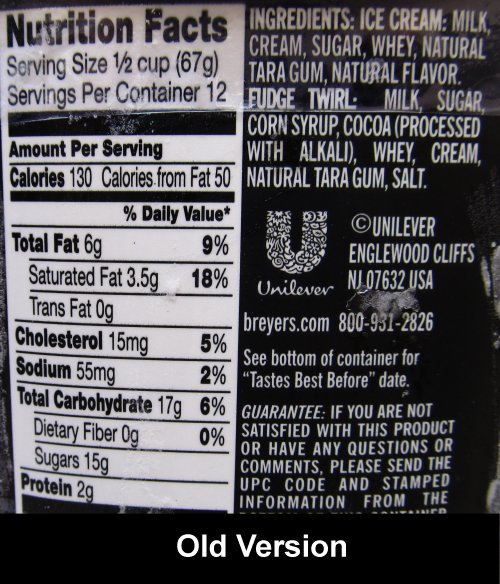
Breyers old ingredients

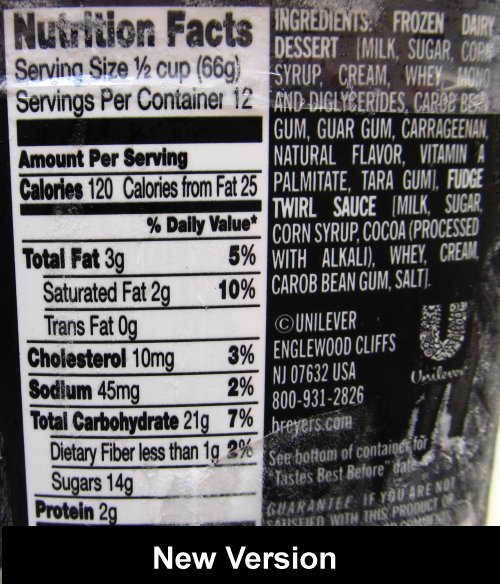
Breyers New Ingredients

The old real ice cream product has milk and cream as the first two ingredients. The new version has cream listed as fourth (with milk, sugar and corn syrup predominating over cream). The new product also has half the fat as the old. While dieters might rejoice, the calories are nearly the same, and the taste is not likely to match the original.

The Breyers’ website spins why they changed many of their ice cream flavors to “frozen dairy dessert”:

Since 1866, Breyers products have consistently delivered high-quality ingredients, great flavors and smooth creaminess that our fans love, and we remain committed to that Pledge. Our Ice Cream and new Frozen Dairy Dessert varieties continue to use fresh milk, cream and sugar. What distinguishes our Frozen Dairy Dessert from our Ice Cream is that it’s blended in a whole new way to create a smoother texture.

Hmmm. They seem to have left out the fact that using less cream saves the company a lot of money.

Updated every Monday!   Subscribe to free weekly newsletter.

Rite Aid Stops Printing Dollars Off Coupons on Your Receipt

Rite Aid +UPAll three major drugstore chains (CVS, Rite Aid, and Walgreens) now advertise sale items only for loyalty cardholders. No card, no savings. Unlike the old days, when you saw Bufferin on sale for $1.99 and actually paid $1.99 for it, now you pay maybe $2.99 (at CVS and Rite Aid) but a get a $1 coupon on your register receipt good only toward a future purchase. It is like getting an IOU for the savings they promised, rather than them giving it to you on the spot. Some would say it is almost like a pyramid scheme.

There are several problems from a consumer standpoint with this scheme. You don’t get instant savings, you are forced to come back again to use up the coupons, you might lose the coupons and thus lose the savings, the coupons expire in 14 days (Rite Aid) and 30 days (CVS), failing to use the coupons means in essence you will have often paid regular price for the advertised items, you may be forced to buy something you don’t want to use up the value of the coupons, and if you buy another sale item with the coupons you will be issued more coupons that will trigger the whole process again.

MrConsumer hates shopping at CVS and Rite Aid for those very reasons. When he does, he places back to back orders at the checkout, with items that will spit out coupons first. He then uses those very coupons immediately on his second order of non-coupon generating items. It a complete pain not just for the customer, but for the checkout clerk as well.

Not able to resist a Black Friday sale even at the drugstore, MrConsumer went to Rite Aid to buy some Russell Stover chocolates and some butter cookies. The chocolates came with a $3 coupon back from Rite Aid and the cookies were a straight $1.69 a tin. The plan was to first buy the candy in one transaction, and then use the $3 coupon toward the $3.39 for two cans of cookies in a second transaction.

As MrConsumer got closer to the checkout he overhead the cashier telling a customer some disturbing news. She said that their coupons are no longer printed out on the bottom of the sales receipt, but rather loaded automatically onto the customer’s loyalty card. Smart idea, I thought. Then she said that the value of the coupons loaded onto the card would not be available until the next day.

What? You are going to make me make a second trip back to the store just to use that damn $3 coupon on the butter cookies?

Upon protesting this change of policy, the manager on duty who happened to be nearby said that anyone can opt-out of the “load2card” program and they can do it right at the register.

Sure enough, they could, they did, and it worked.

Checking to see if people who sign up online for “load2card” are told about the opt-out provision, there it was in the fine print:

*MOUSE PRINT:

load2card

By opting out, coupons will continue to print at the register and back-to-back transactions will still be possible.

The worst part about “load2card” for shoppers is this: with no coupons to shove into your wallet or pin onto your refrigerator, you are more likely to forget to use up those dollars before they expire in 14 days. How clever of those execs at Rite Aid to make the coupons out of site, out of mind. To be fair, however, they do offer an app for your smartphone to remind you what coupons are still loaded on your card.