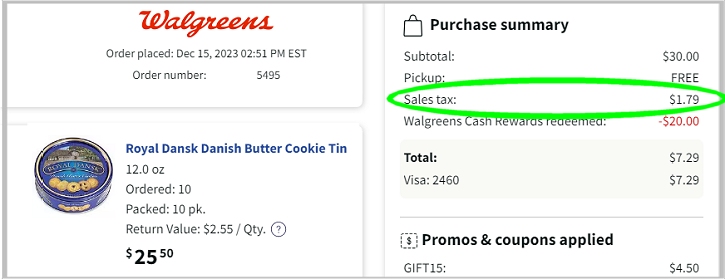
Just before the holidays, MrConsumer spotted a bargain on Royal Dansk butter cookies at Walgreens.com and ordered 10 of them for pickup at his local Walgreens just outside of Boston.
In the ordering process, he noticed that inexplicably he was going to be charged $1.79 in sales tax on them.
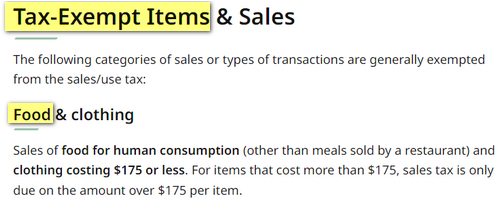
Food in Massachusetts is not subject to sales tax except in restaurants by law.
*MOUSE PRINT:
So before finalizing the order, he called the Walgreens 800 number to see if they could adjust the total to the correct amount. They could not, but said to call back after making the pickup and they would provide a credit.
Upon pickup the next day, I asked the store manager to correct the bill but he could not because it was an online order. Then I called online customer service again and asked for the credit as I had been promised the day before. “Oh, we don’t give back sales tax” was the customer service person’s response. After she started saying that they base sales tax on where the company is located — in Illinois — a total misunderstanding and misrepresentation of how sales tax works, I asked for a supervisor. All that representative was able to do was fill out a form to be sent to the Walgreens tax people for their review.
Of course, MrConsumer’s long-held belief is if a company was going to overcharge anyone, they would never choose him alone to do it to.
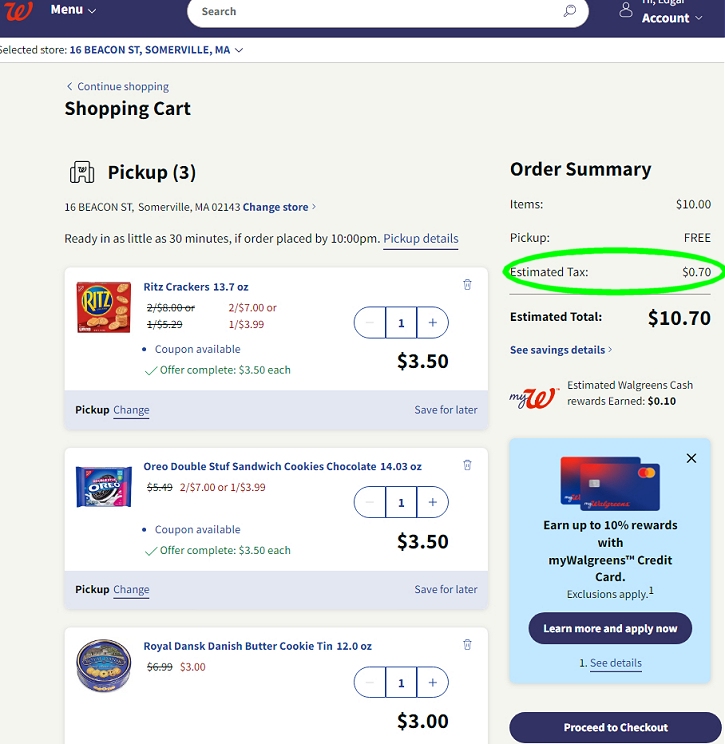
So I went back to the Walgreens website to try to figure out the extent of the tax overcharging in Massachusetts. I put some test purchases of various nontaxable items in my cart to see if tax would be charged. Here’s one of the them.
*MOUSE PRINT:
 Consumer World Photo Illustration
Sure enough, it appears for some unknown period of time Walgreens.com had been charging a 7-percent sales tax on cookies and crackers here wrongfully. And that isn’t even the right sales tax rate in Massachusetts. We pay 6.25-percent on taxable sales, while 7-percent is the meals tax rate.
After a total of four or five unsatisfying contacts with Walgreens’ 800 number and their online customer service department, four days after placing the order, they corrected the website. And the day after that, I was issued a $1.79 refund for the tax overcharge and a $50 e-gift card for bringing the matter to their attention.

Consumer World asked Walgreens PR folks how such a taxation mistake could happen, how long they have been overcharging customers, how much money was collected, and what they were going to do to refund the overcharges. They first said that the problem was limited just to that one brand of butter cookies. But after suggesting they were minimizing the extent of the issue, further research they did revealed the problem was much broader affecting baked snack foods like Twinkies, as well as all cookies and crackers.
In a conference call with two Walgreens officials in December, the company admitted the problem was of their own doing and not of an outside contactor. They explained that they erroneously categorized certain snack foods as bakery items which they thought were taxable.
When pressed to answer the rest of our questions, they later said that they could not determine how long the overcharging had been going on, and due to system limitations, they could not make automatic refunds.
The company also provided this emailed statement which said in relevant part:
If customers believe they have been impacted and now owed a sales tax refund, please contact 877-250-5823 for assistance. We ask that impacted customers who call this number have on hand the order number found on their receipt to assist with the query. Walgreens does not profit off sales tax errors of this kind, as all tax collected is turned over to the state and local taxing authorities.
Consumer World is pleased to see that Walgreens at least fessed up to the problem and corrected it relatively quickly after our contact. We’re disappointed they can’t make automatic refunds since they already have two-years-worth of receipts right on their website. Shoppers should not have to scrutinize and recalculate the tax on every sales slip to figure out if they have been overcharged.
This is not the first time Walgreens has been accused of overcharging on sales tax. They were sued or called out for improperly charging tax on toilet paper in Pennsylvania last year, on COVID test kits in New York in 2022, on milk in Massachusetts in 2019, and on bottled water and certain unsweetened beverages in several Illinois areas in 2015 and 2017.
Many retailers have been accused of overcharging on sales tax over the years, so getting this bit of retail law correct has been a challenge for stores because of the complexity and varying nature of state and local rules.
None of that, however, excuses stores for not getting it right.


 A common ploy used by detergent and fabric softener manufacturers is to exaggerate the number of wash loads you get out of each bottle.