Updated every Monday!   Subscribe to free weekly newsletter.

SlimFast: Clinically Proven to Lose Weight and Keep It Off?

Pick up any SlimFast product and you’ll see a box with this claim:

SlimFast claim

SlimFast products

*MOUSE PRINT:

That tiny asterisk refers to a small disclosure that weight loss is clinically proven when using the product on the SlimFast diet plan.

SlimFast note

In commercials you will see the same claim — clinically proven — also being applied to their diet plan itself.

A competitor challenged those and other claims and brought their case to the National Advertising Division (NAD) of the Better Business Bureau. The NAD handed down a decision last week and on many key points ruled against SlimFast.

NAD said it was reasonable for consumers to believe that any of SlimFast’s products that displayed the “clinically proven” box had been tested by the company and shown to be effective at losing and keeping off weight.

Their decision said:

NAD noted that the advertiser provided no evidence that each SlimFast product has been individually evaluated. Further, the advertiser’s evidence was limited to studies and expert reports based on weight loss studies on discontinued SlimFast products.

NAD recommended that the company discontinue its unqualified claims of “clinically proven” and “Clinically Proven: Lose Weight & Keep It Off.”

Regarding the claim, “Clinically Proven to Lose Weight & Keep it Off When Used as Part of the SlimFast Plan,” NAD found “that the claim expressly and by implication conveys the message that the current products themselves have been clinically proven to allow consumers to lose weight and keep it off” when they had no such proof.

SlimFast vowed to appeal NAD’s decision because they feel they presented substantial scientific corroboration and testimony to support their claims.
Updated every Monday!   Subscribe to free weekly newsletter.

Are King’s Hawaiian Sweet Rolls Really Made in Hawaii?

That’s the issue raised in a new lawsuit filed by two consumers who said they were misled into believing that King’s Hawaiian Sweet Rolls were manufactured in Hawaii.

*MOUSE PRINT:

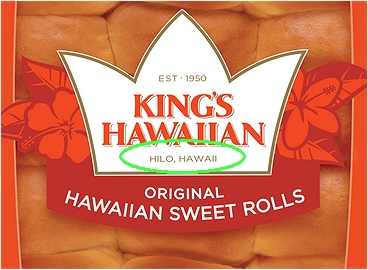
King's Hawaiian

These rolls were first made in Hawaii in the 1950s, and eventually they became so popular that tourists would take them back home, or those on the mainland with friends in Hawaii would ask them to send some.

The consumers who have filed the lawsuit say that it was not only the packaging that gave them the impression that these buns came from Hilo, Hawaii, but language on the website that says the company will send the product to the “mainland” (continental US) for free:

King's mainland claim

There are many local and national brand knockoffs of King’s Hawaiian sweet rolls but these consumers paid a premium price which they would not have done but for the fact that they thought they were getting the real thing from Hawaii.

All is not totally sunny in this case for the plaintiffs, however. There is nothing explicitly on the package or on the website that says these buns are “made in Hawaii.” In fact, when reading the history of the company on their website or looking at the back of the package, one learns that their bakery is in Torrance, California.

So, how do you think a judge will rule? Will he or she side with the consumers or declare their claims to be half-baked?

Updated every Monday!   Subscribe to free weekly newsletter.

Is the Domino’s Random Food Giveaway a Lottery?

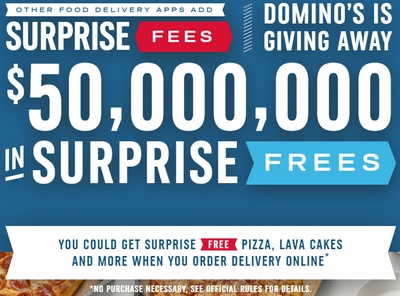
Domino’s just launched a huge national advertising campaign promising random customers who place an order using Domino’s own delivery service a chance of receiving some additional free food items with their order.

Domino's free


*MOUSE PRINT:

According to the promotion, one in fourteen customers placing a delivery order will get a freebie along with the food they pay for.

Domino's free

There’s just one problem. Paying a price for the chance at a prize is considered an illegal lottery when conducted by a company even in this context. Oops.

But not so fast. In tiny print in their commercials and elsewhere, those magic words “no purchase necessary” appear as they are required to into order convert what would otherwise be an illegal lottery into a legitimate sweepstakes.

*MOUSE PRINT:

In the official rules, you can send in a request to get a game code by return mail.

B. Request a Code by Mail:
(i) During the Promotion Period, participate without purchase by requesting an entry code (“Code”) by hand printing your name, home mailing address, valid email address, and date of birth on a piece of paper and mailing it along with a self-addressed stamped envelope [emphasis added] in an envelope with proper postage to “Domino’s Surprise Frees Giveaway,” c/o Merkle, Inc., P.O. Box 5005, Department 848994, Kalamazoo, MI 49003-5005.

So, for your expenditure of $1.10 for postage both ways (soon $1.16), once you receive the code, you will have a 1-in-14 chance of winning an e-gift card worth $13.49.

For those who make purchases anyway from Domino’s, potentially getting free food with your order is a nice extra benefit. But for those who want to play the game for free, it is just a roll of the dice, so save the postage.