Updated every Monday!   Subscribe to free weekly newsletter.

Is Canada Dry Ginger Ale Made With “Real Ginger”?

Multiple lawsuits recently alleged that Canada Dry ginger ale was not the real thing because it did not contain “real ginger” as the label proclaimed.

Canada dry

*MOUSE PRINT:

ingredients

The ingredients statement says that it contains “natural flavor” but tests done by the plaintiffs indicate that the soda did not contain key components one would normally find in ginger root. Further analysis concluded that it only contained two parts per million of ginger extract.

In the settlements agreed to last month, Canada Dry is still allowed to say “made with real ginger” but only if that statement is modified with words like “flavor” or “extract.”

Examples of permissible label claims: “real ginger taste,” “made with real ginger extract,” “real ginger flavor,” “flavor from real ginger extract,” and “natural ginger flavor.” The Permanent Injunction shall also include court-approved use of “ginger extract,” “natural ginger flavor extract,” “natural ginger extract,” “natural ginger flavor,” or “ginger flavor” in the label ingredient line.

Would you catch those nuances?

Consumers who purchased Canada Dry ginger ale are entitled to modest compensation. Without proof of purchase, you can get 40 cents a can/bottle, up to $5.40. With sales receipts, you can get reimbursed at the same rate for up to 100 units.

After the settlement becomes final, you can file a claim here.

Updated every Monday!   Subscribe to free weekly newsletter.

Clorox Splashless Is Also “Disinfectless”

A Missouri consumer is fed up with Clorox brand bleach. She has been waging a three-year long campaign against one of the company’s most popular products that she thinks is being packaged and marketed in a deceptive way. We think she has a point.

There are two primary types of Clorox bleach:

Clorox bleaches

The one on the left is regular Clorox and the one on the right is their “splashless” version. Note how similar the labels are.

According to the company, they came out with a thicker splashless variety because customers complained about the regular type which could inadvertently splatter where it was not intended.

As it turns, that is not the only difference between the two products. Only on the back of the label does the company disclose the following about the splashless product:

*MOUSE PRINT:

Clorox Splashless disclaimer

That’s right, surprise, the splashless version does not disinfect or sanitize. And while certainly many use bleach merely to whiten their laundry others do expect it to sanitize also.

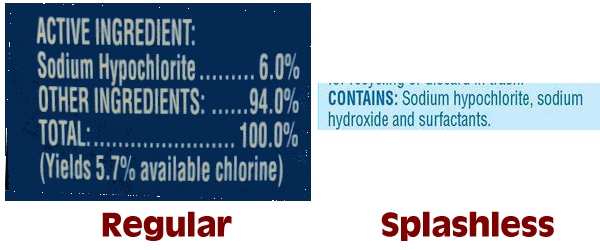
A check of the ingredients statements also reveals a surprise.

*MOUSE PRINT:

ingredients

While the exact amount of the disinfectant, sodium hypochlorite, is stated on the regular product, it is conspicuously missing on the splashless variety. One might reasonably conclude that there is not enough of the active ingredient in the splashless product to sanitize or disinfect properly.

We asked The Clorox Company why they don’t more conspicuously disclose that the splashless variety does not sanitize or disinfect and why the amount of the primary active ingredient is not disclosed. The company did not respond to our questions by publication time.

Updated every Monday!   Subscribe to free weekly newsletter.

This Trick Could Save You $4,000 on Health Insurance

Health plan costs have so skyrocketed that even a plan for a single individual can now exceed $1,000 a month. But a new trick, described here for the first time, could save you a bundle.

MrConsumer has long believed that pricing of health insurance is a mathematical game. If a plan has a seemingly low monthly premium, the insurer makes it back by imposing a deductible and higher copays. But a plan with lower copays and no deductible certainly comes with a higher monthly price tag. I am sure the insurers’ actuaries and accountants stay up late at night juggling these variables so that the house wins most of the time.

But it may be possible, though rare, to save thousands of dollars by doing a calculation no one ever suggested you do — find a plan where the health insurance bean counters messed up the mathematical structure of the plan.

So how can you save money when choosing among plans? It certainly helps if you have a crystal ball and know whether you are likely to have a lot or very few medical expenses in the coming year. A less expensive plan may be best for a healthy individual, while a more expensive plan might better protect a person who is likely to need more medical care. That is the traditional advice.

I discovered, however, while doing some extra number crunching to help a friend pick a plan from the New York marketplace-exchange (“Obamacare”) that the cheapest plan at least in his particular instance could be the best option by far even for someone likely to need a lot of medical care. This turns conventional wisdom on its head for some people.

Definitions:

First, here are some simple definitions to get out of the way:

Deductible: an amount of money you have to pay for medical services first before your insurance kicks in.

Copay: a fixed amount you pay out-of-pocket for a doctor’s visit or service.

Co-insurance: is similar to a copay, but it is typically a percentage of the total cost of a medical service that you have to pay out-of-pocket.

Out-of-pocket maximum: the maximum amount of money during the year that you have to lay out for covered services, not including premiums. Once the total of your deductible, co-insurance payments, and copays reaches the policy’s stated out-of-pocket maximum, the insurer pays for your covered benefits in full for the rest of the year.

Background:

In the past, MrConsumer has recommended the high-end “platinum” plan to his friend because it had no deductible and the out-of-pocket maximum was only $2,000. This means he only paid modest copays for covered services starting on day one, had no co-insurance, and once he met the $2,000 out-of-pocket maximum, he would not have to lay out a penny more for covered services for the rest of the year. He paid royally for this coverage: over $1,200 a month in 2018. But by summer, he reached his out-of-pocket maximum making all further services free.

In a million years, I would never have considered a low-end “bronze” plan with a $5,500 deductible, a $6,550 out-of-pocket maximum, and co-insurance on most services of 50% (meaning he would have to pay half the cost of medical procedures). The worry was that if he had a bad health year, this plan could have been so inadequate that it could have cost him a fortune. Or so I thought.

The New Calculations:

For 2019, however, MrConsumer pushed some new numbers, comparing the actual total costs of the four plans offered taking into account not just the premiums, but the out-of-pocket maximum as well. And a big surprise became evident.

*MOUSE PRINT:

Empire Blue comparison

This example compares Empire Blue’s four “metal” policy choices in New York for 2019 for an individual. These plans all cover the exact same medical conditions, services, and drugs, and use the same network of providers. The only differences are the amounts of the deductible, copays, co-insurance, and out-of-pocket maximums.

Compare the total annual premium of the bronze plan ($8,043) to the platinum plan ($16,520). Assuming my friend had no need for any medical services during the entire year of 2019 — the best (but unlikely) case scenario — he would save $8,000 by choosing the bronze plan. And now take the worst case scenario (the far right column in the chart above), where he had so many medical expenses that he hit the out-of-pocket maximum in both plans early in the year. In that case, the bronze plan would have cost him “only” $14,593 versus $18,520 for the platinum one — still an amazing savings of $4,000. (Note: there is a scenario where the minimum savings could drop to between $2000 and $4,000, but your head will explode if I try to explain it.)

If my friend needed a family plan, the total savings by choosing the bronze 2019 Empire Blue plan over the platinum one could be even more dramatic — between $15,000 and $24,000.

Where one might have expected the total cost figures in the right column above to be roughly equal (given the games the insurer’s accountants play of charging less in one area, but making it up in another), this was a big surprise to see the variation and potential savings.

The out-of-pocket maximum is a magical number that when combined with the annual premium can give you a truer picture of the real maximum costs of the plan, and help you spot a plan that is a mathematical anomaly in an insurer’s offerings. Such is the case here.

Warnings and Limitations:

A few words of caution. Besides the assumptions and facts mentioned above which might not hold true for other plans at other companies or in other states, if you choose a cheap plan and have an urgent and expensive medical need, you may have to come up with a large deductible and co-insurance right away.

Remember, this new calculation is most beneficial for people who expect to have substantial medical needs in the coming year. It is a treasure hunt of sorts to find the rare cases where the insurers’ accountants goofed up the mathematical structure of their plans making one plan’s total costs significantly lower than the others.

Before selecting a new plan, do a lot of comparisons, find plans with a large network, check to see that all your providers and drugs are included, make sure all the plans compared have identical benefits, crunch the numbers looking for a mathematical anomaly, ask a lot of questions to be sure your understanding of the plans is sound, read the actual policies carefully, and cross your fingers.