Updated every Monday!   Subscribe to free weekly newsletter.

Supermarket Sweepstakes’ Free Entry Method Challenged

In early June, a number of the Albertsons Companies supermarket chains (Acme, Albertsons, Carrs, Jewel-Osco, Pavilions, Randalls, Safeway, Shaw’s, Star Market, Tom Thumb, and Vons) began running a “Flavor Adventure” sweepstakes game with over $6-million in prizes. The more you spend in the store, the more entries you get.
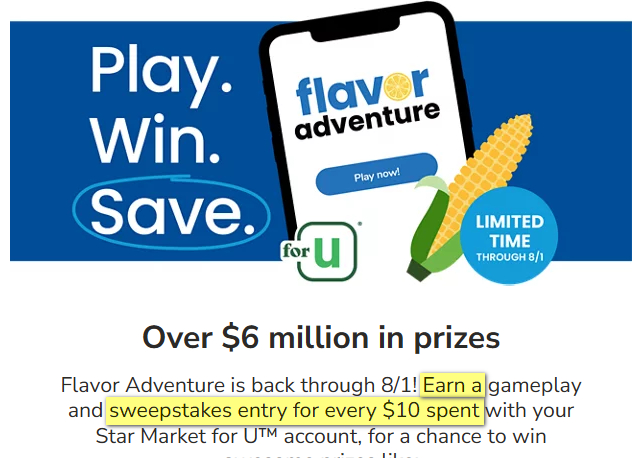
Sweepstakes email

But, no commercial enterprise can require you to spend money in order for a chance at a prize — that is the classic definition of an illegal lottery. They have to offer a simple, free method whereby anyone can enter without making a purchase. That is called an “alternate method of entry” (AMOE). So at the bottom of the company’s email shown above in (too) tiny type is information about that free means of entry with the magic words “no purchase necessary.”

*MOUSE PRINT:

No purchase necessary disclosure footnote

That footnote says to find out the free AMOE you have to visit this link (called “rules”) or for all the details, this link called “Official Rules.” They both take you to the same place. [Note: URLs depersonalized]

Buried in those rules is the free method of entry:

*MOUSE PRINT:

Free means of entry

Rather than tell you in simple terms where to send in an entry, like your name and address on a 3 x 5 card, or provide a specific URL, it just says to go to the promotion website, click on the menu, and then the rules button, etc. Didn’t I already click on the rules and now it telling me to do it again. And which menu on the website am I supposed to click?

But let’s play along. Going to the promotion’s website, [page varies for non-loyalty club members] brings us here. There is no menu, but there is a “play now” button and farther down the page yet another link to the official rules.

If you click “play now” the next page gives you a pop-up that among other things says you have to be a loyalty club member to participate (itself a questionable requirement), and yet another instruction to “See Official Rules for free method of entry.” OMG. Do you feel like you are being sent in circles?
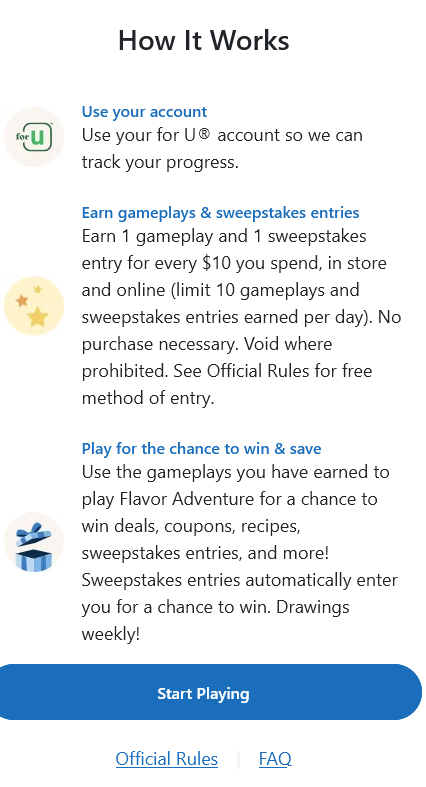
Start playing

And when you click “start playing,” then you get yet another screen with instructions to see the rules about playing for free:
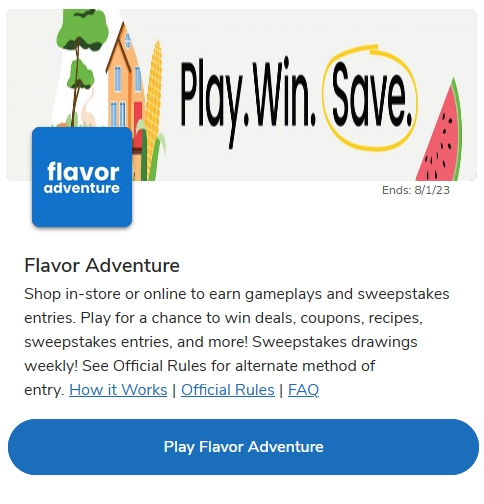
Start playing 2

And if you click that button, you get yet another button to start the game.

Play now

Clicking that button brings up what appears to be the actual start of the game… but nowhere to be seen is how you enter the sweepstakes without having to demonstrate that you bought groceries at the store.

Game 1

I invite intrepid readers to spend time reading the rules, and trying various options on the website to find where exactly the free method of entering the sweepstakes has been hidden and to report in the comments what steps you had to go through to get there. There is an answer and believe it or not, you have not seen the most obnoxious part yet!

In our view, the free means of entry that Albertsons Companies has created is illusory because of the complicated series of hoops they created for nonpurchasers to follow that most people will likely abandon. In essence, the alternative means of entry has failed of its essential purpose. And if that is the case, a consumer-sympathetic judge might deem the Albertsons promotion to be an illegal lottery.

Why would any company make it so difficult for their customers (and noncustomers) to participate in this game? Then it dawned on me. What if it was in their financial interest to make it harder? A scan of the official rules provided a possible answer.

*MOUSE PRINT:

unclaimed prizes

Of the over $6.6-million in prizes being offered, only $1.25-million-worth are prizes over $25 for shoppers. That means as much as $5-million of the smaller prizes if they go unclaimed never have to be given away. Obviously, we don’t know the company’s motivation in designing the sweepstakes as they did.

We posed some very pointed questions in multiple inquiries to the Albertsons Companies’ PR folks, including whether they consumer-tested the no-purchase-necessary-method of entry to see if average humans could follow their instructions. They did not respond.

This promotion cries out for action by the FTC and the consumer bar.

Updated every Monday!   Subscribe to free weekly newsletter.

Wanna Bet These Ads Are Misleading?

More and more states are allowing betting on sporting events, and that has resulted in a huge increase in advertising promotions by betting site operators. And nothing attracts gamblers more than offers of free money.

But some of these ads can be misleading and that has led to a series of class action lawsuits against Caesars Sportsbook for ads like this:

Caesars Sportsbook $1250 offer

The lawsuit contends:

… if a new user places a $1,000 “risk-free” or “free” first bet at Caesars Sportsbook, that person is required to deposit and wager $1,000 in real dollars with the website. If the bet is successful, the winnings are paid out as usual. If the bet loses, however, the customer is credited with the amount lost, not in cash, but in bet credits that can only be used on the Caesars Sportsbook and that expire in just 14 days.

So basically an offer like this only replaces the money you lose with their own funny money but doesn’t allow you to withdraw it. That is not clearly explained in the ads and thus forms the basis for these lawsuits.

One Ohio state gambling official explained the issue this way:

*MOUSE PRINT:

“If something is claiming to be free or risk-free, then it has to absolutely not require the patron to incur any loss or risk their own money,” Matthew Schuler, executive director of Ohio’s Casino Control Commission, said in a recent interview. “Disclosing the risks within the terms and conditions isn’t good enough,” he added.

The parent company of Caesars Sportsbook a couple of weeks ago asked a judge to either dismiss one of the cases or require the plaintiff to go to arbitration as the terms and conditions provided when she signed up for the promotion. The judge has not ruled on that motion yet.

The misleading nature of these promotions is not limited to Caesars. Here is a promotion from FanDuel, another sportsbook, with Rob Gronkowski promising that new customers will “get up to $3,000 back if they don’t win their first bet.”


At the end of the commercial the announcer repeats that customers will “get up to $3,000 back if you don’t win your first bet.”

*MOUSE PRINT:

The unspoken part of the claim is that the money back is in the form of “bonus bets” — merchandise credit, if you will, that cannot be withdrawn. It must be used in 14 days. All that is only stated onscreen, and not all in readable-size type.

But it gets worse. Let’s say you’ve earned $100 in bonus bets and you bet that whole $100 on a sporting event. Lucky you, your bet wins $150. When you go to withdrawn your $150, you may discover that all you really won is $50 because they substract the value of the wager you made using the house’s money. [We confirmed this with a FanDuel spokesperson.]

*MOUSE PRINT:

*After your bet settles (and if it wins), you’ll get to pocket all of the winnings but the initial bonus bet portion of your wager will not be returned to your wallet.” -FanDuel website

As with everything else we spotlight in Mouse Print*, you’ve always got to read the fine print.

Note: Comments submitted Wednesday and afterwards will be delayed in posting.

Updated every Monday!   Subscribe to free weekly newsletter.

Kroger Makes a Half-Hearted Attempt to Provide Digital Coupon Discounts to Unplugged Shoppers

As regular readers know, Consumer World and a coalition of other consumer organizations including Consumer Reports have been trying to get supermarkets that offer digital coupons to also offer a simple in-store alternative for those shoppers who don’t have internet access or a smartphone.

Digital coupons generally require a shopper to use the store’s app or website to find and load digital-only discounts onto one’s loyalty account/card. Then, when they check out in the store and scan their card, they get the digital discount. But for non-tech-savvy consumers of any age, many low income shoppers, the 25-percent of seniors who don’t use the internet, and the 39-percent who don’t own a smartphone, these money-saving offers are illusory.

Digital deal -watermelon

See some of our prior coverage of the digital coupon issue here.

Last week, Kroger issued a statement [see end of article] seemingly recognizing the financial hardship that many experience because they are not tech-savvy and thus far have been generally shut-out of digital discounts. Here’s their solution:

*MOUSE PRINT:

We understand that not all customers choose to engage digitally when shopping with retailers. Customers who would like to take advantage of digital coupons and do not have a digital account, can receive the discounted pricing at any customer service desk.

Because Kroger’s PR folks would not tell us how exactly the new system works, we called two stores, one in Ohio and one in Kentucky. The customer service person in Ohio said that a non-digital shopper can bring the sale items that require a digital coupon to the courtesy desk, where they can buy them at the discounted price. The rest of their groceries have to be purchased in the regular checkout line.

The Kentucky store customer service person asked if I had a computer or a smartphone. I said no. He then suggested that I go to the public library where I could access the digital coupons on their computer.

Thanks for the helpful suggestion. Even the first response is a bit impractical and time-consuming for both shoppers and store personnel. On top of that, how do shoppers even know that Kroger and its various nameplate divisions have changed their policy about giving digital discounts to non-digital customers? You have to read it on the internet, which many cannot do. And those who can go online, would never realize there is a new policy by reading their coupon FAQ which has not been updated:

*MOUSE PRINT:

Kroger coupon faq

There is no mention whatsoever about how an unplugged shopper can get the same savings. Only tucked away on a separate coupon policy page of their website does it say those folks can go to the courtesy desk to get the discounts. [Thanks to Coupons in the News for that discovery.]

We asked the PR folks at Kroger some additional very pointed questions and about issues raised by their policy change, but we have only received their canned statement noted above so far.

While Kroger should be commended for taking at least an initial step to help stop digital discrimination in retail stores, there are better solutions available. Simply requesting the digital discount at the checkout is the easiest way. Alternatively, some stores are experimenting with an electronic kiosk near store entrances where all a shopper has to do is scan their loyalty card or enter their phone number, and all that week’s digital coupons are then automatically loaded onto their loyal card account.

We hope stores realize that digital discrimination hits many of the most vulnerable consumers in the pocketbook at the worst possible time — when inflation continues to batter shoppers’ wallets.