Updated every Monday!   Subscribe to free weekly newsletter.

Tech-Challenged Seniors Denied Digital Discounts by Grocers

Shrimp digital offerThey look like great bargains in the weekly supermarket flyer: chicken breasts $1.97 a pound and bags of large shrimp for $5.97.

But If you are a digitally-disconnected senior citizen, a lower income person, or someone of any age not technically savvy, you may pay more for grocery specials like these because supermarket chains across the country are increasingly making some of their better sale items “digital-only,” according to a review by Consumer World.

Historically, in order to take advantage of all the sale items featured in a chain’s weekly circular, all shoppers had to do at most was to show their loyalty card to the cashier. Now some prominent supermarket chains are adding an extra step that requires internet access. Shoppers who want to buy any item flagged as a digital deal must in advance preselect and load it into their online account on the store’s website or app in order to get the advertised sale price in the store.

This extra technical hurdle disproportionately hurts digitally-challenged seniors in the pocketbook because they are the least likely to have internet access or a smartphone. In fact, according to a 2021 study by the Pew Research Center, 39 percent of those 65 and over do not own a smartphone, and 25 percent don’t use the internet. Lower income people lack online access to a similar degree. This means that millions of seniors and others can’t take advantage of digital-only deals.

Compounding the problem, in the past year, some supermarkets are now extending digital-only deals beyond dry groceries to meat, fish, poultry and produce. These items often replace some conventional weekly specials and are given prominent placement in their advertising flyers.

Star Market ad composite

Among the 50+ supermarkets checked by Consumer World, two-thirds of them advertise some weekly digital-only deals, including at Albertsons, Acme, Baker’s, Dillons, Fred Meyer, Frys Food, Food Lion, Jewel Osco, Kroger, Pick ‘n Save, Ralphs, Randalls, Safeway, Shaw’s, ShopRite, Smart & Final, Smith’s, Star Market, Stop & Shop, and others.

“Digital discounts are no deal for many seniors. They are a clever ploy by big supermarket chains to get people into the store knowing full well that many of them will wind up paying more than the advertised price,” commented Edgar Dworsky, a consumer advocate and founder of Consumer World. “A substantial number of shoppers don’t have online access, don’t understand how to take advantage of digital offers, or won’t be able to follow the cumbersome online procedure no matter what their age is.”

This month, to find out about their policies and any alternative means of obtaining digital-only deals, Consumer World contacted a number of supermarket chains including Albertsons Companies and The Kroger Co. that combined own 5,000 stores operating under about 40 supermarket nameplates. They offer digital-only deals in at least some of their divisions. Neither Albertsons nor Kroger corporate responded. Stop & Shop (a unit of Ahold Delhaize) confirmed it “does not offer an alternative to digital coupons at this time,” but ignored the tougher questions.

Calls to the customer service departments of Albertsons Companies and The Kroger Co. provided the expected response, similar to instructions on their websites: You must load the digital offers onto your loyalty card account online to obtain the savings. Call center representatives at both companies said that there is no non-internet alternative currently available. One said, “We get calls every day” asking for an offline way to take advantage of weekly digital specials.

*MOUSE PRINT:

Sample supermarket FAQ about digital-only offers:

Q. Can I still take advantage of these coupons if I don’t have a smart phone or a computer?

A. These coupons are only available electronically. Manufacturers continue to offer paper coupons through local newspapers.

Informal conversations with store employees provided more insight. One head cashier said she was sure many people don’t understand the advertised digital offers and mistakenly believe that just using the loyalty card would give them the sale price. She said her chain doesn’t allow cashiers to provide the digital discounts directly to customers.

There are some bright spots, however, in dealing with this digital dilemma. Not all chains have adopted digital-only deals and many are using them sparingly. A few chains such as Giant Food use “clip or click” coupons in their weekly ads that allow the customer to choose their preferred redemption method. Texas-based H-E-B provides physical coupons in-store for those who do not use the Internet. And store-level customer service employees at multiple chains said that its cashiers or help desk workers can provide the discounts if asked despite the official policy.

The use of digital-only offers appears to be accelerating. (These in-circular digital deals are separate from stores offering digital versions of manufacturers coupons on their website.) A closer look at 10 of the 50+ chains checked reveals that most doubled or tripled the number of digital-only deals offered in June 2022 compared to the same week last year. Some are even advertised in-store like the chicken above, or on the ice cream shelf tag below. Any shopper without a smartphone will pay much more because they have no way to load the offer onto their account.

sheft tag

“With inflation at a 40-year high, it’s time to stop discriminating against the digitally-disconnected, particularly seniors, and offer them the same discounts already enjoyed by tech-savvy shoppers,” urged Dworsky in a plea to supermarket executives. “Many, if not most seniors are on fixed incomes and need all the financial help they can get.”

What do you think? Should supermarkets make digital deals available to those without internet access? Please add your comments below.

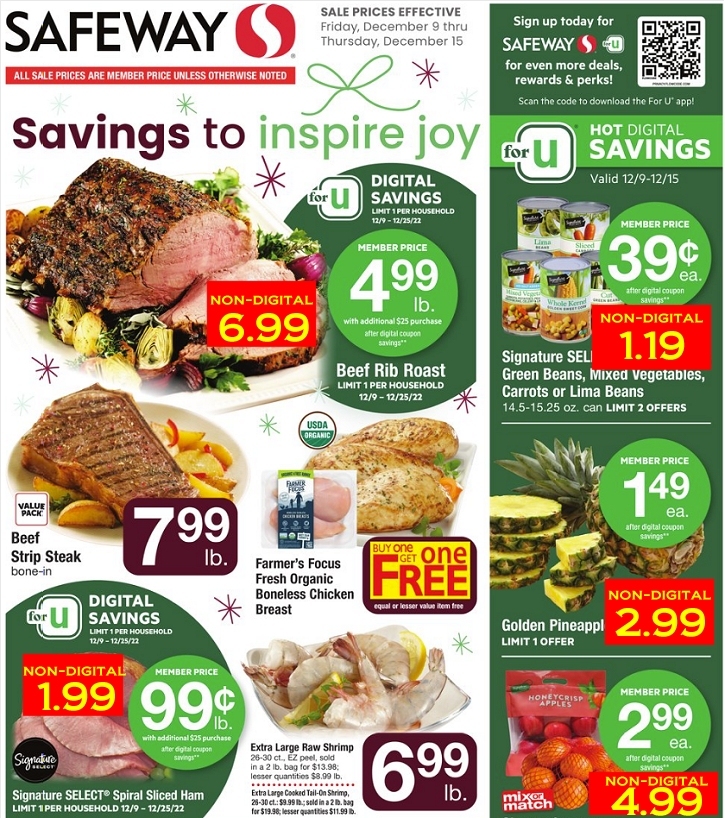
Here are sample digital only deals from some leading supermarket chains:

Digital offers sampleClick graphic above TWICE to enlarge

Updated every Monday!   Subscribe to free weekly newsletter.

Devilish Scam Bombards Victims With Spam to Hide Fraudulent Credit Card Purchases

This was a new one on MrConsumer. A New York friend recently called to say he was getting deluged with spam all of a sudden — over 120 in an hour. They kept mounting up in his inbox and for some reason they generally were not even going into his spam folder.

In the midst of this flurry of junk mail, he was trying to do his taxes and started reviewing his American Express account online. He noticed a $2000+ pending charge at Build.com. My friend knew immediately he did not make that purchase so he called AMEX. They canceled his card on the spot since its use at that online store was fraudulent.

My poor friend, one minute he is being spammed to death and the next he is the victim of credit card fraud. How unlucky can one get to have these two independent events happen to you in the span of an hour? Or were they really a coincidence?

MrConsumer postulates they were all part of a grand scheme by a very clever crook. Someone clearly gained access to my friend’s existing Build.com account which might have had his American Express number saved for future use. Or the scammer separately obtained his American Express account number some other way. With that information, it was easy to make a purchase (or many of them) and send the loot to anyone in the country.

But what does that have to do with the spam bomb that my friend experienced? Since online sellers usually immediately send a purchase confirmation email after an order is placed, the crook had to do something to lessen the chance that my friend would see it in his in-box. So he bombarded him with tons of spam emails at the very time the order confirmation was likely to be received hoping it would go unnoticed, get mistaken for spam, and be deleted along with the rest of the junk mail.

*MOUSE PRINT:

Spam Bomb

Fortunately, my friend was able to contact Build.com in time to cancel the order slated for next day delivery. Their security system also flagged the transaction.

order canceled

So here’s the moral of the story. If all of a sudden you get hit with an unusually large deluge of spam, go through each one looking for an order(s) you never placed. Call your primary credit card issuer(s) to ask about any unusual activity they see on your account, including recent purchases and address changes. Delete any saved credit card numbers from online stores where you make purchases. And change passwords on any affected accounts.

Updated every Monday!   Subscribe to free weekly newsletter.

Target Fined $5-Mil for CA Pricing Violations

Earlier this month, district attorneys from seven California counties reached a court settlement with Target for over $5-million after they sued the chain for allegedly charging shoppers more than the advertised price on some items.

In addition to the run-of-the-mill pricing violations like leaving old sale signs up and then charging customers the full price at the checkout, the DAs alleged something very unusual in their complaint:

*MOUSE PRINT:

“..advertising, posting, marking or quoting a price for a commodity on Target.com or via the Target mobile application (“Target app”) when deployed by a consumer outside the perimeter of the store [such as at home] and then advertising, posting, marking or quoting a different price for that commodity on Target.com or via the Target App when deployed in-store by the same consumer…

..advertising, posting, marking or quoting a price for a commodity on Target.com or via the Target App that is simultaneously available for purchase in a store at a different price without clearly and conspicuously disclosing the sales channel — online or in-store — at which the commodity may be obtained at the stated price.”

With respect to this latter point, Target was apparently not making clear on the Internet whether the price it was showing for specific items was the online price, the in-store price, or was valid for both.

The other issue is a bit trickier to explain. The DAs alleged that Target used technology called “geofencing” to send a different set of prices on some items to consumers’ cellphones when they were close to or in the store compared to the prices displayed when at home. In some cases, a consumer who saw, say, a vacuum cleaner on sale for $99.99 in the Target app or on their website at home, may have discovered when visiting the store to actually look at the item that the price had changed in the app/website to reflect a higher in-store price of $109.99.

Target out-inHypothetical Example

In the settlement with the California DAs, Target is required to maintain an elaborate price verification and audit program checking hundreds of prices weekly. It has to correct the inconsistencies it finds in those price checks and also when customers bring a discrepancy to the attention of store personnel.

Target is also being required to clearly disclose on its website and app specifically where the advertised price shown is valid (in-store, online, or both). And with respect to displaying a different set of prices to customers who enter the store, the settlement says:

“Target will not use Geofencing in conjunction with the Target App or Target.com such that the price of any product advertised as available when purchased online on the Target App or Target.com either (1) increases or (2) switches to a price advertised as available when purchased at a store based solely on the geographic location of the user.”

Both the Sonoma County DA’s office and the one in San Diego County declined to provide further clarification of this and other issues.

But, three cheers for the DAs of California and the weights and measures departments in those counties who continue to watch out for shoppers on these types of pocketbook consumer issues when many state attorneys general ignore them.

Incidentally, back in 2019, the NBC affiliate in Minneapolis (Target’s hometown), conducted an investigation demonstrating how Target sometimes charges a higher price in-store than it does online. Don’t get confused by the story’s reference to a lower “parking lot price.” It is the same price you would see at Target.com using your computer or cellphone at home.

After that segment aired, Target said it would make clear whether a price shown on your phone was an in-store price or an online price.

See also: Our recent story of how prices can vary significantly from one Target location to another.