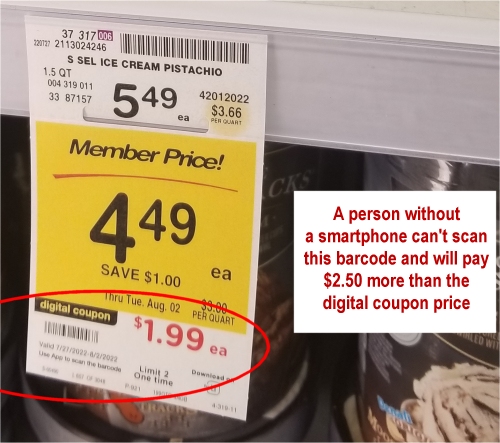
A coalition of national consumer organizations is urging leading supermarket chains to stop discriminating against senior citizens and low income shoppers who cannot take advantage of a new wave of advertised in-store digital-only discounts because millions of them do not have internet access or smartphones.
Read about the issue in our original story.
In a letter to the presidents of a dozen large supermarket chains, the consumer groups (Consumer Action, Consumer Reports, Consumer World, National Consumers League, and PIRG) are urging them to help bridge the digital divide by adopting a workaround so unplugged shoppers are charged the same lower sale prices as connected customers are.
“It’s digital discrimination, and the most vulnerable people are being shut-out of these online discounts at the worst possible time given record high inflation,” explained Edgar Dworsky, founder of Consumer World. “Big supermarkets need to provide an offline alternative to the digitally-disconnected so they can reap the same savings that connected shoppers enjoy.”
In the past couple of years, more and more weekly specials advertised by some supermarkets for meat, fish, poultry, produce, and store brand items are so-called “digital-only deals” (see sample ads). They require shoppers to first go online to electronically “clip” the offers to add them to their loyalty card account to be charged the sale price in the store.
*MOUSE PRINT:
Sample supermarket FAQ about digital-only offers:
Q. Can I still take advantage of these coupons if I don’t have a smart phone or a computer?
A. These coupons are only available electronically. Manufacturers continue to offer paper coupons through local newspapers.
But, since 25-percent of seniors don’t use the internet and 39-percent don’t have smartphones according to a 2021 study by the Pew Research Center, they are effectively shut-out of these deals. Similarly, 43-percent of low income households lack broadband internet access.
Digital-only discounts can provide significant savings for connected shoppers. But an unplugged shopper, for example, could pay $9 more for this package of steak, or $15 more for a 15-pound Thanksgiving turkey because he or she cannot clip the required digital coupon.

Even on smaller purchases, the amount a digitally-disconnected shopper overpays can be significant. In the following examples, he or she is paying twice the price for this tub of store brand ice cream and 75-percent more for this carton of eggs.
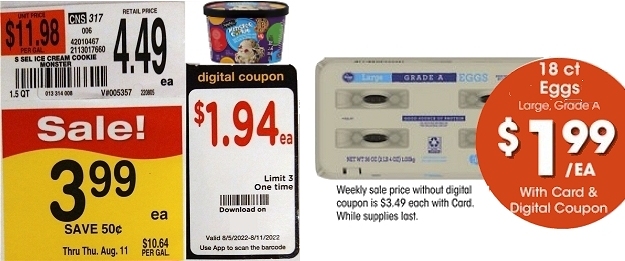
This week, stores across the country are offering digital-only sale items like these.
Not only are people without internet access shut-out of digital discounts, so are the one-in-four shoppers who despite having online access say they may lack the technical ability to use a supermarket’s website or app, according to a recent survey by Consumer World.
The consumer groups have suggested five ways that supermarkets can offer an in-store offline alternative to digital-only deals to accommodate both the digitally-disconnected and the digitally-challenged shopper:
1. Utilize barcoded clip or click store coupons in circulars so the customer can choose their preferred redemption method (e.g., Vons and The Giant Company).
2. Empower cashiers to charge the digital price upon request.
3. Empower customer service personnel to provide refunds for unredeemed digital discounts.
4. Offer physical store coupons next to digital-only deals for those who did not/could not electronically “clip” the offer (e.g., H-E-B).
5. Install coupon kiosks where digital coupons can be added to one’s account in-store (e.g., ShopRite and Food Lion).
The letter to supermarket executives was sent on November 15 to the following chains: Kroger, Albertsons, Stop & Shop, Star Market/Shaw’s, Ralphs, QFC, Jewel Osco, Randalls, Fred Meyer, King Soopers, Smart & Final, and Safeway.
Feel free to offer your opinion of whether supermarkets should make accommodations for seniors and others who don’t have internet access or smartphones to be able to pay the digital price for advertised sale items in stores.




 They look like great bargains in the weekly supermarket flyer: chicken breasts $1.97 a pound and bags of large shrimp for $5.97.