Nothing is easy anymore. You go shopping in a real store, you see the price on the shelf, and you expect that is the price you will pay. But then reality intervenes.
MrConsumer had a $5 coupon from Target that he got when getting his COVID booster and it was about to expire. He finally found something he wanted to buy by checking Target.com on his home computer — four bottles of Market Pantry honey mustard dressing for $1.39 each.

So he went to his local Target, and found the salad dressing on the shelf, but it was $1.99!
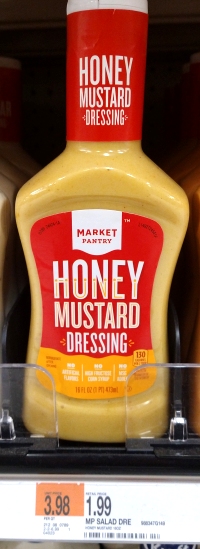
Distressed, he went up to the aisle scanner to double-check the price.

It said $1.79. So now we have three different prices: $1.39, $1.79, and $1.99. We know the middle price is what will be actually charged at the register, but that would allow MrConsumer to only get three of the dressing bottles instead of his planned four with his coupon. Grrr.
MrConsumer asked the checkout clerk to price match the $1.39 Target.com price, and he gladly did. (Here is Target’s price match policy.)
But the story doesn’t end there. Did the online price for this salad dressing vary depending on what store you chose as “your” store on the website?
Checking the online price at over a dozen different Target store locations within a 10-mile radius of Boston yielded shocking results.
*MOUSE PRINT:
Target Price Comparison
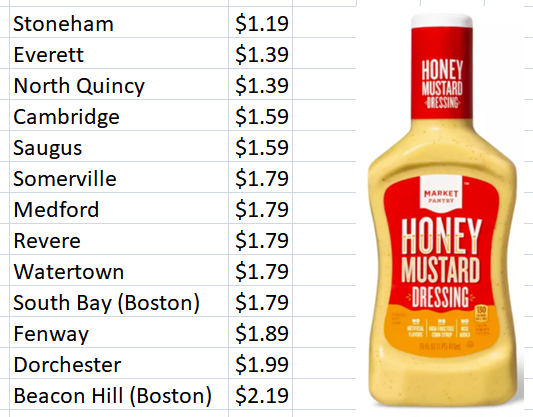
The prices ranged from a low of $1.19 to a full dollar more — $2.19. How crazy is that? Supermarkets and drugstores are known for “zone pricing” (charging different prices in different neighborhoods factoring in local competition) but who knew that Target apparently engaged in that practice too? Of course, a sample size of one item says nothing about how Target prices all its other groceries and other merchandise. So we asked the company for details and an explanation.
A Target spokesperson sidestepped most of our questions but acknowledged:
Like many retailers, overall prices and promotions may vary by location and channel.
In further checking, we also learned that not all the Target locations in the chart above actually carry that item, but a shopper could order that product for delivery at the stated web price.
The bottom line is this. Target’s prices for at least some groceries vary store to store, as perhaps other categories of goods do. And since Target maintains a price match policy, including to the prices on its own website, it behooves shoppers to check there to see if the price is lower. Savvy shoppers might discover this is a new way to save money.
Please share your thoughts about the dramatic price differences brought to light in this story.