Updated every Monday!   Subscribe to free weekly newsletter.

Walk Through Kohl’s Doors and Lose Your Right to Sue?!

Mandatory arbitration clauses that forbid class actions have been in the news lately as Congress and the president last fall struck down a new consumer rule prohibiting such clauses in contracts with banks.

Way before this action, Kohl’s department store cleverly stuck a clause into the terms and conditions on its website banning customers from getting together to sue the company.

*MOUSE PRINT:

Kohl's class action waiver

It is not so out of the ordinary to see arbitration clauses forbidding class actions on retailers’ websites. What is unusual is the fact that Kohl’s seems to be saying that this restriction even applies to people who shop in their stores.

*MOUSE PRINT:

Kohl's waiver 2

It says if you shop in their brick and mortar stores you are subject to the same restriction, and that “shopping in our stores constitutes your acceptance these terms.” Elsewhere in the terms it says if you don’t like these restrictions “you should not and are not allowed to…make purchases in our stores.”

What? So merely walking through the doors of a Kohl’s store I lose my right to be part of a class action against them? It sure seems so. (There is an argument to be made, however, that the combination of BOTH using their website AND shopping in their stores is what triggers the class action restriction. However, if that were true then only people who did both would lose the right to sue and certainly Kohl’s wants to prevent Internet users who never shopped in their stores to be covered by the class action prohibition.)

We asked Kohl’s how in the world the class action waiver could ever apply to people who only shop at their stores and were never put on notice that entering their stores triggered this restriction. (Last I checked, there was no notice on every door notifying shoppers they were about to lose those some consumer rights upon entering.)

The company did not respond.

Updated every Monday!   Subscribe to free weekly newsletter.

A Macy’s Rebate Gone Wrong

SensorGel pillowRight after Christmas, Consumer World promoted a deal on a SensorGel pillow at Macy’s as “Bargain of the Week.” It was $20, but there was a $20 full price rebate.

In January, MrConsumer’s own rebate submission was denied by the rebate fulfillment house indicating that no receipt was received. Of course I had included it. Calling them quickly revealed that indeed they had my receipt in their records, and the rebate was approved.

Then in February, some consumers contacted me saying that their rebate was denied because they purchased the pillow online rather than in the store. Here is what one consumer was told when he engaged the rebate folks in a chat session:

Macy's rebate denial

After complaints like this starting coming in, we checked the fine print of the offer on the rebate form.

*MOUSE PRINT:

Macy's rebate fine print

Clearly, right on the rebate form itself, both online and in-store purchases were permitted for this rebate.

Since it appeared that many purchasers may have had their rebates wrongfully denied, we contacted Macy’s PR folks, asking them to investigate, and if they discovered that customers were indeed owed money, that they honor those submissions. After multiple contacts, Macy’s did not reply to our inquiries.

So, MrConsumer had to use some back-channel methods to get Macy’s to do the right thing. He contacted the former CEO of Parago, the rebate fulfillment house that Macy’s uses, to ask her help. This remarkable woman dropped everything eight years ago to address a similar problem with a Norton rebate. She did the same again by contacting the new CEO at Blackhawk Network, the new owner of the fulfillment house.

A week later, a representative of Blackhawk called to say that after discussion with Macy’s and a review of all the denied rebates, they are making good for some 150 customers! And they are also going to more accurately state on the rebate form when an offer is restricted to in-store or online sales only.

Updated every Monday!   Subscribe to free weekly newsletter.

Blurred Lines: Can Readers Distinguish Ads from Content?

Some websites, even very reputable ones, sometimes blur the distinction between editorial content and advertising. Of course, consumers have a right to know what they are reading is an advertisement when that is the case.

To that end, the Federal Trade Commission has created advertising guidelines for websites that use ads that look like the surrounding non-advertising content (“native advertising”). It encourages them to make clear disclosure to distinguish advertising content from regular new stories or natural search results. But are those disclosures really working? To find out, the FTC just published a study where Internet surfers were exposed to various webpages and asked to identify the advertising, if any, on those pages. The FTC also modified those real pages with simple changes it thought might better identify sections that really were advertisements.

Here is a sample Google Shopping results webpage when searching for computer tablets, and an FTC-modified version of it better highlighting the advertising on it:

Google Shopping FTC

Google only inconspicuously disclosed on the top right of the results page that the links listed have been paid for by the sellers (“Merchant links are sponsored.”) [Note: We’ve added the red arrows.]

The second image reflected a minor modification by the FTC putting the word “Ad” right before each link along with an information bubble explaining that.

The FTC found that few viewers even noticed Google’s disclosure in the upper right corner. In the modified version, the word “Ad” stood out much more clearly.

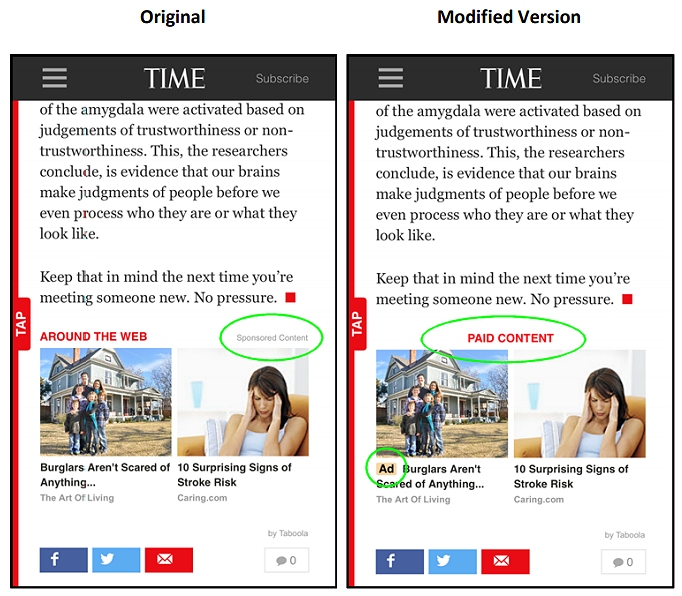
Here is another example of tweaks made to advertising that appeared at Time.com in their mobile version:

time.com FTC

In the original Time version, the two “Around the Web” stories are paid placements with poor disclosure (“sponsored content”) in small type. The FTC’s version made clear this was “paid content” by centering that disclosure above the two stories and adding the word “Ad” under the one on the left which was an advertisement.

Although the FTC study (“Blurred Lines: An Exploration of Consumers’ Advertising Recognition“) was limited, some generalizations can be drawn from the results:

Using some of the common sense disclosure techniques … can greatly increase the likelihood that consumers will recognize an ad as an ad. Minor modifications, including changes to disclosure language, position, text size and color, and to other visual cues such as the borders around or background shadings of ads or ad groupings, can in combination substantially increase the likelihood that a consumer recognizes an ad as an ad and reduce the potential for consumers to be misled as to the commercial nature of paid search and native ads.

Websites could easily make changes like these with minimal effort. The question is, will they?