Last week, Sprint issued a press release touting results of a Nielsen study that found on average, that the Sprint network provided faster download speeds than T-Mobile, Verizon, and AT&T.
One of the comparison charts they included was this:
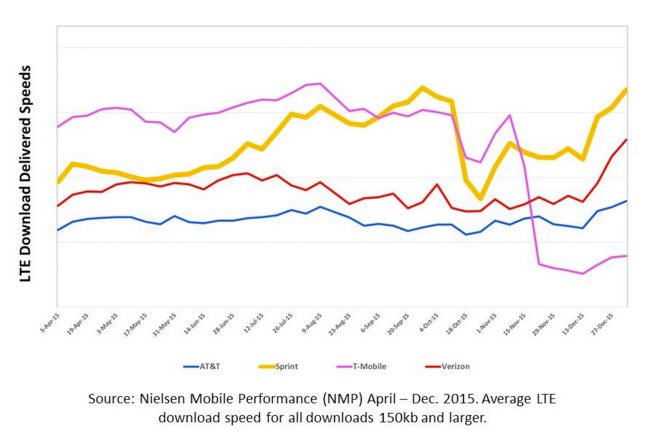
While this chart shows the relative comparison between the cell brands, something important is missing.
*MOUSE PRINT:
The label on the Y-axis (going up the left and right sides) is missing or has been deliberately stripped off. (Remember your high school math teacher warning you to be leery of graphs that didn’t start at zero?)
If the figures on the Y-axis were shown, it would disclose what the actual average download speed was for each of the cellular networks — an important fact for consumers to be aware of. Is Sprint providing average speeds of 50 Mbps (really fast) or only 5 Mbps (really slow)? And what about the other companies and how do those speeds compare to home Internet speeds?
So, we asked Sprint to provide the speeds for each company, but they declined.
“We are not providing speed scale for the other chart per Nielsen’s request that we not share this data.” — Sprint Corporate Communications
They did provide a second chart showing the relative difference between the four carriers.
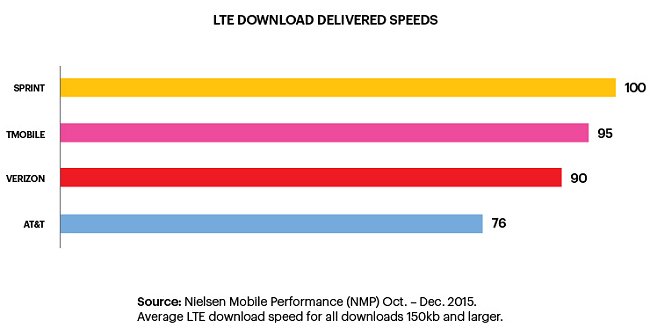
In this one, Sprint and T-Mobile are shown to be only five percent apart. The first chart above, however, makes the difference appear much more extreme.
Hmmm. What’s going on here? Was it really Nielsen that didn’t want this information disclosed, or was it Sprint? (If, for example, Sprint promised a particular download speed to customers, and this study of 70 million downloads proved they weren’t meeting the advertised speed, that could spell a big problem for them or the other companies if they made similar promises.)
So… we asked Nielsen to provide the missing average speeds that they found for each carrier. And despite repeated requests, they would not provide the information nor provide an on-the-record reason why. Why are they hiding this information? We may never know.
To at least put some of the results in context, in the early months of the study, T-Mobile commanded the top spot for fastest downloads in the Nielsen study. It is probably not coincidental that their drop to last place began when, in November, the company introduced unlimited free downloading of video services like Netflix, Hulu, and HBO.