Updated every Monday!   Subscribe to free weekly newsletter.

What a 14-Day Return Policy Means on eBay Sometimes

Many people are reluctant to shop at eBay because unlike buying from a retail store, many items are sold by individuals and don’t come with any return privileges. When you are purchasing antiques, for example, it is often hard to tell just from the pictures what the actual condition of the item is, what the flaws are, and even what the true colors are.

So, it certainly can relieve some of that anxiety when you see that an individual seller has a decent return policy. Take for example this one, that offers a 14-day money back guarantee.

eBay returns

When clicking that “details” link, the truth is revealed.

*MOUSE PRINT:

14 day return policy

I accept returns only on items in which I have made a mistake in the listing. It is the buyer’s responsibility to ask any and all pertinant questions about an item prior to bidding. I require immediate notification, (within 24 hours of receipt of the item), of intent to return by the buyer. I do not accept returns for buyer’s remorse or for items that the buyer assumed could be purchased on approval. If you want your friend’s “expert” opinion on a piece, you need to have them view the listing and read the item description prior to bidding. You do not get to do this after receiving the item because this constitutes “buying on approval”. The returned item must be received by me in the same condition it was in when inititally shipped to the buyer.

Basically, what this seller is really saying is that you have no regular return rights, including 14 days to try out the item. You only have a right of return for a misrepresentation and YOU have to pay the return shipping!

That certainly is far different from what the average consumer would understand “14 days money back” to mean. So as with everything we write about in Mouse Print*, you have to read the fine print or you could get snookered.

Updated every Monday!   Subscribe to free weekly newsletter.

Sometimes There’s Good News in the Fine Print

With minus nine degree weather in Boston last week, MrConsumer’s 1996 Honda Accord wasn’t so eager to start easily. I wondered if my battery was going bad, then again, it hadn’t been that long ago since it was replaced. Checking the receipt revealed that the battery was purchased at Autozone in mid-March 2013.

A further check of the receipt revealed the warranty terms.

*MOUSE PRINT:

Autozone receipt

The battery, which cost about $119, had a five year warranty but provided for free replacement within the first three years if it was defective. Since we were now at the two years and 11 months mark, MrConsumer hightailed it over to Autozone to have it tested. After a few tense moments when they had difficulty connecting the tester, the readout said “bad battery.” Yeah!

We went back in to process the warranty claim. Half expecting some type of snafu or some hidden charge to surface, I was treated to one pleasant surprise after another. They handed me back $4.10 in cash, explaining that the battery was cheaper today than what I paid three years ago. They pointed to a second receipt that popped out of the register good for a rebate of $20 (via gift card). And the worker said that he was giving me a free five year warranty on the replacement battery (rather than the more common practice of only getting the remaining time from the original battery).

Wow. What great customer service! Hats off to Autozone in Medford, Massachusetts.

Updated every Monday!   Subscribe to free weekly newsletter.

Thanks for Nothing #2:
Dollar General Found Selling Obsolete Motor Oil

Many of us shop at dollar stores because of bargains you can often find there. Sometimes, however, the bargain is no deal.

For example, Dollar General sells quarts of its own brand of motor oil, DG, for $2.50 to $2.75. That is cheaper than the big name brands.

Dollar General oil

What could be bad?

*MOUSE PRINT:

Dollar General Oil back of label

The back of the label provides an unexpected shock. This oil is not for use in cars built after 1988?! Who would ever expect a common oil like 10W-30 sold by a major general merchandise chain to be inappropriate for the expected use for most customers?

While the label says it meets a particular automotive specification, that spec is outdated, and has been updated six times since then according to the Petroleum Quality Institute of America.

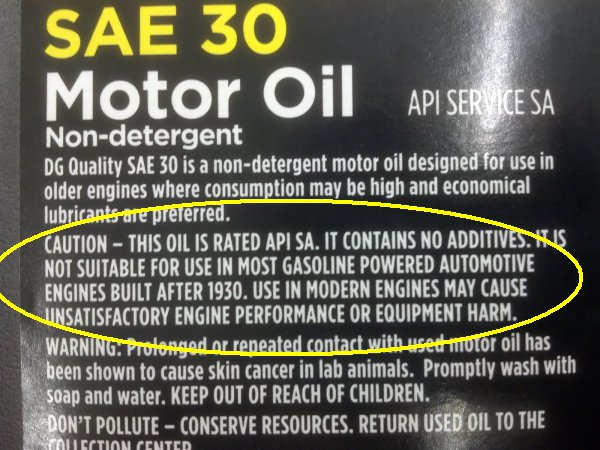
Another product the company sells, an oil called SAE 30, has an even more astonishing disclaimer on the back of the bottle:

SAE 30

This one is not for cars built after 1930! So for everyone with a Model T, go grab some.

But for everyone else, thanks for nothing, Dollar General.

Now, consumers in 14 states have filed lawsuits against Dollar General for selling obsolete motor oil: CA (see lawsuit), CO, FL, MD (see lawsuit), KS, MI, MN, MO, NE, NJ, NY (see lawsuit), VT, OK, and TX.

And our friends at ABC’s Good Morning America, with a little help from Mouse Print*, just completed an undercover investigation of these motor oils:

Good Morning America story
Click to view

We asked the company to explain why they even sell these products that are inappropriate for most of their customers, whether they would put up more prominent warnings for shoppers, and what their reaction was to the lawsuit. They responded as follows in relevant part:

We are confident that our DG-branded motor oil products meet not only our standards for quality and value, but also all applicable federal and state labeling requirements where they are sold. In addition, the labeling on these products contains obvious and unambiguous language regarding the products’ intended and appropriate use.

Dollar General intends to vigorously defend against the claims raised in the recently-filed lawsuits regarding these products, including the filing of motions seeking their dismissal. — Dollar General Corporate Communications

Few shoppers know that there is more to buying motor oil than looking for the proper viscosity, such as 10W-30 or 10W-40. You need to make sure that you are choosing the one specified in your owner’s manual, including the appropriate service category. This is an industry specification, noted on the label, relating to the additives put in the oil to help prevent corrosion, sludge build up, and engine damage.

The most current service category is API “SN”. The oils shown above have obsolete service category designations such as “SA” or “SF,” meaning they are missing more modern additives.

Here is a chart from the Petroleum Quality Institute of America (an organization that tests motor oils for compliance with the labeled standard) showing which car model years are covered by each service category designation. Each category is backwards compatible.

oil chart

=======

We welcome your submissions of other great “thanks for nothing” examples. Just email them to edgar(at symbol)mouseprint.org .