Updated every Monday!   Subscribe to free weekly newsletter.

At Target, The Price is  Right  Variable

Nothing is easy anymore. You go shopping in a real store, you see the price on the shelf, and you expect that is the price you will pay. But then reality intervenes.

MrConsumer had a $5 coupon from Target that he got when getting his COVID booster and it was about to expire. He finally found something he wanted to buy by checking Target.com on his home computer — four bottles of Market Pantry honey mustard dressing for $1.39 each.

Target honey mustard

So he went to his local Target, and found the salad dressing on the shelf, but it was $1.99!
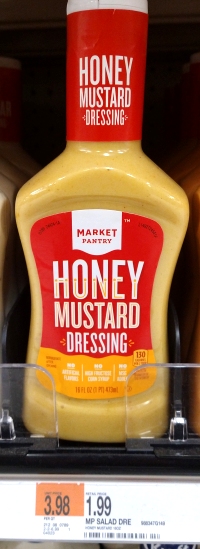
Target Honey Mustard 1.99

Distressed, he went up to the aisle scanner to double-check the price.

Target honey mustard scanner

It said $1.79. So now we have three different prices: $1.39, $1.79, and $1.99. We know the middle price is what will be actually charged at the register, but that would allow MrConsumer to only get three of the dressing bottles instead of his planned four with his coupon. Grrr.

MrConsumer asked the checkout clerk to price match the $1.39 Target.com price, and he gladly did. (Here is Target’s price match policy.)

But the story doesn’t end there. Did the online price for this salad dressing vary depending on what store you chose as “your” store on the website?

Checking the online price at over a dozen different Target store locations within a 10-mile radius of Boston yielded shocking results.

*MOUSE PRINT:

Target Price Comparison
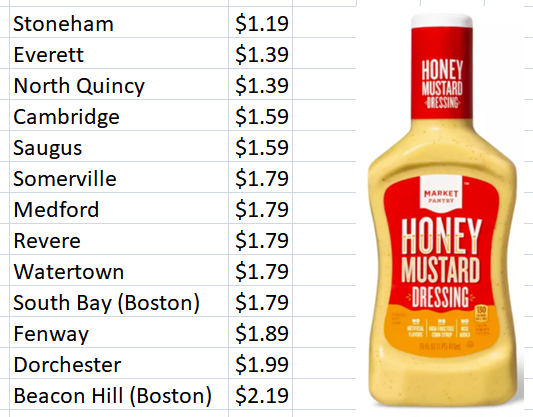
Target price comparison

The prices ranged from a low of $1.19 to a full dollar more — $2.19. How crazy is that? Supermarkets and drugstores are known for “zone pricing” (charging different prices in different neighborhoods factoring in local competition) but who knew that Target apparently engaged in that practice too? Of course, a sample size of one item says nothing about how Target prices all its other groceries and other merchandise. So we asked the company for details and an explanation.

A Target spokesperson sidestepped most of our questions but acknowledged:

Like many retailers, overall prices and promotions may vary by location and channel.

In further checking, we also learned that not all the Target locations in the chart above actually carry that item, but a shopper could order that product for delivery at the stated web price.

The bottom line is this. Target’s prices for at least some groceries vary store to store, as perhaps other categories of goods do. And since Target maintains a price match policy, including to the prices on its own website, it behooves shoppers to check there to see if the price is lower. Savvy shoppers might discover this is a new way to save money.

Please share your thoughts about the dramatic price differences brought to light in this story.

Updated every Monday!   Subscribe to free weekly newsletter.

Is Godiva Chocolate Really Made in Belgium?

Back in September, we told you about the court case of King’s Hawaiian sweet rolls, whose packaging and advertising says “Est. 1950” and “Hilo, Hawaii” under the brand name suggesting that it was manufactured in Hawaii when in fact it was made in California. (See original story.) Most readers thought there was no case here.

Now fast forward a few months to a similar suit [see complaint] where consumers are claiming that Godiva is misrepresenting their chocolates as being made in Belgium when in fact they are manufactured in Pennsylvania. They cite as evidence that the phrase “Belgium 1926” is depicted under the brand name on every chocolate package, each one says “Belgian chocolate,” and the term is used on signs on their buildings and is included in advertising.

Godiva chocolate

In court, the company made a motion to have the case dismissed. The judge denied most of their request in his ruling, saying…

*MOUSE PRINT:

Courts apply the “reasonable consumer” standard to determine whether a representation is false or deceptive under each of the relevant New York and California consumer-protection statutes.

Godiva also contends that the word “Belgium” is inextricably linked to the year “1926,” and the latter “cures any likelihood of deception,” in its labeling. It argues that for a consumer to be deceived into thinking “Belgium 1926” represents that the products [were made] in Belgium, the consumer must also believe that the products she is purchasing were made almost one-hundred years ago -— a clearly unreasonable belief. This argument, however, is too clever by half.

A consumer could reasonably believe that Godiva was founded in Belgium in 1926, as Godiva contends, and that the representation on its products of this heritage means that its products continue to be manufactured in that location.

With that, the judge allowed the case to move forward.

So what do you think? Do the consumers have a good case this time?

Updated every Monday!   Subscribe to free weekly newsletter.

How to Get Free Shipping From Amazon Without a $25 Minimum Purchase

MrConsumer is probably one of the few people in the world who has not become a member of Amazon Prime — the $119 a year membership program that provides “free” two-day shipping and a host of other benefits. He simply does not buy enough on Amazon to make purchasing the membership worthwhile.

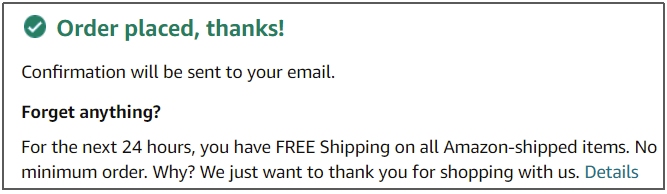
Recently when buying an item which qualified for free shipping for non-members because it was over $25, an onscreen confirmation provided a pleasant surprise:

Amazon free shipping

It indicated that for the next 24 hours, I could place additional orders and not have to meet the $25 minimum for free shipping. What an unexpected offer.

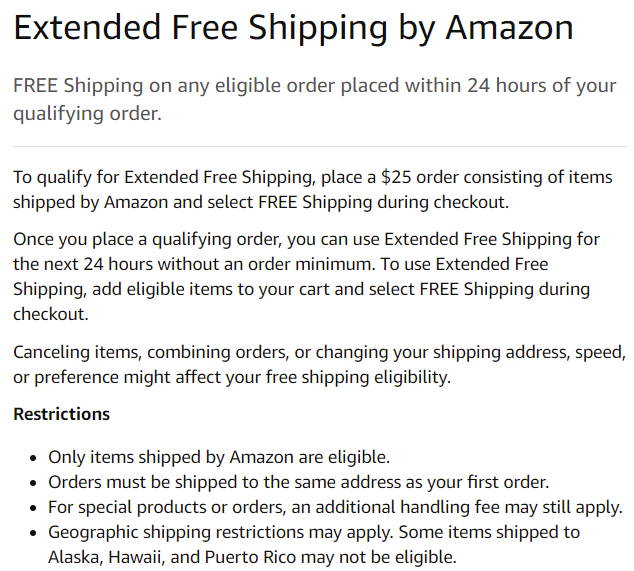
There was some fine print, however, but nothing that significantly diluted the bonus.

*MOUSE PRINT:

Amazon free shipping detail

The key restrictions are that any new purchases have to be ones shipped by Amazon (rather than a third party) and must go to the same address as the original order.

Obviously, this loophole is a narrow exception aimed at shoppers who forgot to order some less expensive items when placing their larger orders the day before. In any event, thanks, Amazon.