Updated every Monday!   Subscribe to free weekly newsletter.

T-Mobile’s “Unlimited?” 4G Service

Few services advertised as “unlimited” are truly unlimited. And T-Mobile continues to be a case in point.

When T-Mobile began advertising “unlimited” data on its cellphones in April 2011, the fine print indicated that only the first two gigabytes were truly unlimited. Any use beyond that would be slowed down or “throttled.” And of course, that fact was not as prominently disclosed as their unlimited claims.

Fast forward to September 2012. T-Mobile published full page ads with a new unlimited claim:

T-Mobile unlimited

However, at the bottom page in almost unreadable type was this:

*MOUSE PRINT:

T-Mobile unlimited fine print

Not obvious on its face, the new unlimited plan is not considered “Ultra” or “Premium” where customers’ data transmission speeds will be given priority when traffic is heavy. That could put those on the new unlimited plan in coach and thus they may not experience the same fast speeds.

Beyond that, on T-Mobile’s “test drive” website, the company seems to proclaim a list of benefits to those who select the new 4G unlimited service (note: graphic has been compressed to fit this page):

T-Mobile

The top-listed benefit is the ability to create a wi-fi hotspot so that data can be shared with other devices nearby such as a tablet. However, when clicking on that benefit, one discovers that this is NOT a benefit of the new unlimited 4G plan.

*MOUSE PRINT:

TM

NOTE: MrConsumer is a member of Verizon’s Consumer Advisory Board, and often criticizes that company for its advertising missteps.

Updated every Monday!   Subscribe to free weekly newsletter.

Oh Gee, Cell Carriers Fudge 4G Claims

If you just landed here from Mars and needed data service to phone home, you would be confused because most cell companies each make you think they have the biggest 4G data networks. Actually, earthlings might be experiencing the same confusion.

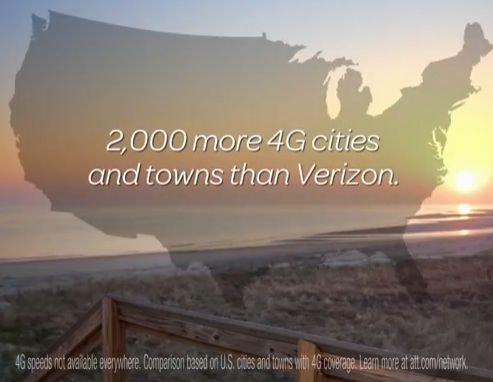
AT&T claims:

AT&T

Verizon claims:

Verizon

T-Mobile claims:

T-Mobile

How in the world can AT&T claim that its 4G network has 2000 more cities than Verizon at the same time that Verizon claims to have more 4G LTE coverage than all other networks combined?

The answer is simple (and deceptive): they all define 4G differently.

*MOUSE PRINT:

On AT&T’s website, they disclose that the company calls two different technologies “4G”:

4G AT&T

AT&T defines 4G as including its HSPA+ and LTE networks, while Verizon only counts its LTE network. Which one is fudging the numbers? According to the Wall Street Journal, it’s AT&T:

*MOUSE PRINT:

AT&T Pins 4G Label to Existing Network

AT&T Inc. flipped a switch and turned on its 4G wireless network Wednesday. The switch, however, was in the company’s marketing department.

By relabeling its existing 3G network, the country’s second-largest wireless carrier joined the noisy fray over so-called fourth-generation wireless technology, which promises mobile Internet speeds so fast that huge files can be downloaded in minutes and streaming video can be watched without the interruptions of earlier-generation technologies.

As recently as September, AT&T executives had referred to the company’s current network, which runs on a technology it calls HSPA-plus, as 3G. — WSJ, January 5, 2011

So, AT&T is making people think their 4G network is larger by simply rebranding its 3G network as 4G, and adding the 53 markets it offers 4G LTE to it. (LTE is commonly viewed as the truly faster 4G network, and the future of 4G.) Verizon, on the other hand, only counts its 4G LTE cities as part of its 4G network.

Our advice: forget the marketing labels. Find out what actual speeds the various networks in your area provide, and make your cell service choices based on real numbers. (Use SpeedTest.net at cell stores to check actual speeds.)

Note: MrConsumer is a member of Verizon’s Consumer Advisory Board (and often criticizes them for advertising missteps).

Updated every Monday!   Subscribe to free weekly newsletter.

Verizon’s “Share Everything” Plan: You’ll Pay Less or More

Last week, Verizon Wireless announced a new “Share Everything” plan, that radically changes how cell services are sold. Starting June 28, if you upgrade your phone and pay a subsidized/discounted price for it, this plan may affect you. You can also voluntarily switch to this plan.

On the positive side, Share Everything lets a family share one pot of data each month the same way they currently share a bucket of minutes. Currently each family plan member has to buy a $30 data pack for their smartphone. Also on the positive side, it appears that most people on unlimited calling plans will save money under the new scheme.

On the negative side, those folks who are looking to reduce their plan minutes for calling may be forced into unlimited calling plans for which they have no use. And they may pay more. People with multiple devices, even individuals, will be charged a fee for each device that can tap into their one pot of data.

*MOUSE PRINT:

To see how this compares with what customers are currently paying, we looked at two (of many) scenarios.

Example 1: One person with one smartphone currently with an unlimited calling plan, 1000 text messages, and 2-gigs of data.

That person pays a total of $109.99 currently (unlimited calling ($69.99), 1000 texts ($10), and 2-gigs of data ($30). Under the Share Everything plan, he or she would pay $100 (smartphone ($40) + 2-gigs of data ($60) + “free unlimited calls and texts”). That is a $10 savings a month. If that person also had a tablet, currently that would add $30 a month to their bill for an additional 2-gigs. Under the new plan, that tablet would only cost $10 extra, but not come with any additional data. If the customer wanted a total of 4-gigs of data to be shared by the smartphone and the tablet, that adds another $10. So this customer in total would save $20 a month compared to the current system.

Example 2: Three people on a family plan with two smartphones and one basic phone, sharing 700 minutes of calling, unlimited texts, and two of them having 2-gigs of data each.

That family currently pays: $169.97 (700 calling minutes ($69.98) + third phone ($9.99) + unlimited texts ($30) + 2-gigs per smartphone ($60) ). Under the new system, they would pay a total of $180.00 ( 2 smartphones ($80) + 1 basic phone ($30) + 4-gigs data to share ($70).

The bottom line is that everyone on Verizon will have to do the math to see if it is best to stick with their current plan or switch to Share Everything.

Note: MrConsumer is a member of Verizon’s Consumer Advisory Board.