Updated every Monday!   Subscribe to free weekly newsletter.

It Pays to Read the Fine Print, Literally

Since 2006, we have encouraged you to always read the fine print so you don’t get snookered by the strings and catches buried in advertisements, contracts, etc. A Georgia teacher did just that a few weeks ago and got an unexpected surprise.

She had visited a travel insurance website called SquareMouth to buy a policy for an upcoming trip. Like all insurance policies, there was a ton of fine print that could trip up a purchaser. Most people don’t have the patience to wade through that stuff, but our teacher did.

*MOUSE PRINT:

Squaremouth excerpt

The section above says because most customers don’t read the fine print of travel insurance policies to their detriment, the company launched a contest to highlight this problem. It went on to say that the first person who spotted this section of the policy and contacted the company would win $10,000!

This smart Georgia teacher found the clause a mere 23 hours after the contest was launched, and is now $10,000 richer.

Squaremouth winner

Share this story:


ADV
Updated every Monday!   Subscribe to free weekly newsletter.

A $2-Million Coupon Surprise

Have you read any good coupons lately? If not, you are in for a surprise courtesy of the folks at Kimberly Clark, makers of paper products like Kleenex, ScotTissue, and Viva paper towels.

Most people don’t read the fine print of anything, let alone cents-off coupons. But maybe they should, particularly if they are trying to pull off some coupon monkey business.

*MOUSE PRINT:

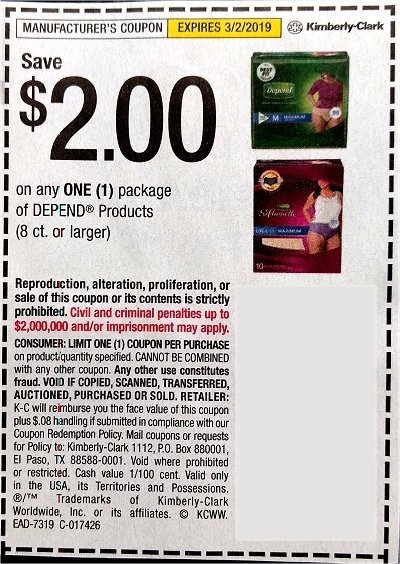
$2-mil penalty

That’s right. Kimberly Clark is threatening those who commit coupon fraud with up to $2-million in criminal or civil penalties or jail if you try to rip them off. This addition to coupons was instituted four years ago but has gone largely unnoticed.

According to the Coupon Information Corporation, the industry group that fights coupon fraud, losses from counterfeit coupons and coupon misuse cost manufacturers (and in turn consumers) millions of dollars a year. In the largest case to date, the head of a coupon clearinghouse was sentenced to 10 years in jail and ordered to pay $65 million in restitution to companies, including Kimberly Clark, after being convicted in a massive coupon fraud case.

The warning on coupons is meant as a deterrent. But for those who ignore it and get busted by the feds by surprise, they may have wished they had actually used this Kimberly Clark coupon:

Depends

Share this story:


ADV
Updated every Monday!   Subscribe to free weekly newsletter.

Magellan’s GPS Takes a Shortcut on Lifetime Benefits

When Donald K. went to update his Magellan GPS with the latest map, he got a nasty surprise. Despite being advertised as coming with “FREE lifetime map updates,” he was informed that his unit did not qualify.

Magellan GPS

Seems pretty unambiguous, right? “Free lifetime map updates.” “Never worry about out-of-date maps again.”

However, farther down the page on Magellan’s website is an inconspicuous disclosure.

*MOUSE PRINT:
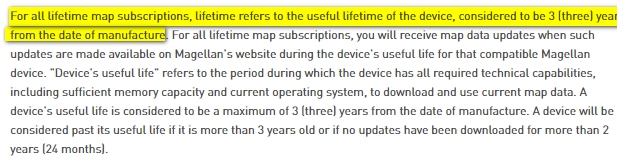
Lifetime = 3 years

Magellan astonishingly defines “lifetime” as just “three years” from the date of manufacture. That is certainly not how the average consumer would define lifetime. Nor how the Federal Trade Commission wants its definition disclosed:

§ 239.4 “Lifetime” and similar representations.
If an advertisement uses “lifetime,” “life,” or similar representations to describe the duration of a warranty or guarantee, then the advertisement should disclose, with such clarity and prominence as will be noticed and understood by prospective purchasers, the life to which the representation refers.

And the FTC also bans the deceptive advertising of guarantees.

Clearly, the disclosure that Magellan makes is not conspicuous, nor in close proximity to their “lifetime” claims. Further, their warranty is really a specified term of years — three — and not an unlimited warranty time-wise as the term “lifetime” implies.

Making the lifetime to which the warranty applies to the device’s own lifetime is circular reasoning. In essence that says the device will last only as long as it will last and then you’re out of luck. And in Magellan’s case, they are even cutting that short.

We asked a spokesperson for the company why they continue to use the misleading term “lifetime” to describe their three-year warranty, and whether they will grant access to map updates to purchasers who feel they were deceived. Here is their response:

We sincerely apologize for any confusion we may have caused to consumers about “lifetime maps” on our Magellan GPS devices. Typically with electronics, “lifetime” refers to the useful lifetime of the device, and for most GPS devices the useful life is about 3 years. Magellan honors customer requests for lifetime map updates as long as the device is still capable of being updated. For support, please visit https://service.magellangps.com/ [and fill out the “contact us” form].

One can only wonder what she meant by saying the device has to be “still capable of being updated” rather than simply saying that as long as the device was still functional they will provide map updates.

Thanks to John Matarese of WCPO-TV for the original story idea.

Share this story:


ADV