Updated every Monday!   Subscribe to free weekly newsletter.

When It Comes to Yogurt, Size and Ingredients Matter

Have you read any good yogurt labels lately? You may be in for a surprise.

Here is the 6-oz. container of Yoplait Original strawberry banana yogurt:

Yoplait 6-oz

It is made with real strawberries and bananas, just as the front label depicts.

Thrifty shoppers, however, may find it more economical to buy the quart size container of Yoplait Original strawberry banana. But, they will get less than they bargained for.

*MOUSE PRINT:

Yoplait 32 oz

Checking the ingredients, all the real strawberries and bananas disappeared! While it does say “smooth style” on the front of the label, one might have reasonably assumed that they merely blenderized the fruit into the yogurt to create a uniform, smooth texture.

Nope. And the fine print of the front of the label doesn’t help much either. It says, “flavored with other natural flavor,” which might to the average shopper merely convey that other flavors are also mixed in.

Not to be outdone by this bit of yogurt trickery, once upon a time, Yoplait made a line of Yoplait Whips for the Girl Scouts evoking the flavors of some of their bestselling cookies.

Here is Yoplait’s Girl Scouts “peanut butter chocolate” Whips… but something is missing.

*MOUSE PRINT:

Yoplait peanut butter

According to the ingredients, there is no peanut butter in Yoplait’s peanut butter chocolate yogurt.

We asked General Mills, the maker of Yoplait, about the labeling of these two products. In particular, why different sizes of seemingly the same product did not have the same contents, and why they don’t more accurately describe the product on the front of the container. The company did not respond.

FDA regulations unfortunately allow manufacturers to play games with how product flavors are labeled, even to the point of permitting none of the depicted ingredient to actually be present in the product.

(i) If the food is one that is commonly expected to contain a characterizing food ingredient, e.g., strawberries in “strawberry shortcake”, and the food contains natural flavor derived from such ingredient and an amount of characterizing ingredient insufficient to independently characterize the food, or the food contains no such ingredient, the name of the characterizing flavor may be immediately preceded by the word “natural” and shall be immediately followed by the word “flavored” in letters not less than one-half the height of the letters in the name of the characterizing flavor, e.g., “natural strawberry flavored shortcake,” or “strawberry flavored shortcake”.

This is called consumer protection?

Share this story:


ADV
Updated every Monday!   Subscribe to free weekly newsletter.

Is Canada Dry Ginger Ale Made With “Real Ginger”?

Multiple lawsuits recently alleged that Canada Dry ginger ale was not the real thing because it did not contain “real ginger” as the label proclaimed.

Canada dry

*MOUSE PRINT:

ingredients

The ingredients statement says that it contains “natural flavor” but tests done by the plaintiffs indicate that the soda did not contain key components one would normally find in ginger root. Further analysis concluded that it only contained two parts per million of ginger extract.

In the settlements agreed to last month, Canada Dry is still allowed to say “made with real ginger” but only if that statement is modified with words like “flavor” or “extract.”

Examples of permissible label claims: “real ginger taste,” “made with real ginger extract,” “real ginger flavor,” “flavor from real ginger extract,” and “natural ginger flavor.” The Permanent Injunction shall also include court-approved use of “ginger extract,” “natural ginger flavor extract,” “natural ginger extract,” “natural ginger flavor,” or “ginger flavor” in the label ingredient line.

Would you catch those nuances?

Consumers who purchased Canada Dry ginger ale are entitled to modest compensation. Without proof of purchase, you can get 40 cents a can/bottle, up to $5.40. With sales receipts, you can get reimbursed at the same rate for up to 100 units.

After the settlement becomes final, you can file a claim here.

Share this story:


ADV
Updated every Monday!   Subscribe to free weekly newsletter.

Hey, Ghirardelli and Russell Stover, Where’s the Chocolate?

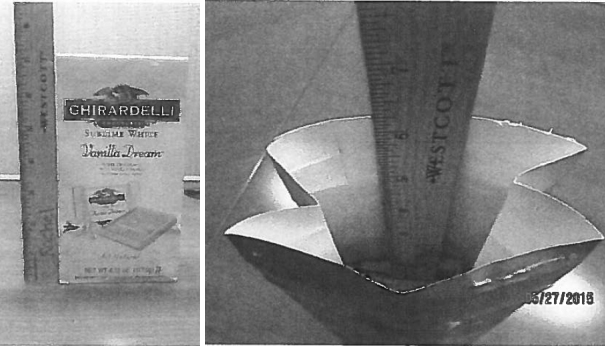
Six California district attorneys filed a complaint last month alleging that Ghirardelli and Russell Stover marketed some boxes and packages of chocolate that were “predominately empty” or that had large empty spaces or false sidewalls.

Readers of Mouse Print* know that this is called “slack fill” — nonfunctional empty space in an opaque product package. Manufacturers understand that consumers purchase products with their eyes. So if they can make the package look bigger, consumers will wrongly assume they are getting more product and thus more value for their money.

In the court case, the DAs alleged that some chocolate boxes had false bottoms, making the package look more filled than it really was.

*MOUSE PRINT:

Whitman's Sampler
Whitman’s Sampler Box with False Bottom

Another example is a bag of Ghirardelli chocolate squares that is full of air and not much chocolate:

*MOUSE PRINT:

Ghirardelli

The bag is seven inches high, but there is five inches of dead space inside.

The owner of both companies quickly entered into a settlement with the DAs and agreed to pay $750,000 in penalties and costs, and change some of their packaging practices.

Hats off to the California DAs who continue to publicly pursue weights and meassures violations for the benefit of everyone. More agencies around the country should step up and do the same.

And they can start with this one…

Lindt

Share this story:


ADV