
Some websites, even very reputable ones, sometimes blur the distinction between editorial content and advertising. Of course, consumers have a right to know what they are reading is an advertisement when that is the case.
To that end, the Federal Trade Commission has created advertising guidelines for websites that use ads that look like the surrounding non-advertising content (“native advertising”). It encourages them to make clear disclosure to distinguish advertising content from regular new stories or natural search results. But are those disclosures really working? To find out, the FTC just published a study where Internet surfers were exposed to various webpages and asked to identify the advertising, if any, on those pages. The FTC also modified those real pages with simple changes it thought might better identify sections that really were advertisements.
Here is a sample Google Shopping results webpage when searching for computer tablets, and an FTC-modified version of it better highlighting the advertising on it:

Google only inconspicuously disclosed on the top right of the results page that the links listed have been paid for by the sellers (“Merchant links are sponsored.”) [Note: We’ve added the red arrows.]
The second image reflected a minor modification by the FTC putting the word “Ad” right before each link along with an information bubble explaining that.
The FTC found that few viewers even noticed Google’s disclosure in the upper right corner. In the modified version, the word “Ad” stood out much more clearly.
Here is another example of tweaks made to advertising that appeared at Time.com in their mobile version:
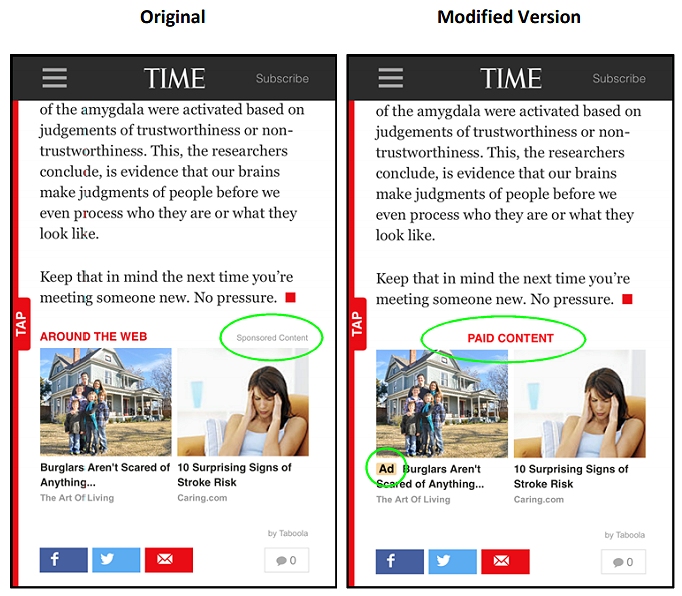
In the original Time version, the two “Around the Web” stories are paid placements with poor disclosure (“sponsored content”) in small type. The FTC’s version made clear this was “paid content” by centering that disclosure above the two stories and adding the word “Ad” under the one on the left which was an advertisement.
Although the FTC study (“Blurred Lines: An Exploration of Consumers’ Advertising Recognition“) was limited, some generalizations can be drawn from the results:
Using some of the common sense disclosure techniques … can greatly increase the likelihood that consumers will recognize an ad as an ad. Minor modifications, including changes to disclosure language, position, text size and color, and to other visual cues such as the borders around or background shadings of ads or ad groupings, can in combination substantially increase the likelihood that a consumer recognizes an ad as an ad and reduce the potential for consumers to be misled as to the commercial nature of paid search and native ads.
Websites could easily make changes like these with minimal effort. The question is, will they?


