Updated every Monday!   Subscribe to free weekly newsletter.

The Fine Print on Vitamin Labels is Wrong!

We often caution consumers not to believe the big print in advertising because the fine print may well contradict it. Now we have to say that you can’t always even rely on the fine print either to give you the straight poop.

Case in point: According to ConsumerLab.com, the fine print on the back of vitamin labels is currently wrong and is going to continue to be wrong for possibly the next four years!

*MOUSE PRINT:

vitamin label

Last July, the FDA changed the daily values (DV) recommended for 20 vitamins and minerals. The amount was raised for eight nutrients and lowered for a dozen others. The catch is that food and supplement makers were given until 2018 to change their labels. But in mid-June, the FDA quietly indicated it was going to extend the deadline. The industry had requested a reprieve until 2021.

This obviously leaves consumers in quandary as to whether they are getting enough or too much of the vitamins and minerals the government now says is the correct amount.

In the above example for Centrum Silver for example, the label says you’re getting two and half times the daily amount of vitamin D in every pill. But the daily amount of vitamin D has doubled from 400 IU (10 mcg) to 800 IU (20 mcg). So Centrum’s 1000 IU dose is really only 25% more than the new recommended amount rather than the two and half times that the label claims.

Here are the changes in daily values of vitamins and minerals according to the FDA.

*MOUSE PRINT:

Magnesium has increased from 400 mg to 420 mg

Manganese has increased from 2 mg to 2.3 mg

Phosphorus has increased from 1,000 mg to 1,250 mg

Potassium has increased from 3,500 mg to 4,700 mg

Calcium has increased from 1,000 mg to 1,300 mg

Vitamin C has increased from 60 mg to 90 mg

Vitamin K has increased from 80 mcg to 120 mcg

Vitamin D has increased from 400 IU (10 mcg) to 800 IU (20 mcg)

Chloride has decreased from 3,400 mg to 2,300 mg

Chromium has decreased from 120 mg to 35 mg

Copper has decreased from 2 mg to 0.9 mg

Molybdenum has decreased from 75 mcg to 45 mcg

Zinc has decreased from 15 mg to 11 mg

Thiamin has decreased from 1.5 mg to 1.2 mg

Riboflavin has decreased from 1.7 mg to 1.3 mg

Niacin has decreased from 20 mg to 16 mg

Vitamin B-6 has decreased from 2 mg to 1.7 mg

Vitamin B-12 has decreased from 6 mcg to 2.5 mcg

Biotin has decreased from 300 mcg to 30 mcg

Pantothenic acid has decreased from 10 mg to 5 mg

A DV for choline has been established the first time, at 550 mg

Share this story:


ADV
Updated every Monday!   Subscribe to free weekly newsletter.

Beefers: Where’s the Beef?

Clara Peller, the famed octogenarian who squawked “Where’s the Beef?” when confronted with skimpy burgers in Wendy’s commercials of yesteryear, would possibly have suffered a heart attack on camera had she ever seen these beef patties.

They are I&J Beefers, the top-selling frozen hamburger in South Africa.

Beefers

They look like pretty normal frozen beef patties. But there is a secret lurking on the back.

*MOUSE PRINT:

Beefers ingredients

What? They are only 36% beef? Yep! And the rest of it is mostly water and soy flour.

South Africa’s labeling regulation requires food manufacturers that emphasize a key expensive ingredient in the name or description of a product to declare the percentage of that ingredient in bold type on the front of the pack. The company says they comply with the law. While the package above clearly did not, new packages do:

Beefers percentage

I&J, the manufacturer of Beefers, also sells frozen fried fish. We can only imagine what’s under the breading.

Share this story:


ADV
Updated every Monday!   Subscribe to free weekly newsletter.

Celebs/Companies Warned to Disclose Paid Connections

When you see a celebrity using Twitter or Instagram in what looks like a personal post saying how much they love a particular product, you have to be suspicious. Were they paid by the product’s maker to casually say nice things about it, or was the post an honest sharing of the celeb’s favorite things?

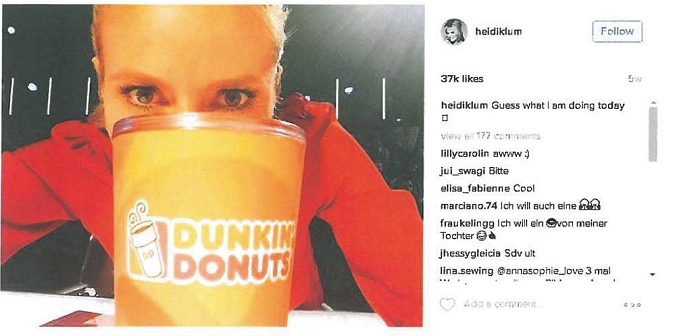
Heidi Klum
Does Heidi Klum really like Dunkin’ Donuts, or was she paid to promote them?


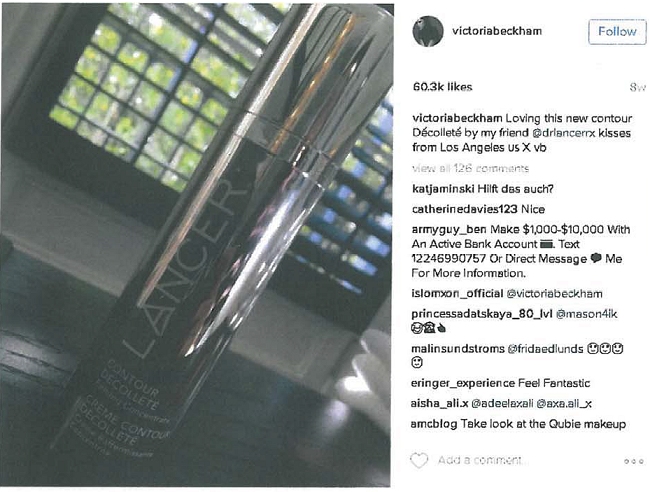
Victoria Beckham
Does this fashionista really use this makeup, or was she paid to say nice things about it?

 
To help separate the honest opinions from the “paid to say it” posts, the FTC’s Testimonial and Endorsement Guidelines require that there be a conspicuous disclosure of any material connection between the endorser (the celeb) and the company that made the product. How often have you seen such a disclosure? Probably rarely if ever. That’s why we say the worst mouse print is the fine print disclosure that is missing in an advertisement.

This past March, the Federal Trade Commission (FTC) sent “warning” letters to close to 100 celebrities and companies “educating” them about the federal rules on disclosing when an endorsement is really a paid advertisement. The FTC could not always tell if there was a financial connection between the celeb and the product manufacturer or not, so the letters were rather gentle. Here are copies of all of them and the names were NOT redacted.

The list of those warned reads like a who’s who in entertainment, including Jennifer Lopez, Lindsay Lohan, Sofia Vergara, Heidi Klum, Victoria Beckham, and even Nicole (Snooki) Polizi. And big companies like Dunkin’ Donuts, Puma, Chanel, and Johnson & Johnson also received greetings from the FTC.

The FTC letter sent a strong message to these celebrity influencers, as they are called. The question is whether they will fess up in future posts.

Share this story:


ADV