There are many people who insist on buying only 100% cotton clothing. Some say they can even tell by the feel against their body if a garment is a blend of cotton and polyester or all cotton. MrConsumer is not that discerning. But, he is sensitive if a product suggests that it is all cotton, but in fact it is not.
Many shoppers buy relatively inexpensive unadorned tee shirts at Michael’s and A.C. Moore, two very large crafting chains. During a recent sale, MrConsumer picked up several at both stores. Depending on the color (apparently) some shirts had a primary label on the top inside just under the collar that said “Heavy Cotton” while others said “Ultra Cotton.”

One might say “great” these are all cotton tee shirts and look no further. But, lifting the brand label to expose the washing instructions and fiber content of three different “Heavy Cotton” colored tee shirts revealed an unexpected surprise:
*MOUSE PRINT:

Even though each shirt had the same “Heavy Cotton” label, the actual fiber content varied from 50-50 cotton/polyester to 90-10 to 100% cotton. There was no rhyme or reason to what “Heavy Cotton” meant in any particular case. The shirts also had a cellophane sticker on them with the words “preshrunk cotton.”
A similar problem was discovered with shirts labeled “Ultra Cotton” :
*MOUSE PRINT:
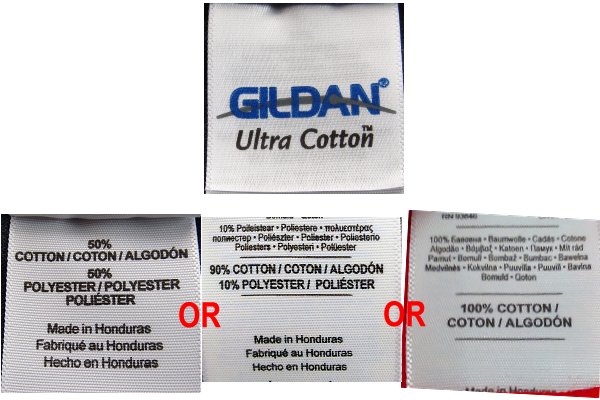
Again, depending on which color shirt you picked up, those labeled “Ultra Cotton” were either 50-50 cotton/polyester, 90-10, or 100% cotton.
The concern is several-fold: shoppers seeing the terms “Heavy Cotton” and “Ultra Cotton” could easily believe these shirts are all cotton. For the more inquisitive shopper who happened to pick up a shirt marked “Ultra Cotton” and noted that it was 100% cotton, that person might reasonably conclude that other shirts marked “Ultra Cotton” were 100% as well.
Mouse Print* asked the manufacturer, Gildan, some very pointed questions about their labeling practices, such as why shirts labeled with a particular name like “Heavy Cotton” or “Ultra Cotton” were not consistent in their fiber content, and did they understand how those labels could mislead shoppers. We also asked how the company’s labeling practices square with federal law that prohibits misleading fiber content labels, and how they square with their own code of ethics that says that the company “will not make false or unsubstantiated representations about the quality or value of our products and services.”
Their Director of Corporate Communications replied, in relevant part:
Gildan is committed to compliance with all regulatory requirements, including the detailed requirements of the many countries where our products are sold. Gildan is also committed to its customers’ satisfaction.
The Heavy Cotton and Ultra Cotton® names are sub-brand names we use to differentiate between collections within two distinct categories of products.
Our labels display clearly all information required to allow consumers to make an informed purchase decision, including fiber content, country of origin, size, care and wash instructions.
Spin aside, the company is capable of playing it straight as evidenced by this “Heavy Blend” label found on one of their sweatshirts, but for whatever reason they don’t use it on these tee shirts.

The lesson here, as in so many other consumer contexts, is “don’t assume” that what you see is what you’ll actually get without more detailed checking and double-checking.