 Certain items come in standard sizes, whether it is mattresses or gallons of milk. At Costco, however, one particular brand of “king size” bed pillows is significantly smaller than standard size.
In the bedding industry, a “king size” pillow is typically 36 inches long by 20 inches wide. And that is exactly what most consumers would expect when buying this twin pack of king pillows, particularly since the bag is labeled KING KING KING and the exact dimensions are right there on the package:
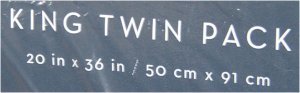
Upon taking the pillows home from Costco, MrConsumer noticed that these king size pillows seemed noticeably smaller than the old ones they were replacing. And checking the manufacturer’s “do not remove on penalty of death” Tyvek tag that was sewn onto the pillow itself confirmed the observation and revealed a surprise:
*MOUSE PRINT:

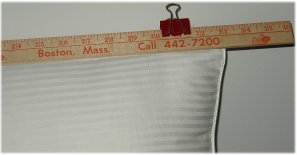
The pillow was indeed two inches shorter than standard king size length and two inches shorter in width. Worse, when actually measuring the length of the pillow, it wasn’t even the 34 inches represented on the legal tag, it was even shorter — 33 inches (and that was stretching the material as taut as physically possible):
Mouse Print* contacted Costco’s PR department for an explanation. Shortly thereafter, a representative from the pillow’s manufacturer responded, in part:
The pillows you are referencing are not sub standard size but rather the top of the line and one of the best values in the market. The law tag you are referring to should have stated the size as 18â€x34â€x2â€. The 2†refers to the size of the gusset on this pillow and as is our industries practice included in the total dimensions. As a company we felt it would be more confusing to the customer stating the dimensions as 18â€x34â€x2†on the polybag. This type of pillow has been sold by us for years and this is the first complaint we have ever received regarding the size.
The fact that the pillow had a side gusset didn’t seem relevant to the issue of the pillow’s shorter length and width, so further inquiry was made of the manufacturer. The representative responded:
In order for the pillows to fit in standardized pillow cases, US manufacturers have to use the total square inches of a pillow in order to size the shell. Once the pillow is placed in a case and the product is compressed (while sleeping), the pillow will expand to the proper dimensions. If not, the product will be too large to fit properly. The US government has also regulated that the actual shell dimensions are to be used on the law tag (a legal document) for compliance. I understand the confusion of conflicting information and maybe we will need to correct the bag moving forward. When measuring the dimensions, they equal, what you are calling a standard size pillow when you include the gusset.
So if you add in the extra height of the pillow, that makes up for the shorter length and width? I don’t think so. Not satisfied that Costco had said nothing about what it was going to do about pillows on its shelves that were in bags marked with dimensions larger than the actual pillows they contained, Mouse Print* prompted the company again for a comment. Their assistant buyer in home textiles responded:
We appreciate your feedback and are indeed reviewing our packaging verbiage addressing the dimensions of our gusseted pillows. Once approved, the revised packaging will be utilized as the current inventory of bags is depleted by our supplier.
One would have expected them to say that in the meantime, they were at least going to put up a sign notifying customers of the discrepancy. Nope.
Now to be fair to Costco and Hollander (the manufacturer), king pillows on the market with gussets are all over the place on sizes. Some say 20 inches by 36 inches on the package and on the sewn-in label. Others put no dimensions on the package and only the word “king”, then show dimensions smaller than 20 x 36 on the label. Still others put 20 x 36 on the package, and a variety of smaller sizes on the label, including 20 x 34 and 18.5 x 34.5.
The best advice if you want a full length king size pillow is to take a tape measure to the store with you because you cannot always trust what the product says.
