In MrConsumer’s American Express Optima bill for February, buried on page seven of a 10 page statement, was a “Notice of Changes to Your Account“. The changes were precipitated by “the challenging environment and the increasing costs of doing business”, the company said. Whenever a credit card company uses the word “changes”, it is a not good thing for customers. It usually means higher prices or lowered benefits.
Typical of most credit card issuers, they give you the new language, but generally don’t explain how the terms are different from before. So, unless you have the cardholder agreement that you received when your card was first issued, you may have no idea how exactly you are being screwed affected.
Besides presumably cutting back on their luggage and travel insurance benefits and raising finance charges for some cardholders, the notice contained an interesting section about telephone communications which is replacing the old one. To see just how it changed, I tried to find my original cardmember agreement, but was unable to. I checked AMEX’s website, and it was not there either. I called an AMEX representative and asked for a copy to be emailed, but alas, they can only do snail mail which will take seven to 10 business days. I also asked him to read a certain portion of it to me. He could not. They don’t even give their own representatives access to the contract that governs the card.
The change I was trying to find out about concerned a deletion of the old “Telephone Communications” section of the agreement, which presumably only said that you agree that they can record telephone conversations you have with them. Here is the substitute language:
*MOUSE PRINT:
“You agree that from time to time we may monitor and/or record telephone calls between you (or Additional Cardmembers on your Account) and us to assure the quality of our customer service or as required by applicable law. You authorize us to call or send a text message to you at any number you give us or from which you call us, including mobile phones. You authorize us to make such calls using automatic telephone dialing systems for any lawful purpose, including but not limited to: suspected fraud or identity theft; account transactions or servicing; offers of American Express products and services; and collecting on your account. You authorize us to place prerecorded calls in connection with the status of your account, or security and identity theft matters. You agree to pay any fees or charges you incur for incoming calls or text messages from us without reimbursement.”
Translation: If you ever gave AMEX your cellphone number or called them from it, you are permitting them to call you or text you on your cellphone, with among other things, advertising messages. And you have to pay the cellphone charges that those calls and texts may incur.
By notifying you of the changed language and coupling that with your pre-agreement to allow AMEX to change their contract with you at anytime, AMEX could easily assert that any laws that may require you to give permission (“express consent”) to receive unsolicited promotional calls on your cellphone have been complied with. One would hope that a court would never let your silence constitute consent in the situation described. [ See basic rules about calling and texting to cellphones. ]
Now back to that conversation with AMEX’s customer service representative. At the end of the call (in which I had never mentioned the specific subject matter in the agreement that I was interested in), he asked if he could update my account with … my cell number! “Like hell,” I said. “I just read the new rules that by giving you that number you can spam me and run up my cell bill.”
Update: American Express has responded to this issue:
We want to point out that Cardmembers do have some choices about receiving communication from American Express:
If a Cardmember doesn’t want to receive marketing offers, including offers via land or cell phones, they can select not to receive them by logging onto americanexpress.com/communications and we won’t contact them with any offers. Of course, we will contact Cardmembers for service related issues, for example if we detect fraud.
We don’t send marketing or promotional offers via text message unless a Cardmember enrolls to receive offers. While we may text a Cardmember for servicing related issues, within the text message Cardmembers are given the option to unsubscribe. — Vice President, Public Affairs

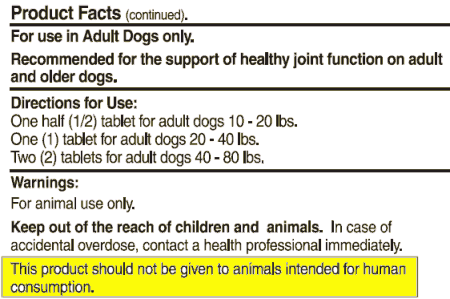
 Recently, a Mouse Print* reader (Faith) who had purchased a bottle of 21st Century K-9 Maximum Joint Formula, wrote a note of concern about a warning she found on the back of the bottle.