Updated every Monday!   Subscribe to free weekly newsletter.

Tropicana: Please Don’t Squeeze the Customer

Manufacturers are rushing to downsize their products as a sneaky way to raise the price without the customer realizing it many times. As this proliferates, we are going to see fewer and fewer standard size products on supermarket shelves.

The quart of mayonnaise has gone by the wayside, as has the three pound tub of margarine. Now it is orange juice’s turn. Typically sold by the quart, half gallon, three quart jug, and gallon, we are beginning to see oddball sizes replace the old standard ones.

Tropicana is the latest to downsize just in the past few weeks. Their three quart jug no longer holds 96 ounces.

*MOUSE PRINT:

tropicana

Seven ounces are gone from the jug. Side by side, the difference in jug shape is obvious, but consumers rarely get to see the old and the new together on a supermarket shelf. While they may notice the shape is different, they may not realize they are getting almost a cup less of oj. According to one supermarket dairy manager, the price has stayed the same.

And as is often the case when a product is downsized, the manufacturer diverts your attention away from the net weight statement by pointing out something new. In this case, they discontinued the old screw cap and added a new flip top one. On second thought, maybe the company just found a new way to screw customers.

A Tropicana customer service representative explained the company’s position:

The downsizing from 96 to 89 ounces wasn’t a decision we took lightly. As you are aware, oil costs have skyrocketed. Oil is used to make plastic bottles, fuel our factories, and ship our juice across the country in refrigerated trains and trucks. We had the choice to either increase prices or to downsize the bottle. We chose to downsize the bottle but add value through the innovation of the SNAP cap and new bottle, which consumers were seeking.

Although you may not agree with our decision, we hope you can appreciate that they were made in the best interest of our consumers and shareholders.

Share this story:


ADV
Updated every Monday!   Subscribe to free weekly newsletter.

Bayer with Heart Advantage: Not a One a Day Aspirin

You may have seen TV and print ads for a new low dose aspirin called “Bayer Aspirin with Heart Advantage.”  It is an 81 mg aspirin combined with an ingredient that can lower your cholesterol.

With about 50 million Americans taking daily aspirin therapy to reduce the risk of heart disease, what a great idea (seemingly) to incorporate an ingredient that can also lower cholesterol.

Bayer

There is just one little problem with this little pill.

*MOUSE PRINT:  At the bottom of the ad, in fine print, (magnified below) is this advisory:

Bayer

Translation: In order to get the cholesterol lowering benefits of this pill, you need to take two of these 81 mg pills a day – twice the typically recommended 81 mg. dose of aspirin. (The most common dosage for daily aspirin therapy is 81 mg. because larger doses can cause internal bleeding, and are no more effective.)

A spokesperson for Bayer confirmed the necessity of taking two caplets in order to receive the cholesterol lowering benefits promised, but said,

… 162 mg is well within the accepted low dose range of aspirin therapy of from 50 to 325 mg … We advise patients to ask their physician before they start Bayer Heart Advantage…

One only has to wonder how many people will grab this product, take their regular single 81 mg pill as usual thinking they were getting “more heart protection” when they are not. Why didn’t Bayer just put the full 800 mg of phytosterols necessary to get a heart advantage in a single 81 mg aspirin caplet and thus avoid mis-dosing?

“The FDA claim specifies that ‘the daily dietary intake of plant sterol or stanol esters should be consumed in two servings eaten at different times of the day with other foods.’ The health claim also says that dietary supplements or food containing at least 400mg per serving of free phytosterols, eaten twice a day with meals for a daily total intake of at least 800mg, as part of a diet low in saturated fat and cholesterol, may reduce the risk of heart disease by lowering blood cholesterol.” — Bayer spokesperson.

To emphasize that the dosing is different for this product, Bayer should put a conspicuous disclosure on the front panel that says “Take one twice a day,” and not merely rely on the fine print instructions on the back.

Share this story:


ADV
Updated every Monday!   Subscribe to free weekly newsletter.

Free Sample: No Obligation to Buy?

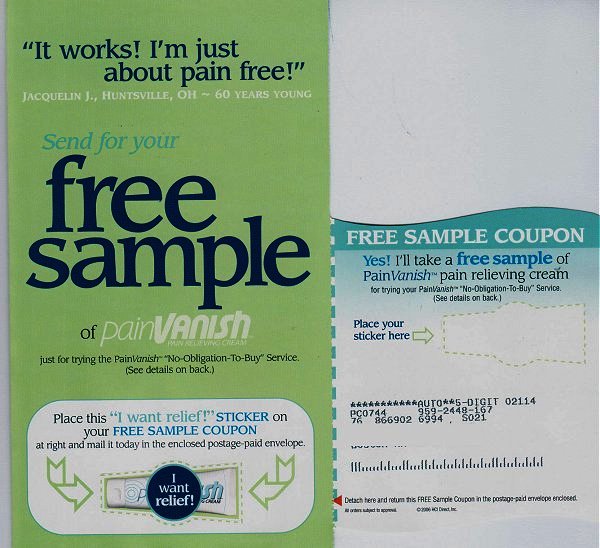
pain cream smallWho doesn’t like free samples, right? So when this offer of a free sample of PainVanish pain relieving cream arrived, a Mouse Print* reader was anxious to give it a try.

It promised to bring “freedom from your aches and pains.” And all you have to do is cut out the little “I want relief” sticker and place it on the free sample coupon for mailing back to the company.

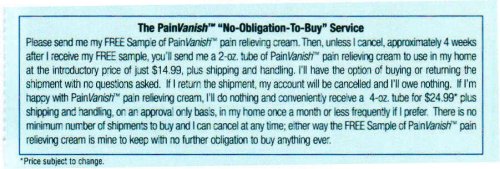
There is small print repeated multiple times that says the free sample is just “for trying our ‘No-Obligations-To-Buy’ Service”. While one might reasonably conclude that the sample you are going to get is the way this company will try to induce you to place future orders if you like the product, they have something else planned. This disclosure is on the back of the brochure, not the back of the tear off coupon:

*MOUSE PRINT:

pain cream string

Translation: This is really a “pain cream of the month” club. If you don’t tell them to cancel, a month after your free sample arrives, you will first get a two ounce tube of cream for $14.99 plus unspecified shipping and handling charges, and then every month thereafter you will get a four ounce tube for $24.99 plus shipping and handling. You are not just getting a simple free sample by replying to this offer.

Negative option plans such as this are required to clearly and conspicuously disclose the continuing nature of the offer and to get you to affirmatively agree to it. Whether this disclosure meets that test is for a judge to decide.

This pain relief offer may turn out to be a pain itself if you didn’t read the fine print.

Share this story:


ADV