SharkNinja, the maker of Ninja cookware, claims that the nonstick coating sprayed on their pots and pans is heated to 30,000 degrees so that it won’t stick, chip, or flake.
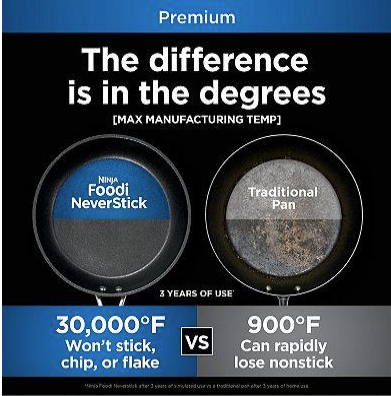
There’s just one problem with that claim according to the consumer who is suing the company. Her complaint says in part…
*MOUSE PRINT:
The “difference is in the degrees” and 30,000ºF claim is as deceptive as it is preposterous. According to NASA, as presented at the Triennial Earth-Sun Summit, “the surface of the sun is a blisteringly hot 10,340 degrees Fahrenheit…”. Defendant would have the average consumer believe that their nonstick pans are manufactured at a temperature that would vaporize the aluminum pan base metal into gas.
This is not the first time that Ninja’s nonstick cookware has come under fire (so to speak). In 2021, the National Advertising Division (NAD) of the BBB ruled that their “never stick” claims were false and misleading because such claims “reasonably convey an unsupported superiority message that, unlike traditional non-stick cookware which rapidly loses its non-stick properties, NeverStick cookware would exhibit a greater level of resistance against sticking, chipping, and flaking.”
Also in 2021, in an unpublished Mouse Print* story, we found that the company was misleading shoppers about it’s lifetime warranty because its idea of “lifetime” is five years, not what the average shopper would expect.
*MOUSE PRINT:
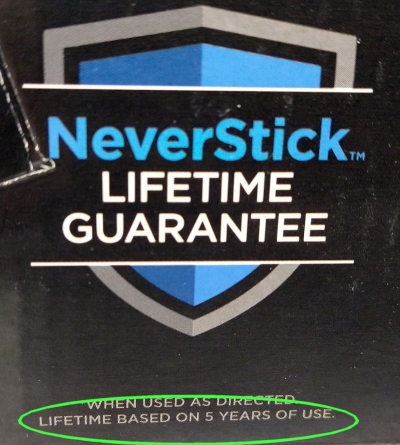
The NAD also addressed the lifetime guarantee issue in its 2021 decision.
NAD also recommended that SharkNinja discontinue claims that NeverStick has a “lifetime guarantee.” NAD determined that a reasonable takeaway from such claims is that the product’s useful life is far longer than the five years for which it is guaranteed…
SharkNinja has been the subject of multiple NAD cases by competitors alleging that the company makes misleading claims for their products. As a company headquartered here in Massachusetts, it is about time that our attorney general got out of the frying pan and into the fire to review this company’s advertising practices.


 A common ploy used by detergent and fabric softener manufacturers is to exaggerate the number of wash loads you get out of each bottle.