Updated every Monday!   Subscribe to free weekly newsletter.

HP Sued Over Printers That Won’t Scan or Fax When Ink Is Low

Two consumers who bought Hewlett-Packard (HP) all-in-one printers are suing the company after they discovered that their machines would not scan or fax when it was low on ink or empty.

HP all-in-one

Of course, neither scanning nor faxing requires any ink in order to accomplish those tasks.

This case is essentially similar to a complaint filed against Canon last year where a consumer claimed that his printer stopped scanning when his ink cartridges were low or empty. [See story.]

*MOUSE PRINT:

The lawsuit against HP claims:

6. What HP fails to disclose is that, if even one of the ink cartridges is too low or empty, the scanning function on the “all-in-one” printer will be disabled and will not work as advertised (hereinafter, the “Design Flaw”).

7. None of HP’s advertising or marketing materials disclose the basic fact that its All-in-One Printers do not scan documents when the devices have low or empty ink cartridges.

12. HP’s intent is clear, namely, to have their multi-function devices revert to an inoperable “error state” so that a large subset of those multi-function device purchasers will purchase additional overpriced and unnecessary ink cartridges in order to be able to scan and to fax documents. The end goal is to increase the sales of one HP’s largest profit makers, ink.

So the consumers are suing for misrepresentation, breach of warranty, and unfair or deceptive practices.

A related issue alleges that some HP all-in-one printers won’t scan when their ink cartridges have plenty of ink but have expired. That was reported by two of our readers last year but is not raised in this lawsuit.

Share this story:


ADV
Updated every Monday!   Subscribe to free weekly newsletter.

The Subway Tuna/No Tuna Saga Continues

For the past year and a half, two California consumers have doggedly pursued Subway, the sub sandwich restaurant chain, claiming that its tuna subs contained no tuna according to their laboratory tests. (See our first story.)

The case brought headlines worldwide.

Subway Tuna Headlines
.

After some media conducted their own tests and one found real tuna in Subway’s tuna sandwiches, the consumers withdrew the case and filed an amended complaint claiming that their tuna was not 100% sustainably caught skipjack or yellowfin tuna. (See our third story.)

A judge dismissed the case, and then the consumers refiled a new one, now claiming they tested 20 samples from all over California, and only one contained tuna. (See our fifth story.)

The company has consistently denied the allegations and recently moved to have the current case dismissed again.

The judge made his ruling last week.

*MOUSE PRINT:

As Subway correctly notes, the amended complaint contains no facts pertaining to Dhanowa [one of the two consumers suing Subway]; it “does not allege that she purchased any Subway products, does not allege that she relied on any statements that Subway made and does not allege that she suffered any harm.” ECF No. 57 at 9. Plaintiffs do not respond to this argument. The Court therefore grants Subway’s motion to dismiss Dhanowa’s claims.

So Subway wins on that score, getting rid of one of the two plaintiffs.

The judge continued:

…the Court will not dismiss the allegation that the tuna products contain “other fish species, animal species, or miscellaneous products.” Moreover, even if the Court accepted Subway’s statement that all non-tuna DNA must be caused by cross-contact with other Subway ingredients, it still would not dismiss the complaint on this basis.

Finally, the complaint alleges that the products “wholly lack[] tuna as an ingredient.” Because a reasonable consumer would expect that a product advertised as “tuna” to contain at least some tuna as an ingredient, the Court also denies the motion to dismiss this theory.

The Court finds that the complaint “as a whole” is sufficiently specific about what is false and why. It states that the “tuna” description is false either because there is no tuna in the products and/or because there are ingredients that a reasonable person would not expect to find in an item described as “tuna.” That is enough.

In summary, the judge felt the one remaining consumer theoretically does have a case if she can prove that Subway tuna sandwiches are not 100% tuna (except for mayonnaise, bread, etc.) or contain unexpected non-tuna components.

No date has been set for the trial. We’ll keep an eye on the case.

Share this story:


ADV
Updated every Monday!   Subscribe to free weekly newsletter.

What? Barilla Pasta Is Not Made in Italy!

Two California consumers are suing Barilla claiming they were misled into believing that many of the company’s products were made in Italy and from ingredients sourced in Italy.

How did they get that impression? They say it was right on the front of the box: “Italy’s #1 brand of pasta.” And they even adorn that claim with the colors of the Italian flag.

Barilla front of box

The consumers’ lawyers go on to assert in the complaint that the reasonable inferences they made based on that were false.

*MOUSE PRINT:

However, contrary to this labeling, the Products are not made in Italy, the Products’ ingredients are not from Italy, and the Products are not manufactured in Italy. Rather, the Products are made and manufactured in Iowa and New York, with ingredients (such as the main ingredient, durum wheat) sourced in countries other than Italy.

The consumers say they wouldn’t have paid as much for the product, or not purchased it all had they known the true facts.

The consumers’ lawyers also refer to numerous Italian references on the Barilla website, including on the homepage where it says that Barilla is “an Italian family-owned food company.” However, a bit disingenuously, they also assert that the consumers were bamboozled because:

Plaintiff Sinatro has no way of determining whether the Challenged Representation [suggesting it was made in Italy] on the Products is true.

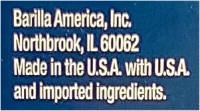
Well, had these consumers just looked at one of the side panels of the box, they would have seen the actual origin of the product. Of course, no one is suggesting that a shopper has some obligation to read the six sides of every package before they buy it.

*MOUSE PRINT:

Barilla Made in USA

The lawyers accuse the company of false and misleading representations among other claims. They are seeking refunds for consumers, punitive damages, an injunction to stop the company from continuing its allegedly misleading practices, and an order for them to commence a corrective advertising campaign to dispel the notion that the products come from Italy.

What is your impression of Barilla? Had you believed it was imported from Italy?

Share this story:


ADV