Updated every Monday!   Subscribe to free weekly newsletter.

Goli Gummies Dealt Bitter Pill on Claims

Recently the National Advertising Division (NAD) of Better Business Bureau National Programs came down hard on Goli Nutrition, the maker of those apple cider vinegar (ACV) gummies that are advertised on TV and on their website.

The product seemed like a sweet alternative for those who take several doses a day of traditional liquid ACV to control their acid reflux. Even diluted with water, drinking ACV is not pleasant.


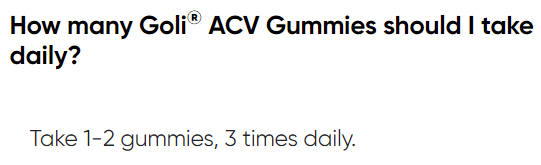
Goli 3 times a day

Given the small dose recommended by the company, of particular concern were their broad claims like, “Finally a delicious way to get all the benefits of apple cider vinegar.”

*MOUSE PRINT:

In its decision

NAD recommended that the advertiser discontinue or modify its advertising to avoid conveying the unsupported message that the amount of ACV contained in its gummies is associated with the health benefits of traditional liquid ACV.

Further, NAD found that the recommended dosage statement, “1 to 2 gummies 3x day,” in the context of its advertising conveyed the unsupported implied message that the recommended dosage provides the nutritional and health benefits associated with the recommended dose of traditional ACV and recommended it be discontinued.

During the proceeding before the NAD, Goli agreed to voluntarily discontinue the claim it made in several of the challenged advertisements that two Goli gummies were the equivalent of one dose of traditional apple cider vinegar. Nonetheless, it is appealing NAD’s decision. But that is not the end of the controversy for Goli. These and other issues are supposedly the subject of pending federal litigation.

Share this story:


ADV
Updated every Monday!   Subscribe to free weekly newsletter.

At CVS, You May Get Shortchanged Using Multiple Coupons

CVS logoA Consumer World reader, M.D., wrote to say that CVS shortchanged him recently when he went to purchase a pair of Dr. Scholl’s insoles after applying various coupons.

In particular, M.D.’s order included a Dr. Scholl’s product with a $21.49 regular price. He tendered two coupons: a $5-off Dr. Scholl’s manufacturer’s coupon and a CVS 50% off coupon on any one non-sale item. (To simplify this example, we are omitting CVS ExtraBucks credits, other account credits and sales tax that would otherwise apply in our consumer’s actual transaction.)

M.D. was expecting to get the Dr. Scholl’s insoles for around $5.74:

    $21.49 Dr. Scholl’s regular price
-$10.75 50% off CVS coupon
$10.74 Price after 50% off
         -$5.00 $5 manufacturer’s coupon
=================================
$ 5.74 net price

Instead, according to his receipt, he was charged $8.24:

$21.49 Dr. Scholl’s regular price     
-$5.00 $5 manufacturer’s coupon
           $16.49 Price after mfr. coupon deducted
-$ 8.25 50% off CVS coupon          
==================================
$ 8.24 net price

The difference in those two totals is caused by the order in which the discounts were applied. If the percent-off discount is applied first followed by the deduction for the dollars-off coupon, the consumer comes out ahead and pays a lower price. If the dollars-off coupon is applied first followed by the percent-off discount, then the store comes out ahead and the consumer pays more. It’s simple math.

In our consumer’s example, CVS programmed its checkout system to use the second method saving it $2.50 on the transaction. It doesn’t matter the order the consumer presents the coupons to the checkout clerk because the checkout system juggles the order to the company’s benefit. And the CVS coupon policy says they can do just that:

*MOUSE PRINT:

coupon policy

CVS’ internal policy of ordering the coupons to its own benefit is not uncommon. Kohl’s, which offers percent-off and dollars-off coupons simultaneously,does it the same way — dollars-off coupons first, then percent-off coupons. The difference is that Kohl’s clearly discloses this method in their coupon acceptance policy and they don’t accept manufacturers’ coupons.

In our consumer’s particular case, there is an additional important distinction to be made. The $5 off coupon he presented was a manufacturer’s coupon and the 50% off coupon was a CVS one. We believe, as does M.D., that CVS should not get an extra benefit because the consumer also tendered a manufacturer’s coupon. They offered 50% off the regular full price of an item via their own coupon, and it was their obligation to do just that. Instead, contrary to the terms of the coupon, they only gave the consumer 50% off a reduced price.

If the consumer was savvy enough to use a manufacturer’s coupon to save more, good for him. After all, the store is getting that full $5 back from the manufacturer no matter what. Now, had both coupons been from CVS, there is a stronger argument to be made since both discounts were coming out of the store’s own pocket that the store can decide in what order they are applied.

We asked the PR folks at CVS to comment on this case, and whether they will change the company’s algorithm to apply a store coupon first when a manufacturer’s coupon is also tendered.

Their PR spokesperson’s reply in relevant part only restated the company’s policy:

As outlined in CVS Pharmacy’s coupon policy which is included both online and in each store, we reserve the right to process coupons in any order.

We think CVS missed an opportunity to stand back and re-evaluate its coupon acceptance policy to make it more fair for customers.

Share this story:


ADV
Updated every Monday!   Subscribe to free weekly newsletter.

Candy Box Slack-Fill Case Dismissed

Judges are not looking favorably on consumer cases against candy manufacturers who only fill their boxes halfway.

When manufacturers over-package a product creating empty space inside that has no function other than to make consumers think they are getting more for their money than they really are, that is called slack fill, and it’s illegal under federal law (and the law of some states). It is not illegal if the empty space is needed because of settling of the product, or because the machinery to fill the package requires it, or the space is needed to protect the product (such as the cushioning pillow created by large potato chips bags).

A federal court judge just let Tootsie Roll off hook for its five-and-a-half inch high boxes of Junior Mints that are close to half empty inside.

*MOUSE PRINT:

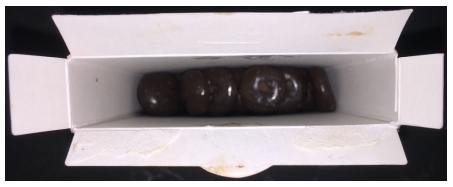
Junior MintsJunior Mints inside

Note that the illustration with a ruler is of a revised box introduced after the lawsuit ended that states on the front the minimum number of mints inside.

In ruling against the consumer who brought the case, the judge said in part in his opinion:

To begin, the Products contain a disclosure that the Products are sold by weight, and not volume, which addresses the very information that Plaintiff alleges was misrepresented.

Furthermore, the net weight of the candy, both in metric and standard measurements, is displayed on the front of the Products’ boxes in easily discernable font.

And citing some other related cases, the judge adopted their conclusions:

“the slack-fill enclosed in [a box of Junior Mints] would not mislead a reasonable consumer” because the Junior Mints’ boxes included the net weight of the candy and consumers have come to expect some slack-fill in certain products…

…a consumer “can easily calculate the number of candies contained in the Product boxes simply by multiplying the serving size by the number of servings in each box, information displayed in the nutritional facts section on the back of each box.”

What’s troubling is the judge’s reasoning that since the net weight is stated on the package (as all packaged food products are required to) that somehow makes irrelevant that the product is packaged in a box that makes it look like it contains more content than it really does. What is the point of the slack-fill law if over-packaging like this is continued to be allowed?

Share this story:


ADV