 They look like great bargains in the weekly supermarket flyer: chicken breasts $1.97 a pound and bags of large shrimp for $5.97.
But If you are a digitally-disconnected senior citizen, a lower income person, or someone of any age not technically savvy, you may pay more for grocery specials like these because supermarket chains across the country are increasingly making some of their better sale items “digital-only,” according to a review by Consumer World.
Historically, in order to take advantage of all the sale items featured in a chain’s weekly circular, all shoppers had to do at most was to show their loyalty card to the cashier. Now some prominent supermarket chains are adding an extra step that requires internet access. Shoppers who want to buy any item flagged as a digital deal must in advance preselect and load it into their online account on the store’s website or app in order to get the advertised sale price in the store.
This extra technical hurdle disproportionately hurts digitally-challenged seniors in the pocketbook because they are the least likely to have internet access or a smartphone. In fact, according to a 2021 study by the Pew Research Center, 39 percent of those 65 and over do not own a smartphone, and 25 percent don’t use the internet. Lower income people lack online access to a similar degree. This means that millions of seniors and others can’t take advantage of digital-only deals.
Compounding the problem, in the past year, some supermarkets are now extending digital-only deals beyond dry groceries to meat, fish, poultry and produce. These items often replace some conventional weekly specials and are given prominent placement in their advertising flyers.

Among the 50+ supermarkets checked by Consumer World, two-thirds of them advertise some weekly digital-only deals, including at Albertsons, Acme, Baker’s, Dillons, Fred Meyer, Frys Food, Food Lion, Jewel Osco, Kroger, Pick ‘n Save, Ralphs, Randalls, Safeway, Shaw’s, ShopRite, Smart & Final, Smith’s, Star Market, Stop & Shop, and others.
“Digital discounts are no deal for many seniors. They are a clever ploy by big supermarket chains to get people into the store knowing full well that many of them will wind up paying more than the advertised price,” commented Edgar Dworsky, a consumer advocate and founder of Consumer World. “A substantial number of shoppers don’t have online access, don’t understand how to take advantage of digital offers, or won’t be able to follow the cumbersome online procedure no matter what their age is.”
This month, to find out about their policies and any alternative means of obtaining digital-only deals, Consumer World contacted a number of supermarket chains including Albertsons Companies and The Kroger Co. that combined own 5,000 stores operating under about 40 supermarket nameplates. They offer digital-only deals in at least some of their divisions. Neither Albertsons nor Kroger corporate responded. Stop & Shop (a unit of Ahold Delhaize) confirmed it “does not offer an alternative to digital coupons at this time,” but ignored the tougher questions.
Calls to the customer service departments of Albertsons Companies and The Kroger Co. provided the expected response, similar to instructions on their websites: You must load the digital offers onto your loyalty card account online to obtain the savings. Call center representatives at both companies said that there is no non-internet alternative currently available. One said, “We get calls every day” asking for an offline way to take advantage of weekly digital specials.
*MOUSE PRINT:
Sample supermarket FAQ about digital-only offers:
Q. Can I still take advantage of these coupons if I don’t have a smart phone or a computer?
A. These coupons are only available electronically. Manufacturers continue to offer paper coupons through local newspapers.
Informal conversations with store employees provided more insight. One head cashier said she was sure many people don’t understand the advertised digital offers and mistakenly believe that just using the loyalty card would give them the sale price. She said her chain doesn’t allow cashiers to provide the digital discounts directly to customers.
There are some bright spots, however, in dealing with this digital dilemma. Not all chains have adopted digital-only deals and many are using them sparingly. A few chains such as Giant Food use “clip or click” coupons in their weekly ads that allow the customer to choose their preferred redemption method. Texas-based H-E-B provides physical coupons in-store for those who do not use the Internet. And store-level customer service employees at multiple chains said that its cashiers or help desk workers can provide the discounts if asked despite the official policy.
The use of digital-only offers appears to be accelerating. (These in-circular digital deals are separate from stores offering digital versions of manufacturers coupons on their website.) A closer look at 10 of the 50+ chains checked reveals that most doubled or tripled the number of digital-only deals offered in June 2022 compared to the same week last year. Some are even advertised in-store like the chicken above, or on the ice cream shelf tag below. Any shopper without a smartphone will pay much more because they have no way to load the offer onto their account.
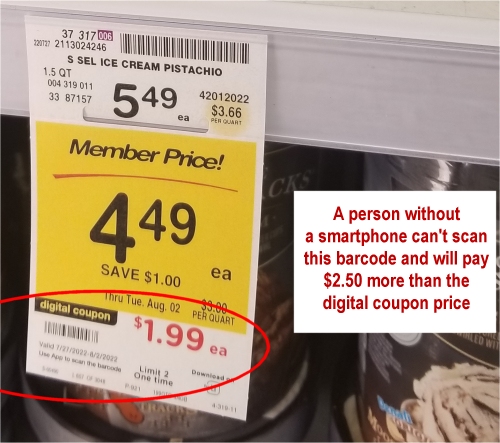
“With inflation at a 40-year high, it’s time to stop discriminating against the digitally-disconnected, particularly seniors, and offer them the same discounts already enjoyed by tech-savvy shoppers,” urged Dworsky in a plea to supermarket executives. “Many, if not most seniors are on fixed incomes and need all the financial help they can get.”
What do you think? Should supermarkets make digital deals available to those without internet access? Please add your comments below.
Here are sample digital only deals from some leading supermarket chains:
 Click graphic above TWICE to enlarge



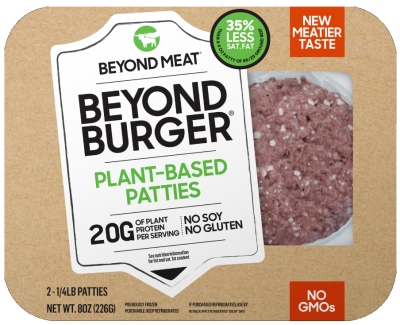 Six Illinois consumers are suing Beyond Meat, one of the leading makers of plant-based burgers and other meat substitutes, alleging that the company overstates the amount of protein in most of their products. It goes on to assert that the “daily value” percentage (“DV”) representing how much protein the product contributes to meeting the government’s daily requirement for protein is grossly exaggerated.