Updated every Monday!   Subscribe to free weekly newsletter.

AMEX Cash Back Offers: Too Good to Be True?

American Express is known for promoting very generous cash back offers such as ones that provide $10 back if you spend $10 or more at a small business. Here are some other recent examples, good deals for sure:

Amex typical offers

Last week, however, people on a bargain discussion board couldn’t believe their eyes when some of them found this offer in their AMEX account:

*MOUSE PRINT:
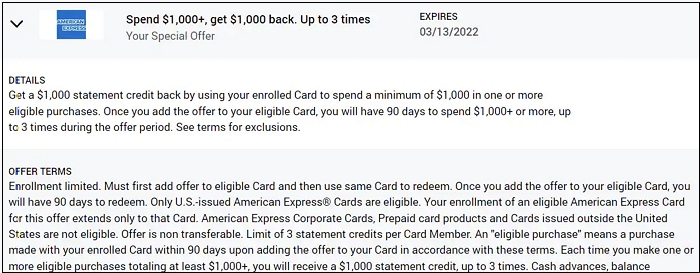
Amex 1000 off 1000

That’s right, spend $1,000 in one or more purchases and American Express will give you back a $1,000 statement credit. And you could do it three times! People couldn’t believe it. Then it got even crazier as other people checked their accounts. Most got nothing or a promise of bonus points. But others hit the jackpot, like this lucky cardholder.

*MOUSE PRINT:
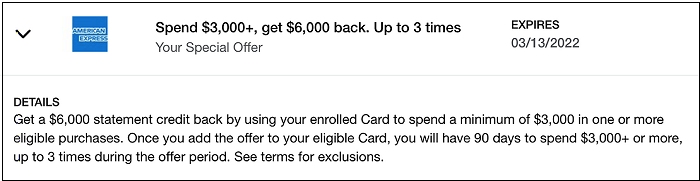
AMEX 6000

Holy ****. Spend $3,000 and get back $6,000!? Keep in mind, this is on the genuine American Express website on a page of offers you see only after you log in to your account. People speculated that the company had been hacked, or there was a typo because the payback was probably meant to be “points” rather than “dollars,” or that some rogue employee decided to maliciously take revenge on the company. Others thought it was real, kept screenshots of the offer they signed up for, and hoped that AMEX would make good on it.

We asked the PR folks at American Express for an explanation. A spokesperson for the company told Consumer World:

“Due to a technical error, a small number of American Express Card Members were shown and subsequently enrolled in a statement credit offer for an incorrect amount. We quickly caught the error and removed the offer. American Express will honor this offer for the limited number of Card Members who enrolled.”

Wow! Hat’s off to American Express for honoring the erroneous offers. And merry Christmas to the several hundred cardholders who were lucky enough to get and enroll in them before they were pulled.

Share this story:


ADV
Updated every Monday!   Subscribe to free weekly newsletter.

Delta to Economy Fliers: No Miles for You!

DeltaLast week, Delta quietly changed a policy so that basic economy class tickets purchased on or after December 9, 2021 would not longer earn frequent flier miles in their SkyMiles program. This big policy shift was not announced in a press release but rather via a fine print asterisked footnote on its website.

Here is a page from Delta’s website as of December 8 explaining how to earn frequent flier miles:

Delta Dec 8

And here is the same page a day later on December 9 with an added footnote.

*MOUSE PRINT:

Delta Dec 9

What a difference a day makes. For flights on or after January 1, 2022, basic economy passengers will no longer earn five miles for every dollar spent nor any miles at all.

What a sneaky way to take away a benefit that has existed for decades and decades.

Hat tip to Points Guy who first reported this discovery.

Share this story:


ADV
Updated every Monday!   Subscribe to free weekly newsletter.

Is Godiva Chocolate Really Made in Belgium?

Back in September, we told you about the court case of King’s Hawaiian sweet rolls, whose packaging and advertising says “Est. 1950” and “Hilo, Hawaii” under the brand name suggesting that it was manufactured in Hawaii when in fact it was made in California. (See original story.) Most readers thought there was no case here.

Now fast forward a few months to a similar suit [see complaint] where consumers are claiming that Godiva is misrepresenting their chocolates as being made in Belgium when in fact they are manufactured in Pennsylvania. They cite as evidence that the phrase “Belgium 1926” is depicted under the brand name on every chocolate package, each one says “Belgian chocolate,” and the term is used on signs on their buildings and is included in advertising.

Godiva chocolate

In court, the company made a motion to have the case dismissed. The judge denied most of their request in his ruling, saying…

*MOUSE PRINT:

Courts apply the “reasonable consumer” standard to determine whether a representation is false or deceptive under each of the relevant New York and California consumer-protection statutes.

Godiva also contends that the word “Belgium” is inextricably linked to the year “1926,” and the latter “cures any likelihood of deception,” in its labeling. It argues that for a consumer to be deceived into thinking “Belgium 1926” represents that the products [were made] in Belgium, the consumer must also believe that the products she is purchasing were made almost one-hundred years ago -— a clearly unreasonable belief. This argument, however, is too clever by half.

A consumer could reasonably believe that Godiva was founded in Belgium in 1926, as Godiva contends, and that the representation on its products of this heritage means that its products continue to be manufactured in that location.

With that, the judge allowed the case to move forward.

So what do you think? Do the consumers have a good case this time?

Share this story:


ADV