Updated every Monday!   Subscribe to free weekly newsletter.

Haagen-Dazs Allegedly Cuts Corners With Milk Chocolate

Haagen-Dazs is one of the premier brands of ice cream, so it is surprising to hear of a lawsuit alleging that the company is cutting corners on the milk chocolate it uses to coat its ice cream bars.

Haagen-Dazs bars

According to the complaint, the company mixes in coconut oil to the milk chocolate.

*MOUSE PRINT:

Haagen-Dazs ingredients

And under federal regulations, if milk chocolate has an optional ingredient in it like vegetable oil, then it must be labeled as “milk chocolate and vegetable fat coating” or “milk chocolate and ___ oil coating.”

The problem is that Haagen-Dazs doesn’t do that on the principal display panel, but only in the fine print ingredients statement.

As such, the lawsuit contends that consumers are misled, they wouldn’t have paid as much for the product, or would not have purchased it all.

For its part, Froneri, US Inc., the maker of these chocolate bars, said “The labels on our Häagen-Dazs ice cream bar products accurately describe the products, comply with FDA regulations, and provide consumers with the information they need to make informed purchasing decisions.”

Companies have to use an emulsifying agent like coconut oil to more easily coat the ice cream in a hard chocolate layer.

We’ll let you know how the case turns out.

Hat tip to Truth in Advertising for the case.
Updated every Monday!   Subscribe to free weekly newsletter.

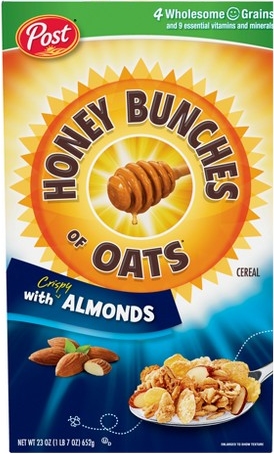
Where’s the Honey in Honey Bunches of Oats?

Honey Bunches of OatsFor years, we’ve all seen the commercials for Post’s Honey Bunches of Oats cereal where the female assembly line worker waxes poetic about her crispy crunchy bunches.

Last year, a health-conscious California consumer bought a box of this cereal thinking that honey would be a more healthy sweetener to have rather than sugar or corn syrup. Soon thereafter he learned (probably from a class action lawyer rather than a nutritionist) that the product in fact had almost no honey.

A check of the ingredients statement on the side of the package revealed the not-so-sweet truth.

*MOUSE PRINT:

Honey Bunches of Oats Ingredients

There are three other sweeteners in the product — sugar, corn syrup and molasses — all of which are in greater amounts than any honey. In fact, there was more salt in the cereal than honey. (Barley malt extract is also a sweetener, incidentally.)

So our consumer sued Post claiming false advertising and misrepresentation. He believed the packaging conveyed the impression that honey was either the only sweetener or certainly a significant one in the product.

Post argued among other things that no reasonable consumer would understand that the cereal’s packaging was making a claim about the amount of honey in the product. MrConsumer always loves when a company tries to assert that only stupid consumers would believe the baloney the manufacturer shows and tells them right on the package.

The company asked the judge to dismiss the case, but she sided with the consumer in her procedural decision.

In applying the reasonable consumer standard, however, the packaging must be considered in context. That is, the image of a radiating sun, the words “HONEY BUNCHES OF OATS,” and the honey dipper dripping honey occupy about two-thirds of the front of the packaging. Although the package does not make any objective representations about the amount of honey in the cereal, a reasonable consumer could see the prominent honey-related words and imagery and be deceived into thinking the cereal contained relatively less refined sugar and more honey. If so misled, the reasonable consumer is not expected to pick up the product and examine the fine print of the ingredient list. –Judge Yvonne Gonzalez Rogers, U.S. District Court

And so the case moves forward. We’ll keep you “Posted,” so to speak.

Updated every Monday!   Subscribe to free weekly newsletter.

Purell Maker Sued for Unsubstantiated Claims

Purell labelJust at the time when consumers nationwide are clearing the store shelves of Purell comes word that the Food and Drug Administration and several private lawsuits are charging the company with making unsubstantiated health claims for its products.

In January, the FDA sent a warning letter to GOJO Industries alleging that as marketed and advertised PURELL® Healthcare Advanced Hand Sanitizers are unapproved new drugs because of claims like:

  • “Kills more than 99.99% of most common germs that may cause illness in a healthcare setting, including MRSA & VRE”

  • “In a recent study, student absenteeism was reduced by 51% when PURELL hand hygiene products were used in conjunction with a curriculum to teach kids about good hand hygiene[] . . . 10% Less Teacher Absenteeism”

  • “Even though norovirus is highly contagious, there are ways you can reduce the risk of its spread. … Alcohol-based hand sanitizers with at least 60% alcohol can be used in addition to handwashing . . .”

  • “Is PURELL® Advanced Hand Sanitizer Effective Against Ebola? … [WHO and the CDC] are recommending the use of alcohol-based hand sanitizer as a preventive measure during this outbreak . . .”
  • The FDA goes on to say that claims like these suggest that Purell is intended to prevent or reduce disease from Ebola, norovirus, and the flu, but the agency is not aware of any studies that correlate killing bacteria or viruses on the skin with a corresponding reduction of those diseases. As such, because Purell is intended for the “diagnosis, cure, mitigation, treatment, or prevention” of disease and thus by definition that makes it is a drug. And an unapproved new one at that. New drugs need to be FDA-approved before being sold.

    The maker of Purell posted a response to the FDA on its website, saying in part:

    It is our responsibility to ensure that we comply with all requirements of FDA regulations and federal law, and we take that responsibility very seriously. To that end, we have begun updating relevant website and other digital content as directed by the FDA and are taking steps to prevent a recurrence.

    At least three consumer class action lawsuits (most recent one here) have been filed against GOJO claiming consumers were misled because the company made 99.99% effectiveness claims without having reliable substantiation.