Updated every Monday!   Subscribe to free weekly newsletter.

You’ll Never Guess the Main Ingredient in These Stouffer’s Meals

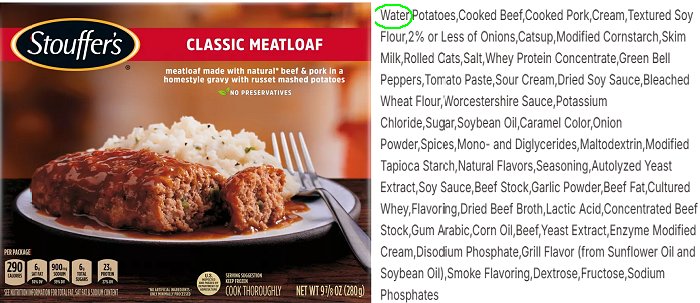
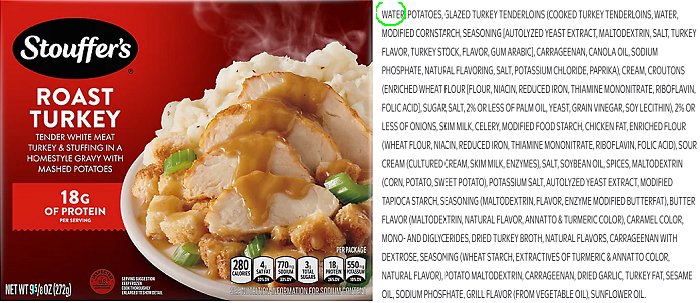
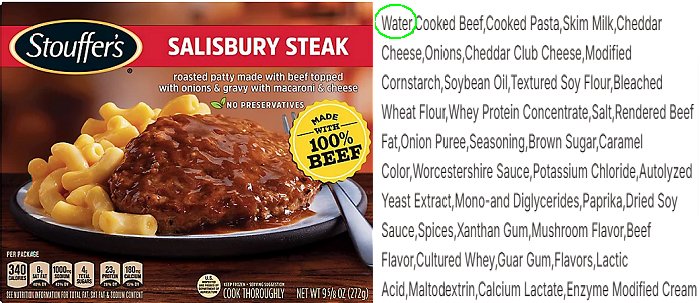
In MrConsumer’s mind, Stouffer’s is a respected name brand of frozen food. So it came as a big surprise when he learned that some of their meals like roast turkey, salisbury steak, and meatloaf all had the same first ingredient. How can that be?

Can you guess the first ingredient of all these meals?

*MOUSE PRINT:

Stouffer's meatloaf

Stouffer's turkey

Stouffer's salisbury steak

How is that possible? We asked the company for an explanation, but they never responded.

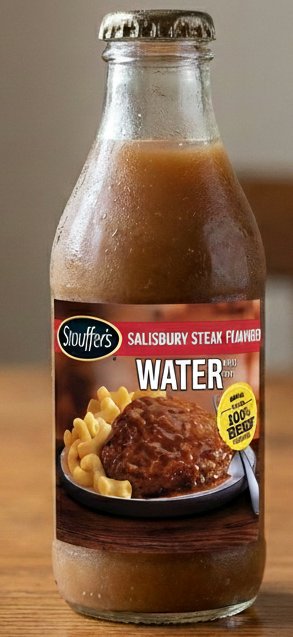
So maybe the company should rename those products to various varieties of meat-flavored water:

Stouffer's Salisbury Steak Flavored Water

Happy holidays. The next new Mouse Print* story will be published on Monday, January 5th.

Updated every Monday!   Subscribe to free weekly newsletter.

Hey Campbell’s, Where’s the Beef?

The Campbell Soup Company was recently sued by a New York consumer who said she was misled by Campbell’s Chunky soup label “Beef with Country Vegetables” which has more vegetables than beef.

*MOUSE PRINT:

Campbell's Chunky Beef & Veg

The ingredients statement above shows that there is more water, carrots and potatoes in the can than beef. In fact, the entire 18.8 ounce can has 15 grams of protein, which is only about two ounces of beef!

One has to wonder if Campbell’s took lessons from The Three Stooges on how to make cheap soup?

By contrast, Progresso beef and vegetable soup, has beef as the primary solid ingredient after broth and water.

The consumer’s lawyer further argues that the product should be labeled “Vegetables and Beef” since vegetables predominate over beef. He may be thinking of label rules that require On-Cor, for example, to call the product below “gravy and turkey” because there is more gravy in it than turkey:
en-cor turkey
I don’t know if those rules apply here. The product in question is beef soup and it probably doesn’t even need to have pieces of beef in it.

I think the chances of this case succeeding are… m’m, m’m not good.

Updated every Monday!   Subscribe to free weekly newsletter.

Blue Bunny No Longer Real Ice Cream

Blue Bunny ice cream has been a rebel. When other brands downsized to 56 ounces, they stayed at half a gallon. Subsequently when the industry moved to a 48-ounce container, Blue Bunny didn’t follow. But ultimately, they did conform to the now standard 48-ounce size.

The company also saw other brands in the ice cream business like Breyer’s convert some of their real ice cream flavors to “frozen dairy desserts” — a product no longer allowed by federal law to be called “ice cream” because it has less than the required 10% milkfat. Back in 2016, Blue Bunny told Mouse Print*:

[other brands are] electing to stray from the true definition of ice cream and deliver frozen dairy dessert… the quality of our ice cream has not been ignored, in fact our ice cream is better than ever!

Fast forward a few years and so much for that noble stance. Our friend, the Ingredient Inspector, discovered a very inconspicuous change that Blue Bunny appears to have made three years ago. The words “ice cream” quietly disappeared from most of their 48-ounce containers, and “frozen dairy dessert” appeared next to the net weight.

*MOUSE PRINT:

Blue Bunny frozen dairy dessert

Even the best of us would not likely spot that change. But how does that wording change translate in the composition of the product?

*MOUSE PRINT:

Blue Bunny ingredients

Instead of milk and cream as the primary ingredients in the real ice cream product, now skim milk and whey powder predominate in the revised version, and they’ve added coconut oil.

I bet that most Blue Bunny customers never realized the product changed, making this an early example of skimpflation.

For more examples of the ingredients changes in Blue Bunny “frozen dairy dessert” please see the detailed story at the Ingredient Inspector.