Updated every Monday!   Subscribe to free weekly newsletter.

Don’t Assume Similar Products Have the Same Ingredients

Our friend, Dana McCorvie, the Ingredient Inspector, scrutinizes product labels for changes and surprises in ingredients listings. This time, she looks at product line extensions where a manufacturer comes out with a similar product that plays on the popularity of the original one. But, when you check the ingredients of the fraternal twin, they are not always the same.

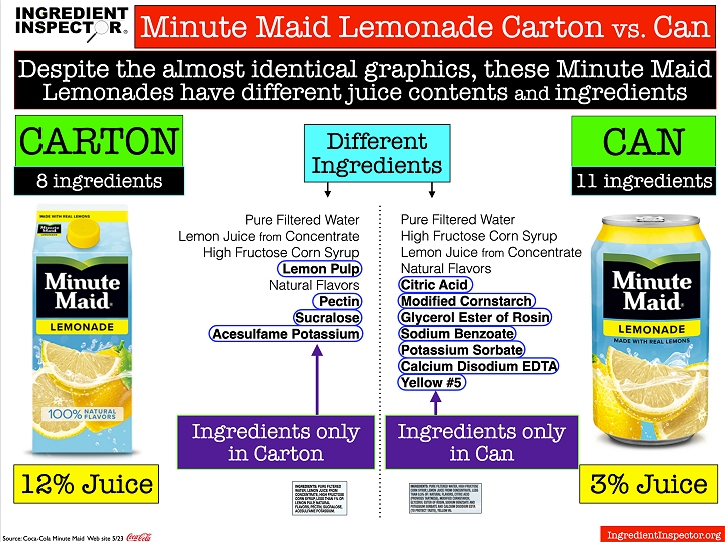
Example 1 – Minute Maid Lemonade

*MOUSE PRINT:

Minute Maid’s lemonade in cans has added chemicals and coloring compared to the version in cartons. But worse, while there is 12-percent real fruit juice in the regular product, the version in cans only has 3-percent juice.

Minute Maid Lemonade


Example 2 – Hi-C Orange Drink

*MOUSE PRINT:

If you buy juice boxes of Hi-C Orange Lavaburst at the supermarket, they actually contain some small amount of real juice, But if you order a glass of it at McDonald’s, that version has no real juice, almost 50-percent more sugar, and added chemicals and artificial colors!

Ingredient Inspector Hi-C

For more examples of products whose fraternal twin products are not like the original, please visit this special section for Consumer World and Mouse Print* readers at the Ingredient Inspector.

Updated every Monday!   Subscribe to free weekly newsletter.

Anheuser-Busch Settles “Lime-a-Rita” Case

With the popularity of margaritas, sangrias, mohitos and other specialty cocktails, it is no wonder that big beverage companies would want to mass market some of those drinks. And that is exactly what beer giant Anheuser-Busch did by introducing the “Ritas” brand of drinks like “Lime-A-Rita,” “Ritas Sangria Spritz,” and “Ritas Mohito Fizz.”
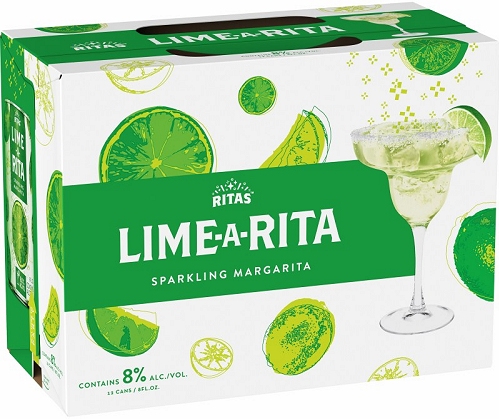
Lime-a-Rita

There was just one problem according to a couple of class action lawsuits [second lawsuit] filed against the company.

*MOUSE PRINT:

…reasonable consumers of the Margarita Products expect that based on the word “MARGARITA” on the package of the Margarita Products the products would contain tequila. This belief is further reinforced by the image of a salted margarita glass on the packaging.

However, unbeknownst to those consumers, the Margarita Products do not contain tequila.

Moreover, nowhere on the front, sides, or top panel of the packaging (the consumer facing panels) does Defendant state that the Margarita Products do not have tequila, or that the Margarita Products are actually just flavored beers that taste like a margarita. Instead, the bottom panel of the packaging, where no reasonable consumer would look prior to purchase, contains a small font statement that the Margarita Products are actually “Malt Beverage[s] With Natural Flavors and Caramel Color”.

In any event, to the extent seen on the underside packaging, reasonable consumers are unlikely to understand the foregoing “malt beverage” statement as meaning that the Margarita Products do not contain tequila…

So this margarita drink which most consumers would expect to contain tequila, has none. And the only disclosure about that is on the bottom of the carton, where consumers are not likely to look nor understand that fact based on the wording there.

The plaintiffs also allege that the company’s sister products don’t contain the specialty alcohol normally associated with that type of drink. So, their sangria doesn’t contain red wine, and their mohito doesn’t contain rum. Basically, these products are all just flavored beers. That means, according to the consumers’ lawyers, that Anheuser-Busch mispresented these products in violation of consumer protection laws.

In a bit of legal maneuvering, one of the cases was withdrawn and the other was just tentatively settled. Details of the settlement were not available at publication time.

Updated every Monday!   Subscribe to free weekly newsletter.

Purina Grain-Free Dog Foods Allegedly Contain Grains

Imagine deliberately seeking out a grain-free or limited-ingredient dog food because your dog has an allergy to wheat or soy, for example, only to learn that the product is not actually wheat-free or soy-free.

That’s what happened to a number of consumers who purchased Purina Pro Plan Adult Sensitive Skin & Stomach Salmon & Rice Formula, Purina Pro Plan Adult Sensitive Skin & Stomach Lamb & Oat Meal Formula, and Purina Beneful Grain Free with Farm-Raised Chicken accented with Blueberries, Pumpkin
and Spinach.

Purina Grain-Free

So they filed a lawsuit against Purina at the end of August. Each of the plaintiffs tells the story of having an allergic dog that improved when eating only whole foods. But that was an expensive proposition. So they switched to one of these grain-free products but discovered the allergic symptoms recurred. How could that be if the particular product did not contain the offending allergen?

*MOUSE PRINT:

According to the suit:

…independent testing of the Subject Foods confirms that these representations are false. Both Pro Plan formulas contain significant amounts of wheat, while the Beneful formula contains significant amounts of soy.

The complaint does not specify the exact amounts of the offending ingredients that were discovered, however. “Significant amounts” to the plaintiffs may be trace amounts to a judge.

As a result of their test finding, the plaintiffs alleged that Purina misrepresented the contents of these premium-priced products. As such, they say they overpaid for them or wouldn’t have purchased them in the first place.

Undeclared ingredients may be an industry-wide problem in the pet food business according to prior studies. Researchers in 2014, for example, found that 82% of products tested contained certain ingredients that were not listed on the label. That is a scary thought if you have to carefully watch what you feed your pet.