
 Not everything sold on Amazon comes from Amazon. It has “marketplace” sellers too. These are independent third party companies that contract with Amazon to include their offerings in Amazon’s product listings and pay them after they are sold. Some of the marketplace sellers will ship goods directly to shoppers from their own warehouse. Others will use a service provided by Amazon called “fulfillment by Amazon.” In those cases, the outside sellers send their inventory of the item to Amazon to be warehoused by the Internet giant. Amazon then apparently pools or commingles those goods, if the seller so chooses, with its own inventory of that item and with the same item sent in by other sellers too.
So, when you buy an item from Amazon, you may never know the actual source of it. Items with the same UPC code are generally warehoused together but may well have come from different places.
In an ideal world, this is would probably be considered good inventory management. In the real world which is inhabited by some number of crooks, this can be problematic.
Some categories of goods are more likely to be counterfeit (designer handbags) or be bogus (prepaid telephone cards), for example. When these items are stored in a pooled inventory, you the consumer have no way of knowing who actually provided that item to Amazon.
Now how is this a problem for shoppers? If you wind up with worthless goods, as our reader David B. did, you may have a fight on your hands with the marketplace seller who claims to only sell legitimate goods or with Amazon itself. And the problem may also manifest itself in a different way for shoppers.
Here is the rating of one marketplace seller on Amazon (Note: this seller is being used as an example and is not to suggest that this company did anything wrong. It may in fact be a victim.):

With a 100% rating and a good number of reviews, as a shopper you would feel confident in doing business with this marketplace seller. However, if you look at the actual reviews, a different picture is painted.
*MOUSE PRINT:
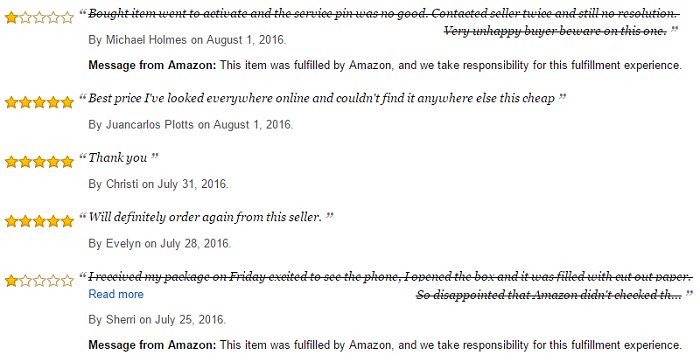
There are actually 15 one-star reviews for this seller alleging the receipt of prepaid cards with invalid PINs, broken or missing contents inside the box, etc. Those 15 one-star complaints out of a total of 49 reviews for this seller amount to just over 30%. Yet, Amazon says there are only 34 ratings, thus giving this seller five stars with a 100% rating. What’s going on here?
Each of the one star reviews is crossed out with a notation from Amazon:
Message from Amazon: This item was fulfilled by Amazon, and we take responsibility for this fulfillment experience.
Apparently all the items that this seller was down-rated for came from Amazon’s pooled inventory of goods since the company used “fulfilled by Amazon” to ship out the orders. And Amazon didn’t want to brandish this seller with bad ratings when those goods may actually have come from a source other than this seller. This is completely understandable, but there are some downsides. See Amazon’s strikethrough policy.
We asked Amazon why they eliminate the one-star ratings from the calculation of a seller’s total rating when the seller uses fulfillment by Amazon (“FBA”). An Amazon spokesperson replied:
“For FBA orders, Amazon takes responsibility for fulfilment-related issues. When a customer leaves negative feedback that mentions the fulfilment experience of an FBA order, the Seller can request that feedback be struckthrough. This doesn’t affect the Sellers rating because FBA is a fulfillment service provided and operated by Amazon.”
Huh? This makes it sound like Amazon denies tinkering with sellers’ star ratings.
The company did not reply to other questions about whether they refund complaining consumers in full, and whether they understand that artificially increasing a seller’s rating can potentially mislead shoppers.
Our advice: don’t rely on the summary rating for marketplace sellers. Read reviews in full on their full website (not app) to see if the particular seller deals in items that have a high risk of fraud.
We bought an $800 Dell laptop from a 3rd-party seller with the product handling fulfilled by Amazon just a couple of months ago. It arrived with a flaky hard drive so I had to send it back. Amazon refunded the full price, including shipping. We wasted a lot of our time dealing with the issue but ultimately we were not out any money.
By the way, Amazon packaging leaves a lot to be desired. I suspect that having the laptop rattling around in the shipping box during transit might have caused the problem in the first place.
I’m not saying any fraud was involved here. I’m just speaking to Amazon’s refund practice which was mentioned in the article.
Now I understand. I bought a pair of Keen sandals, and really liked them, they fit well, etc etc, so l ordered another pair. The quality was mediocre and the straps frayed. I checked them thoroughly and found that the first pair were made in Thailand,and the second in China. Same appearance but different quality. I contacted Amazon, and they allowed me to download a mailing label to return them. They immediately sent out another order that arrived by FedEx for a replacement. Given what I read above, I can now understand why this happened. To give credit and appreciation to Amazon, they did respond, no delay or argument, just at no charge, replaced the sandals. So, some and some, I will still order from Amazon, but with caution.
From what I get from this article, unless no other seller has ever sold a particular item on amazon, you don”t have any idea what you’re getting. Since they co-mingle articles with the same UPC, like the article says, counterfeit/used (when supposedly sold as new) may be mixed together. While that may be a good inventory practice, it isn’t good for the consumer who is expecting what they bought to be as advertised.
Thanks for bringing this practice to light. Maybe Amazon needs to keep inventories separate.
BTW, I always read reviews. I discount many of the 5 star ratings and like to look at the mid-range reviews. They ‘seem’ to be more truthful, mentioning issues the reviewer had with the product and how the company may have dealt with that issue. Many of the one star reviews are not very descriptive. “Piece of junk”, “fell apart after one use”, “damaged in shipping” (how is that the actual products fault?).
Good article. It brought to light a process that I never even considered.
I don’t go by what I receive, but rather what I ordered, to know where an item really comes from. But even so, the shipping practices can be highly annoying. We’ve received items “from Amazon” that were damaged because of the 3rd party’s packaging practices, then found that we had to send the return directly back to the seller instead of back to Amazon and had to then pay for shipping the broken product. FBA can create a lot of confusion and lower the expected quality across the board.
I think Amazon’s rating/review adjustment is entirely warranted in such a case. Why should a (presumably) honest seller get dinged because someone else added bad stuff to Amazon’s inventory.
The problem is Amazon’s pooled inventory that leads to this. Even if they continue to pool, each individual item should be tagged in Amazon’s records with the seller that provided it, so that when there are issues, Amazon can go back to the provider (and ban them after repeated or blatant problems).
If an item fulfilled by Amazon is a pool of different sellers, I don’t understand why Amazon would even bother including the names of individual sellers. If the seller truly has no responsibility for the product after it reaches an Amazon warehouse, then Amazon is only hurting themselves by not punishing deceitful or neglectful sellers.
Amazon now requires products I send in for FBA inventory to have unique barcodes added. I suspect this is for closing the loophole with sourcing their inventory.