
 Elsie the cow would probably turn over in her grave if she could see all the newfangled milks on the dairy shelf, like Milkwise, which we wrote about in 2015. And there are a lot of soy milks and almond milks.
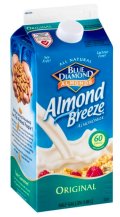
Almond Breeze is one of the big brands. It looks and sounds wholesome and nutritious. But even checking the ingredients listing doesn’t give you a full picture of what you are really buying.
*MOUSE PRINT:

It may seem like a bit of circular reasoning, but “almondmilk” is the first ingredient in almond milk. But if you are just casually reviewing the list, it appears that almonds are the second ingredient in the order of predominance after water. But that is a bit of word trickery — almonds are not really second overall. After that is a form of sugar, which might give a clue to what you are really buying. And the nutrition label offers yet another clue by noting it only has one gram of protein.
The trouble is we really don’t know how much of the product is derived from almonds. I don’t know about you, but when I squeeze an almond, I can’t get any milk out of it. 🙂 So leave it to some industrious lawyers who found out the answer.
*MOUSE PRINT:
According to a lawsuit they have filed in 2015, Blue Diamond Almond Milk only contains two-percent almonds.
So the product is really just a bunch of water and sugar with a pinch of almonds. While the flavor may be pleasing to many, the nutritional value of the product seems questionable at best.
Fast forward to late 2016 and early 2017.
A settlement of this class action was announced last month that will cost Blue Diamond $9-million. And of course, the company denies any wrongdoing and stands by its advertising. Consumers who purchased Almond Breeze are entitled to $1 back per container, for up to 10 containers, depending on whether they have proof of purchase or not. The deadline for filing a claim is April 13, 2017.
Last November, 25 members of Congress wrote to the Food and Drug Administration calling on the agency to investigate and take action against any producers of “milk” products that are not derived from cows.
And just last week, Wisconsin Senator Tammy Baldwin introduced a bill in Congress to fight back against nondairy products mislabeled as milk, yogurt or cheese.
I stopped buying commercially made almond milk when I learned how easy it is to make your own. (One cup almonds yields four cups almond milk–the rest is water & flavorings/sweeteners.)
The milk bill in Congress is for the dairy industry, fighting because they are losing market share (read: $$$) to plant-based milks, like Helmann’s lawsuit about the name Just Mayo in an attempt to put a vegan mayo producer (Hampton Creek)out of business. Unsuccessful, partly because the real thing is MAYONNAISE, not MAYO. Corporate greed = dirty tricks & hijinks–on both sides, sometimes!t
Would you rather at the grocery store purchase:
Almond Milk
ORRRR….
Almond Flavored Water??
Sunny is right. Almond milk is easy to make based on the recipes I saw online..
This phrase “…take action against any producers of “milk” products that are not derived from cows.” discriminates against produces of milk from other species, like goats, sheep, camels, water buffalo, etc. Yeah, I’m picky about wording…maybe a product of reading sites like this.
After I consumed almond milk and soy milk, I quickly realized that it was actually almond water and soy water with added sugar. I did not make the mistake of purchasing those products again
Exactly Russell. If you take animal science classes you will learn “milk” is modified sweat. Plants don’t sweat but most mammals do.
Geez where can I get that recipe of almond milk? .Thank you.