
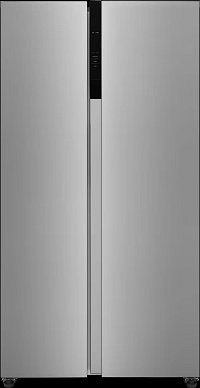
 Amanda C. wrote to us in July about a major appliance nightmare she was living through but now had hit a brick wall.
Last August, she bought a Frigidaire side-by-side refrigerator at Best Buy in Massachusetts for almost $1,000. Last month it stopped cooling properly. Apparently, the seal around the door was faulty so the refrigerator was running constantly, failing to keep food at a safe temperature while wearing out the compressor. The refrigerator got so warm inside that black mold started growing.
Contacting Best Buy was a dead end according to our consumer because they told her the return period was long over. When calling the manufacturer for repair, they provided her with contact information for a service company. But Amanda told us:
The company has cancelled the appointment multiple times, asked to reschedule, etc. after I had to rearrange my work schedule and life to accommodate the scheduling. After the 5th or 6th cancellation, I called Fridgidaire and filed a complaint.
The consumer contacted us asking for some guidance. We provided some executive level contacts at Electrolux (the maker of Frigidaire) and urged her to create a written record of the issue before the warranty expired. We suggested she follow some of the complaint resolution suggestions and contacts at Elliott.org .
She sent emails to key people at both Electrolux and Best Buy. Miracle of miracles, an Electrolux supervisor agreed to give her a replacement. But less than 12 hours later they told her they can’t replace it because that model has been discontinued.
Hope seemed to be lost at that moment. But then an executive resolution specialist at Best Buy reached out to our consumer and said they would pick up the old fridge and deliver a new one. Yeah!
*MOUSE PRINT:
Amanda was put through the wringer despite the law being on her side. In Massachusetts, a seller is just as responsible as the manufacturer in the case of defective goods. And here, when goods are defective, it is also the consumer’s choice of one of the three “R’s” — repair, replacement, or refund. Unfortunately, too many retailers simply point the finger at the manufacturer and brush the customer off.
We applaud Best Buy for finally stepping up.
Should you face a similar issue, our suggestion is to document the problem and climb the corporate ladder when a retailer or manufacturer tries to weasel out of its obligations. Find corporate contacts at Elliott.org . Should that fail, file a complaint with your state consumer office or attorney general, consider small claims court, and if the issue is newsworthy, contact a consumer reporter.
My household had a similar experience with a new GE refrigerator/freezer less than 30 days-old, that failed to keep fridge and freezer at safe temperatures. GE’s service arm Bodewell, canceled several appointments, and then failed to show up for others. After multiple failures to show and hours on the phone getting nowhere, a certified letter was sent to Bodewell’s Office of Legal Counsel, demanding repair, replacement or refund, and promising a small claims action if the matter was not resolved within 30 days. Within hours of receipt of the letter, a person claiming to be an “executive resolution specialist” called and promised a service technician would arrive the next day. The promise was kept, although it took two additional service calls to get the appliance working properly. The lesson for all major purchases, is to first use a credit card, as credit card charges may in many cases be disputed. If something is unsatisfactory, document it immediately, including date, time, description of event, witnesses and names of persons spoken with. Put everything down in writing. Take pictures and video. If a service person comes to the home, take a date and time-stamped picture of their service vehicle, including the license plate. Make notes of everything said and done. Learn and know your consumer rights. Consider reaching out to media consumer reporters. Be insistent and persistent. if all else fails, consider filing a small claims action. The filing fee for a MA small claim not exceeding $7000, is $150 as of this writing.
Edgar,
Perhaps you remember (and I’m not mis-remembering) the old Massachusetts “lemon law” for automobiles, where an arbitrator would respond to a customer complaint by scheduling a meeting with the customer and the manufacturer’s rep before ruling on the matter.
Before it passed, all the automakers voiced strong support for this measure.
Later we discovered why they supported the law — all the manufacturers had to do was skip the meeting and the customer was stuck with the lemon.
I hear echoes of this in your story (and Glenn’s in the comments). The manufacturers promise to send a repairman, cancel repeatedly, and hope the customer will give up.
Plus ça change !
Jerry… I actually wrote the regulations under which the Massachusetts New Car Lemon Law operated, including the arbitration rules.
I honestly don’t remember an instance where the manufacturer failed to comply with the arbitrator’s buy back order if that was the result of the hearing. In fact, we actually called in General Motors because they were having more than their share of arbitration hearings. We pointed out they were really turning off customers by forcing consumers to go to a hearing when their car entered “lemonhood” based on the criteria in the law. From that point on, they changed their tune, and settled most cases in advance before any arbitration hearing was needed.
I’m not surprised to learn you were involved back then!
My specific memory comes from a story in the Boston Globe reporting the no-show strategy some auto makers were using. Unfortunately, the Globe online archive goes back only to 2011, so I couldn’t pull up that article.
But I’m happy to learn about your role in creating the law and your success in changing auto makers’ behavior.
And in this era when the federal government has retreated from regulation and enforcement, the current lemon law seems to be working well.
My recollection was a little off, but the auto makers’ failure to participate in the arbitration process is accurate.
Here’s a 1986 report that mentions the flaw in the original arbitration program and the changes made to the process. See section IV.B.1.
https://archive.org/details/massachusettslem1986mass
“No manufacturer in Massachusetts set up a panel that met Lemon Law standards. Consumers who believed they had ‘lemons’ had no means to enforce their rights other than to file a court claim — a time consuming and expensive option.”
Thanks for doing the research, Jerry, and refreshing my memory. The original 1984 lemon law let manufacturers set up voluntary arbitration panels to hear cases if a consumer’s car met the state criteria for refund or replacement. No manufacturer set up a qualifying program. And consumers were stuck having to go to court.
I joined Consumer Affairs in 1985 and after I was there, the legislature changed the law to have state-run arbitration that was mandatory. I oversaw THAT new program, and wrote the regulations under which it and arbitration operated. That program has successfully handled thousands of arbitration cases over the past four decades.
Yes you will always have to go through 6 clueless people to find the one who can actually help you, its designed to get you to give up after 2 or 3 tries….and you lose.
I feel the Massachusetts law make the seller to be just as responsible as the manufacturer is unfair and wonder if it has any challenges in court. The seller in this case, Best Buy, appears to have a stated return policy for “bad out of box” items. Even if they sold an extended warranty they are a retailer and not an insurer. Best Buy probably was getting bad press so they replaced the unit. Also, Electrolux saying they couldn’t replace it because it was a discontinued model is beyond hysterical! Surely they make a comparable model. (I have never been employed by Best Buy, Electrolux, or any retailer large or small in my life)
I agree with you John. I think it’s a bad precedent to make every retailer personally liable for everything they sell outside of a stated return policy. I believe that states may try to push for that because it’s easier to go into Best Buy and complain instead of calling Electrolux, but retail stores are already hurting because of online store competition and forcing policies on them that make it even more expensive to do business isn’t helping.
If Electrolux makes the appliance, Electrolux should be responsible for fixing it once it’s outside of the return policy.
Joel and everyone…
Most states have adopted the Uniform Commercial Code which has a section of the law about the Implied Warranty of Merchantability. Unless the seller disclaims it, such as by selling goods “as is,” implied in every sale by a seller who normally sells that type of product is a guarantee that the product will function properly for a reasonable period of time. If that warranty is breached such as in the case of defective goods, the SELLER under this law has to make it right for a reasonable period of time. Some courts have said that the implied warranty lasts at least as long as the manufacturer’s warranty. So it is not unfair for retailers to have to stand behind the products they sell beyond the return period period, it is the law.
Both sellers and manufacturers have responsibilities when goods turn out to be defective.
The retailer could at least go to bat for you with the manufacturer. The manufacturer is likely to care a little bit more about its relationship with Best Buy than you.
Stinks she had to go through so much just get a replacement.
Recent problem with the Frigidaire air conditioner (not a cheaper one either). Purchased last June, and this year decided it wasn’t going to work. Frigidaire was no help. When I explained the whole situation to Amazon, where I had purchased the AC, Amazon finally gave in and gave me a full refund, even though it was over the one-year warranty for Frigidaire and well past the Amazon warranty. Frigidaire basically sucks. I have heard from people with the same problem.
Karen… you are very lucky that Amazon gave you back your money. You must be very persuasive!
Our Frigidaire’s seal started to separate from the door, creating a situation similar to this person’s but not as dire. Apparently there were only 3 spots where the glue had been applied to adhere the seal to the door–corners, and middle. We used E6000 glue to re-glue it. Won’t be looking at Frigidaire again.
First mistake was buying a Frigidaire. Used to be a good company, but no longer. I’d be surprised if the replacement fridge makes it to 5 years before crapping out.
Their dehumidifiers don’t even last 2 years anymore. When I ordered yet another one, it was defective out of the box. They made me jump through hoops to start a warranty claim, only to insist that I ret’n it to Amazon (after I was told I was eligible for a replacement.)
No more Frigidaire/Electrolux for me…Ever.