Since the beginning of January, owners of Quicken 2005 have been bombarded with reminders (via pop-ups when starting up the software, and by mail) that on April 30, 2008 many important features of the program will stop functioning. Mouse Print* this week will examine the stark contrast between these current elaborate disclosures and how poorly new customers are warned before purchase that the software will become substantially disabled in three years.
In a January mailing to Quicken 2005 customers, the company warns:

When starting up the software in 2008, this pop-up warns of the forthcoming crippling:

For many users, the ability to download statements from their bank and stockbroker monthly, get stock quotes, as well as being able to pay bills and transfer money online, are key reasons to use Quicken.
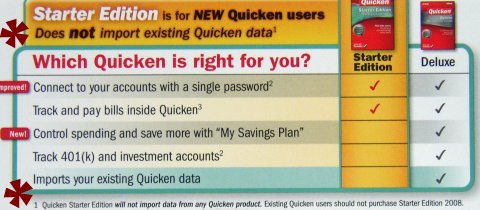
After presenting the bad news, Intuit, the maker of Quicken, offers the solution: buy an upgrade to Quicken 2008. In the past, for many users this has not been a huge issue because Quicken Basic has always been free after rebate when purchasing the company’s tax preparation software, TurboTax. This year, as noted in last week’s edition of Mouse Print*, the company discontinued Quicken Basic and made its substitute product (Starter Edition) incapable of importing existing Quicken files. That forces customers to buy an upgrade for $59.99 (less during promotions) to Quicken Deluxe.
Incidentally, the company says it is costly to support prior versions of Quicken, and that is why they discontinue these critical functions every three years. They apparently have not changed the technology they use to communicate with banks and brokerage firms, however. That would have been an understandable reason for the nonfunctionality. It appears that the company just deliberately disables the online functions to enable it to generate more income from current owners.
Okay, so Quicken has a three year life for certain important functions. How do they convey that critical limitation to prospective customers?
*MOUSE PRINT: On the spine of the 2008 box, buried within the copyright notice, in type so small the actual notice is less than an inch wide, it says (enlarged below):

The disclosure merely says that online features are subject to change in accordance with the “discontinuation policy” (previously called their “sunset policy”) listed on their website. The “subject to change” language also appears in a tiny footnote on the back of the box. Similar non-specific notices appeared on the 2005 Quicken box.
In no way, shape, or form is this adequate notice that the Quicken product you are about to buy will have key features of the software disabled/crippled in April three years after the date on the box. The essence of consumer protection (and fair dealing) is to provide the customer with all the relevant facts before purchase so they can make a more informed buying decision.
 As we approach tax time, many consumers are in the market for new tax prep software and may at the same time upgrade their financial management program such as Quicken. The bad news is that the combination deals of past years where one could get Quicken Basic free after rebate when purchasing TurboTax are all but gone. The replacement offer is less generous than it appears to be because of details in the fine print, and a change of corporate philosophy.