Updated every Monday!   Subscribe to free weekly newsletter.

Beware Costly Restocking Fees

About half of stores that sell electronics and furniture have restocking fees on some items. That’s a deduction made from the refund you would otherwise be entitled to when returning an item to a store. Restocking fees can range from 10% to 100%. These fees are usually triggered by returning an electronics item that has been opened, used, damaged, or doesn’t have all the original packaging.

While many retailers and etailers are good about returns and about disclosing their policies by means of store signs and in the customer service section of their websites, some other sellers are vague about how much breaking the rules will cost you.

Overstock.com, for instance says:

If you return an item that has been opened or shows signs of wear, we will issue a partial refund minus both original shipping charge and return shipping fees. Products decrease in value over time. Therefore, we reduce refunds for returns you initiate more than 30 days after delivery or received at our returns processing facility within 45 days.

Well, how much is the partial refund? For most items, the company does not say. But if you dig deeply enough into their website, Overstock has very specific, hard-as-nails rules for figuring out how much they will deduct from your refund for returned jewelry and watches:

*MOUSE PRINT:

Jewelry and Watch Returns Condition Policy:

A Master Certified Watchmaker or Graduate Gemologist rigorously inspects jewelry and watch returns, which are subject to the following guidelines:

1. Excellent: 100% Refund (minus $10 inspection fee and shipping)

  • Falls within Overstock.com’s Jewelry & Watch 30-day Return Policy.
  • Pristine showcase condition. Looks new, unworn and needs no refurbishing.
  • Arrives in new, undamaged original box or case.
  • Complete with all original parts, links and accessories.
  • Complete with all original certificates, manuals, appraisals and tags.
  • No evidence of sizing, service, alteration, wear or blemish of any kind.
  • Items with Mylar tags must have the tag attached and unbroken.

2. Good: 40% to 80% Refund

  • Falls within Overstock.com’s Jewelry & Watch 30-day Return Policy.
  • Can be restored to “like-new” condition.
  • Arrives in new, undamaged original box or case.
  • Complete with all original parts, links and accessories.
  • Complete with all original certificates, manuals, appraisals and tags.
  • Sizing, service, alteration, wear or blemish of any kind that we cannot refurbish.
  • Items with Mylar tags must have the tag attached and unbroken.

3. Fair: 0% to 40% Refund

  • Falls within or outside Overstock.com’s Jewelry & Watch 30-day Return Policy.
  • Cosmetic defects that cannot be refurbished (e.g. gold plating or special finishes that are scratched or rubbed off and scratched/ripped bands of leather or rubber).
  • Missing or damaged original box.
  • Missing any parts, links or accessories (subject to evaluation for each).
  • Missing original certificates, manuals, appraisals and tags.
  • Significant wear or damaged but repairable watch movement.

4. Poor: NO Refund

  • Falls outside Overstock.com’s Jewelry & Watch 30-day Return Policy.
  • Items that do not match the serial number or SKU number of the item originally ordered.
  • Mechanical damage that is unrepairable or significant cosmetic damage.
  • Wear, blemish or cosmetic damage or damaged watch movement due to inappropriate wear or use.
  • Missing original box or case.
  • Missing parts, links or accessories.
  • Missing original certificates, manuals, appraisals and tags.

One can only assume that similar criteria might apply when they judge how much to give you back on an opened electronic item.

Other stores, including Brookstone and BJ’s, have some restocking fees, but do not state how much they are. And Sears equivocates on whether a 15% restocking fee will be applied to open box electronics.

The best advice: if you think you might return a particular gift, DON’T OPEN THE BOX.

Updated every Monday!   Subscribe to free weekly newsletter.

The Limits of Unlimited Cell Service

More and more cell companies are advertising unlimited service packages these days. Here’s one from a company you have never heard of:

unlimited

Their “unlimited” plans range in price from $39.99 to $69.99. So do they really give you “unlimited” service?

*MOUSE PRINT:

From their FAQ:

Q: Is there a cap on the unlimited program. A: Yes, the unlimited Local & LD Plans are capped at 10,000 minutes per month.

Q: How many text messages can I send per month? A: Unlimited Text Messaging is capped at 30,000 per month.

Q: How much data can I use on the unlimited program? A: Unlimited MMS, Internet & Data is capped at 5 Gig

Ten thousand minutes of talk time sounds like a lot, but it really is only about 5.5 hours a day.  Some business people may in fact be on their phone longer than that.  At least they disclose the actual limits of their “unlimited” service, unlike most of the big brand name cell companies that make you hunt through their terms and conditions to find out that their unlimited service is subject to (sometimes unstated) limits. 

Realistically, while most users won’t go over these limits, that should not give a company the right to call a service unlimited when it is not.  From a consumer protection standpoint, no company should advertise “unlimited” service unless it actually is that.

Updated every Monday!   Subscribe to free weekly newsletter.

Staples Easy Rebates: Now Harder to Cash

Staples was a pioneer in making rebates easier for shoppers by allowing most rebates to be filed online, without the need for cutting out UPCs or mailing receipts. Rebates came more quickly, usually as a postcard-check.

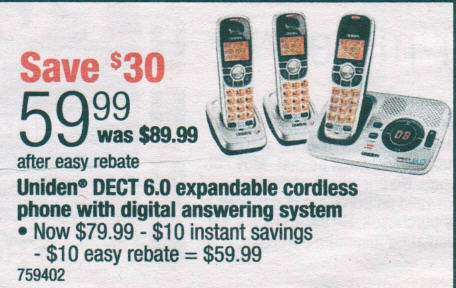
When shopping for a cordless phone recently, MrConsumer was attracted to the net price, after an Easy Rebate was factored in. Upon leaving the store, and scanning the provided rebate form (for those who prefer to mail in their rebates), it became clear the rebate was a not a cash rebate (by check), but rather would be paid via a prepaid Visa card. I questioned myself about how I could have missed that in their weekly advertisement.

Upon closer scrutiny, there was no such disclosure associated with the cordless telephone:

stapeasyexample1

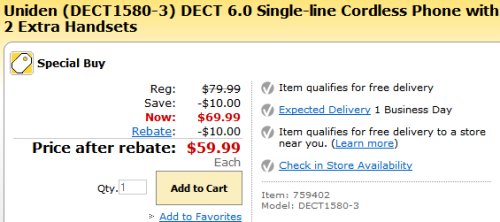
Even looking online, the item is promoted with a $10 “rebate” on the page where you add it to your basket, and no mention that the rebate is via a prepaid Visa card is made right there.

stapezexam2

Back in the circular, an unasterisked fine print footnote where details of financing terms and copyright information is usually disclosed noted this:

*MOUSE PRINT:

“Easy rebates are now even easler. Most easy rebates will be delivered in the form of a Visa prepaid card, which can be used everywhere Visa debit cards are accepted. Visa prepaid cards will be mailed within 4-6 weeks after receipt of validated claim. The Visa prepaid card is not redeemable for cash and may not be used for cash withdrawal at any cash-dispensing location. … Subject to applicable law, a monthly maintenance fee of $3 (USD) applies, but is waived for the first six months after the card is issued.”

Besides the obnoxious monthly fee, Visa debit cards are difficult to use up in their entirety. You can’t swipe them at self-service gas station pumps yourself. Elsewhere, you have to press “credit” instead of “debit”, even though “debit” is clearly marked on the face of the card.

Worse, when you are trying to use up the remaining money on the card, you have to do an oddly structured split tender, if the item you are buying costs more than the remaining balance on the card. (A “split tender” is where you use two forms of payment in one transaction.) Visa debit cards need to be tendered first in a split tender transaction, and the cashier must deduct only the exact amount remaining on the card, which may not even be known. One penny more, and the card is rejected. Split tenders using a Visa debit card cannot be done at some self-service checkouts (which can otherwise handle split tenders very easily). Even when a real live human cashier is present, he or she may have difficulty because not all cash register systems can handle them properly.

In addition, there are other inconveniences: you have to forego rewards and other benefits that you would otherwise be entitled to when using your regular credit card, you cannot track the purchases put on the card for tax purposes using programs like Quicken, you wind up with a wallet filled with plastic rebate cards with unknown balances on them, and you cannot get cash for the balance on the card through an ATM or any other method.

Some people simply refuse to do rebates when a prepaid card is involved for these very reasons, so to have a Visa card rebate sprung on the customer without disclosure at the point the item is advertised, is dirty pool.

When asked to comment on why Staples is using Visa cards for rebates, whether they were aware of the problems they can cause customers, and whether they would change their advertising to clearly disclose the fact that the rebate was in the form of a Visa card, the company responded [portions edited]:

[We] conducted a thorough pilot to gauge customer satisfaction – always our number one concern. The results of the pilot were very favorable. In a post-pilot survey, customers noted convenience, ability to immediately spend the rebate,and elimination of check cashing fees as the main reasons they were satisfied with the switch. In addition, by offering a prepaid card, we were able to extend the rebate redemption period to six months from three months with checks. Based on customers’ positive feedback from the pilot, we began using Visa prepaid cards in June 2008. Since that time, the program has been well received by customers.

In the survey, a vast majority of customers indicated that they had no concern about being able to use their rebate funds. We provide a number of ways that customers can easily access their card balances to help make split tenders easier, including a toll-free phone number on the back of the card and via text message whenthis option is selected online.

Since the pre-paid card program launched in June 2008, we have communicated the use of Visa cards in our rebate program in multiple marketing vehicles to our customers, including in circulars, online and in-store signage. We believe we have done so in an effective way. Nonetheless, we are constantly reviewing the effectiveness of our marketing/advertising materials to make sure that our customers remain informed of all important program terms.

For one, this Staples shopper and consumer advocate is not swayed in the least by Staples’ PR spin, and is dismayed that the company refused to more clearly disclose that its rebates were now being made via prepaid Visa cards. In essence, you are getting a merchandise credit instead of the advertised cash back.