There is a high profile move in Michigan to repeal that state’s item pricing law — the law that requires most products sold at retail to have a price sticker affixed to them. The deceptive tactics being used to turn public sentiment again the law is the subject of this Mouse Print* story.
[Note: MrConsumer is the author of the Massachusetts food store item pricing law, and therefore has a personal interest in efforts to water down similar statutes elsewhere.]
It was bad enough from a consumer protection standpoint that the Governor in Michigan came out swinging against the law. A few days later, the retailers’ association there released a headline grabbing “study” claiming that item pricing was costing Michigan shoppers $2.2 billion a year.
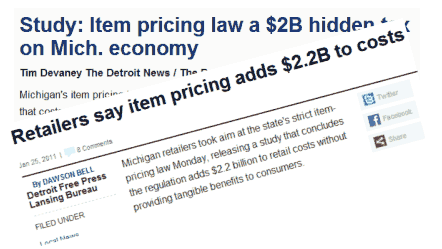
In tight economic times, who wouldn’t be against something that costs consumers $2.2 billion, or an average of $562 a year per household?
The trouble is, that $2.2 billion price tag for item pricing is just plain wrong.
*MOUSE PRINT
The missteps in the study are numerous:

The Michigan report used data from a 2001 price survey — a full decade old — that purported to show that prices in New York (an item pricing state) were 8-10% higher than prices in New Jersey (a non-item pricing state). They said the average item was 25 cents more expensive in New York because of item pricing.
How can anyone conclude anything legitimate about Michigan prices based on what prices were in New York 10 years ago? Michigan retailers did no study whatsoever comparing Michigan prices to those of neighboring states to see if in fact there were any price differences today. And even if they had done a survey and found a difference, who is to say that item pricing would be the cause?
So how did the 2010 Michigan study come up with their claim that item pricing is costing Michigan consumers $2.2 billion a year needlessly? They said that Michigan consumers spend $24.2 annually on groceries and household goods, and since grocery prices were 9%Â higher in New York, on average, that means that Michigan goods are $2.2 billion more expensive than they should be.
*MOUSE PRINT
Remarkably, the 2010 Michigan study contained data that definitively disproved their own claims.
They say there are two basic cost components of item pricing: the cost of labor to put prices on items, and the cost of the labels and price guns. As to labor, they say a typical supermarket spends 2083 man hours a year item pricing 5 million units of groceries. Let me assume the wage there is $15 an hour. That works out to $31,245 as the labor cost component of item pricing in a typical supermarket. The study also confirms that the labor necessary to do item pricing is the equivalent of one full time worker.
The second cost component of item pricing is the paper price stickers and label guns. They say that stickers and label guns cost $6000-$10,000 per store. I will take the middle number, $8000, and add that to the labor cost. Therefore in total dollars, the initial cost of item pricing based on THEIR REPORT is $39,245 per supermarket per year. Since they say that such a store sells five million units of groceries per year, that works out to a mere $0.008 — 8/10ths of one cent per item as the true cost of item pricing — not the 25 cents per item (9% of total cost of groceries) they claim. Therefore the $2.2 billion claimed cost is wildly exaggerated, has no basis in fact, and serves only to wrongfully fuel public outrage and anti-item pricing sentiment.
Since the actual cost of item pricing BASED ON THE RETAILERS’ OWN FIGURES is only 8/10ths of one cent per item, not 25 cents per item, that works out to only $17.98 a year per household as the real cost of item pricing — less than 35 cents a week — not the $562 per year that they claim.
*MOUSE PRINT
The retailers indicate that costs are higher for them because of item pricing, and most of that cost is in the form of labor costs. However, the report’s own statistics show that Michigan has fewer employees on average per retail store than 39 other states. And the report quotes retailers as saying that “their Michigan staffing levels are the same as those in non-IPL [item pricing] states.”
So, if Michigan retailers do not have more employees because of item pricing, how is it costing consumers there $2.2 billion extra? And, if retailers are to be believed that they will not fire workers, but rather reassign them to other tasks in the store like customer service, where are the savings?
The implied message in the retailers’ argument that item pricing is costing Michigan consumers $2.2 billion extra a year is clear. If you get rid of item pricing, prices will fall to the tune of $562 a year per household ($2.2 billion). If you believe that, I have a bridge in New York to sell you too.
The media in Michigan can also be faulted for blindly reporting the $2.2 billion lie without a critical reading of the study.
My guess is that Michigan consumers will be the big losers in this battle. Without item pricing, it will be harder to find and compare prices in the store. Shopping will take more time if a consumer has to find a distant self-service aisle scanner to verify prices. And it will be more difficult to catch scanner errors both at the checkout and at home since there will be no price on the item to act as a double check.