Updated every Monday!   Subscribe to free weekly newsletter.

Act Mouthwash: Now With Less Fluoride?

A sharp reader found what he thought was a new example of skimpflation — when a product is reformulated with cheaper ingredients, or perhaps simply watered down.

He wrote about Act Total Care mouthwash which is an anticavity product with fluoride that you swish around in your mouth once a day to provide added protection for your teeth.

A closer look at the front label reveals an inconspicuous difference between the smaller bottle he had at home and the larger one he had just bought.

*MOUSE PRINT:

Act small and big

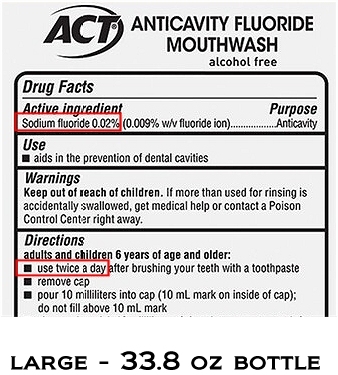
Could the print be any smaller? The strength of the fluoride is less than half in the large bottle going from 0.05% to just 0.02%! So users have to wonder whether it is going to be less effective since in essence they are giving you diluted fluoride.

But there was a second difference on the back label. Instead of gargling once a day, you have to use the product on the right, the larger bottle, twice a day.

*MOUSE PRINT:

Act smallAct large

The effect of both these differences seems like a double-whammy for users. You’re getting half the strength so you have to use twice as much a day, and the larger bottle costs more.

We asked Sanofi, the maker of Act, to explain these changes, as well as calling their consumer line. We were provided with a most unexpected answer. Although the products look the same but for the size of the bottle, and have the same name, they are actually two separate products. The smaller bottle is meant to be a once-a-day product and the larger one is meant to be a twice-a-day product, and this is nothing new. The customer service rep said the larger bottle has to have a less concentrated amount of fluoride since you are taking twice as much of it.

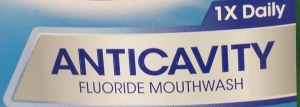
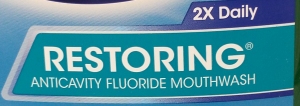
There is no indication on the front label that you need two doses a day from the larger bottle of Act Total Care unlike some other of their mouthwashes that at least have a tiny designation on the front.

*MOUSE PRINT:

Act 1x Act 2x

We can only wonder how many people are taking the wrong dose of Act Total Care if they change bottle sizes? Some may wind up taking double the dose, while others could wind up with only getting half the protection they expect. When we asked Sanofi why they don’t try to prevent misdosing by clearly labeling the products “1x Daily” or “2x Daily,” their spokesperson (non)responded:

“All of our products are labeled in accordance with FDA regulation.”

Updated every Monday!   Subscribe to free weekly newsletter.

CPSC Slow to Issue Product Safety Warnings

We expect state and federal agencies charged with protecting public safety to warn and protect us from dangerous products and defects in a timely way.

That is particularly the role of the U.S. Consumer Product Safety Commission (CPSC). In the story below, grieving parents of a baby who died by suffocation in a Fisher-Price Rock ‘n Play sleeper in 2017 say the agency knew about previous deaths and injuries but the product was still on the market.

The baby sleeper in this case was eventually recalled by Fisher-Price but only after information about its safety issues and reported deaths was obtained by Consumer Reports and made public. Here is some history.

*MOUSE PRINT:

The federal law being called into question here, section 6(b) of the Consumer Product Safety Act, has been controversial for years. It basically requires the CPSC to give manufacturers at least 15 days advance warning before it goes public with news of a safety defect from which the public could learn the name of the manufacturer and product involved. The manufacturer can then respond to the CPSC with its position, and object to the release of the information.

Since the CPSC is surprisingly not empowered to order a product recall without going into court to sue for one, the agency and manufacturer are often at loggerheads for years over the issue. This is why when you hear about a recall, it is typically the manufacturer “voluntarily” doing it and not the CPSC. Additionally, some say if manufacturers know that the product defect and injury reports they file with the CPSC are not going to be easily made public that incentivizes them to continue to make such important disclosures.

While the TV report above asserts that section 6(b) is a gag order being placed on the CPSC, a former assistant general counsel at the agency says it is not. He asserts the real problem at the agency is that it fails to understand and use its existing authority.

No matter, in the current Congress, the Sunshine in Product Safety Act was filed to abolish section 6(b), but it has gone to committee and not likely to pass.

Whether section 6(b) is preventing the CPSC from naming names and alerting the public early to safety hazards, or they are not effectively using their own rules and tools, the result is the same. We deserve better protection.

Updated every Monday!   Subscribe to free weekly newsletter.

Carnation Breakfast: Where’s the Promised Protein?

Earlier this month, a class action lawsuit was filed against Carnation about the allegedly misleading label on some of its Breakfast products.

The product, which comes in packets, boasts on the front of the package that it has 13 grams of protein, 21 vitamins and minerals, 3 times the vitamin D of milk, and three times the calcium of Greek yogurt.

Carnation breakfast

On the far right of the package, in tiny type, is a key disclosure:

*MOUSE PRINT:

Carnation - add milk

Most shoppers are not likely to see that, and it certainly isn’t remotely close to the protein claim. On the back, the ingredients statement has powdered nonfat milk as the primary ingredient. That might lead one to believe all you have to do is add water.

However, when checking the nutrition facts label, it becomes clear that the protein content of each packet is only 5 grams, and only magically becomes 13 grams as represented on the front of the package when consumed “as prepared” when adding milk.

*MOUSE PRINT:

Carnation nutrition label

So, what do you think? If you picked up this product and saw the 13 grams of protein claim on the front of the package, would you understand that that amount is only the result of adding milk to the product? There are no instructions on how much to add.