Updated every Monday!   Subscribe to free weekly newsletter.

Is Quaker Lower Sugar Oatmeal Really Lower in Sugar?

Alan B. recently wrote to us saying that Quaker Oats was promoting its lower sugar variety of instant oatmeal as having a 33% reduction in sugar. He suggested this was a bit of smoke and mirrors because while the ingredients were the same, the packets of the lower sugar version were simply about one-third less in weight than the regular version, so of course they are lower in total sugar.

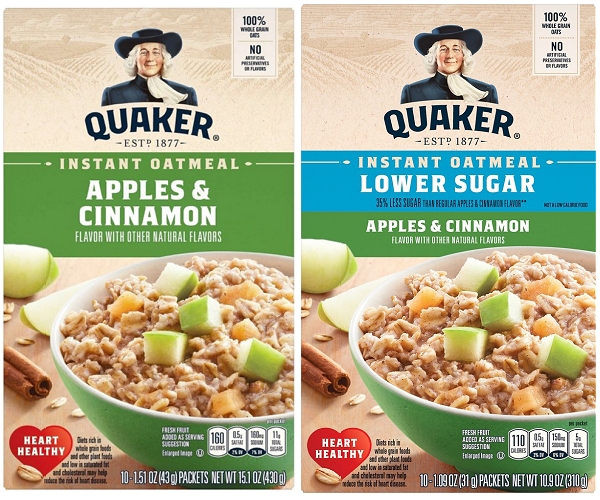
Quaker Regular vs Lower Sugar

So, we launched a massive investigation to see if there was an actual reduction in sugar or if it was just a packaging trick.

*MOUSE PRINT:

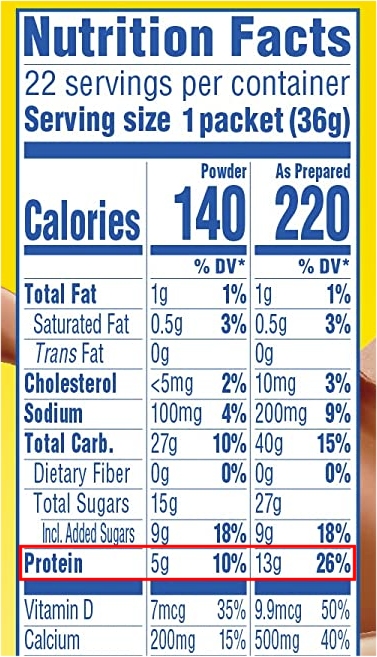
Quaker comparison

The regular version had 11 grams of sugar per packet, while the lower sugar one had only four grams. But because the packets are different sizes, we have to look at the percentage of sugar in each. The regular version is 26% sugar and the lower-cal version is only 13% sugar. If the lower sugar version packet was the same size as the regular one, its sugar content would be 5.5 grams – exactly half the amount in the higher sugar version.

So you really are getting a product with significantly less sugar. And despite our reader’s assertion that the ingredients are the same, they are not.

*MOUSE PRINT:

Quaker ingredients

Since ingredients are listed in the order of predominance, there are actually more apples in the lower sugar version than sugar.

So Quaker appears to be under representing the reduction in sugar on the box. The lower sugar version has 50% less sugar, not the 35% claimed.

Updated every Monday!   Subscribe to free weekly newsletter.

When It Comes to Eye Drops, They Can’t All Be the #1 Doctor Recommended Brand

MrConsumer has been having trouble focusing on his computer screen, and his eye doctor recommended using eye drops for dry eyes. In reviewing the websites and product labels of various brands, I discovered a curious thing — three companies all claimed their products to be the “#1 doctor recommended” brand!

Systane by Alcon

Systane

*MOUSE PRINT:

On their website, Alcon, the maker of Systane, shows all their tears products with the #1 claim on the box, and says the claim is based on an IQVIA ProVoice Survey of Eye Care Professionals 12 months ending December 31, 2021.


Refresh by Allergan

On its website, Allergan, the maker of Refresh brand eye drops also says that its family of products is #1 doctor recommended. Their claim is based on an Ipsos survey done in 2021.

Refresh


iVizia by Similasan

And just to further confuse the situation of dueling #1 claims, now comes a new product entrant into the U.S. market called iVizia.

iVizia

*MOUSE PRINT:

It boldly says “#1 Doctor Prescribed.” But in smaller type it is not that this specific product is most prescribed, but rather this manufacturer is number one in Europe.


Company Response

We wrote to the makers of both Systane and Refresh to ask some very pointed questions of how they both could be making the same #1 claim. We requested details of the survey, who qualified as an eye care professional, how the key question upon which their claim was based was worded, and whether they thought consumers picking up a specific product would understand that the number one claim was not necessarily about that product but rather an overall brand preference.

Abbvie, the maker of Refresh, did not reply to multiple requests for comment. Alcon, the maker of Systane, said in a not particularly responsive prepared statement:

“Alcon stands behind the #1 doctor recommended brand of artificial tears claim, which is substantiated by an IQVIA ProVoice Survey of 4,441 eye care professionals during the period January 1 to December 31, 2021. IQVIA is a third party that specializes in advanced analytics and clinical research services to the life sciences industry. Alcon complies with all applicable advertising and marketing laws and regulations in making the claim.”

We didn’t ask the makers of iVizia about its claim since it clearly distinguishes its claim as an overseas recommendation.

Without more facts to better evaluate and understand the basis for the other claims, however, the truth just becomes blurred.

Updated every Monday!   Subscribe to free weekly newsletter.

Beyond Meat Sued Over Protein Content of Its Veggie Burgers

Beyond Burger frontSix Illinois consumers are suing Beyond Meat, one of the leading makers of plant-based burgers and other meat substitutes, alleging that the company overstates the amount of protein in most of their products. It goes on to assert that the “daily value” percentage (“DV”) representing how much protein the product contributes to meeting the government’s daily requirement for protein is grossly exaggerated.

For the product above, for example, the company claims each burger has 20 grams of protein and that represents 40% of an adult’s daily requirement.

Beyond Burger Nutrition Facts

The lawyers for the consumers say otherwise in their complaint because they had the products tested by a laboratory.

*MOUSE PRINT:

Plaintiffs’ counsel commissioned testing of Defendant’s Products, which show that the Products do not contain the amount of stated protein amount and/or protein DV [Daily Value] %. For example, Defendant’s Beyond Beef Plant-Based Ground 16oz Patties, which is labeled as “20G Per Serving” and “40% DV” for protein, actually contains 19G Per Serving by nitrogen testing, and 7% DV for protein.

So the tests showed that there is slightly less protein, but how much the protein contributes to your daily requirement for protein is completely out of whack according to the lawyers. They say you are only getting 7% DV because of the quality of the pea protein used, not the 40% claimed. This is because, they contend, the company did not use the proper test to determine protein quality as required by federal regulations which factors in the digestibility and amino acid utilization of the protein being tested. For further reading, here is an article about pea protein vs. whey protein and how they are tested and compare. Contrary to what the lawyers claim, however, it says that pea protein concentrate rates pretty high generally.

The lawsuit concludes that Beyond Meat has misrepresented many of its products in violation of various federal and state consumer protection and other regulations.

For its part, Beyond Meat said “The allegations in the filing are unfounded and not representative of Beyond Meat’s products. We are prepared to vigorously fight this case.”