Updated every Monday!   Subscribe to free weekly newsletter.

Thanks for Nothing #6

Here is the latest collection of advertisements that made us do a double-take when checking the fine print.

Example 1:

In many parts of the country, real estate prices have gone crazy. And that is certainly true in and around Boston… but this is ridiculous.

price increase

A jump from $300,000 to $1.5-million? The question is, which number is wrong?


Example 2:

Many Macy’s ads indicate that items are on “special” during certain hours and that after the special, the price will be higher. Apparently, that is not the case here.

Macy's after special price

During the limited time special, the price of these pillows was $20. After the “special,” they dropped to $12.99. The rebate was not limited to certain times of the day incidentally.


Example 3:

Here’s a nutty example from last December. Walmart had a small 5.5 ounce bag of Emerald mixed nuts on sale 47% off. Wow, you say… until you see the actual price.

Walmart's nutty price

What? This small bag of nuts had a regular price of $30.99, but they are “only” $16.36 on sale? Who would be nutty enough to pay such a high price? Now that eight months has passed, we have good news. The price has dropped to a mere $13.94 on their site! Thanks for nothing, Walmart.


Example 4:

In this disclosure from Sears, they try to explain that when they say that something is merely “on sale” that means only selected groups of items are actually on sale. But when they use the term “all” then it really does means all. Or does it?

Sears all on sale

Apparently when they use the term “all on sale” that really doesn’t mean “all” since over two dozen groups of items are not included. Thanks for nothing, Sears.

If you find a good example of a humorous surprise in the fine print, please submit it to Edgar(at symbol)MousePrint.org .
Share this story:


ADV
Updated every Monday!   Subscribe to free weekly newsletter.

Eye-Opening: Systane vs. Systane Ultra

Continuing our look at line extensions of popular over-the-counter products, we turn our gaze to Systane — a leading brand of eye drops.

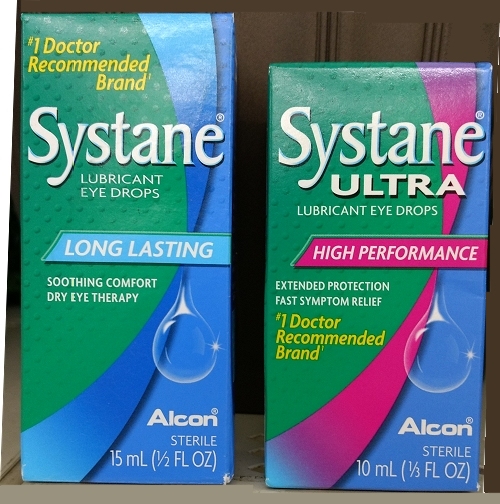
Here are two of their lubricating eye drop products:

Systane

The product on the left is regular Systane “long lasting,” while the one on the right is Systane Ultra “high performance.” Based on its name and description, Systane Ultra seems to be a premium product offering “extended protection.”

A check of the active ingredients of both products, however, reveals a surprise.

*MOUSE PRINT:

Systane ingredients

Both regular Systane and Systane Ultra have exactly the same active ingredients and seemingly in the same strength! So is this just another marketing gimmick like the one we spotlighted where regular Aleve and Aleve Back & Muscle have identical active ingredients?

We asked Alcon, the maker of Systane, what the actual difference is between these two products, and why they sell two different products with the exact same active ingredients.

A spokesperson for the company explained that the secret is primarily in the inactive ingredients which differ slightly between the two products. According to her that is why the “Ultra” product performs better.

“Compared to Systane, Systane Ultra has a unique mechanism of action due to the inclusion of sorbitol, which serves to optimize the viscosity of the drop to minimize blur by delaying the cross-linking of other inactive ingredients until the drop is actually in the eye. The way the inactive ingredients cross-link once Systane Ultra is dropped into the eye results in the creation of a viscoelastic protective layer over the ocular surface that reduces friction and is maintained between blinks for prolonged ocular comfort. Finally, the interaction of Systane Ultra with natural components of the tear film (e.g., calcium, zinc, and magnesium) strengthens the cross-linking of the protective layer and prolongs retention of the active ingredients on the ocular surface.” –Alcon spokesperson.

Got that?

Given that the “Ultra” product is nearly 50% more expensive, does it then last 50% longer than their regular one? The company didn’t answer that question.

Who would have suspected that two products with identical active ingredients would function differently because of the inactive ingredients? And that poses a problem for label readers who would not be able to glean that fact simply by examining a product’s contents.

Share this story:


ADV
Updated every Monday!   Subscribe to free weekly newsletter.

Tropicana Orange Juice Downsizes Again

Back in the good old days, one could buy half a gallon of Tropicana orange juice in a container. Then in 2010, the company (and the industry) downsized the traditional 64 ounce container to 59 ounces.

Tropicana 64-59
Tropicana 64-59 net contents

Then they introduced attractive carafes of orange juice in a shape not easily distinguishable as a particular size, but they were still 59 ounces.

Now in the summer of 2018, Tropicana, following the lead of Simply Orange, is in the process of downsizing again. This time to a mere 52 ounces.

*MOUSE PRINT:

Tropicana 59-52 ounces

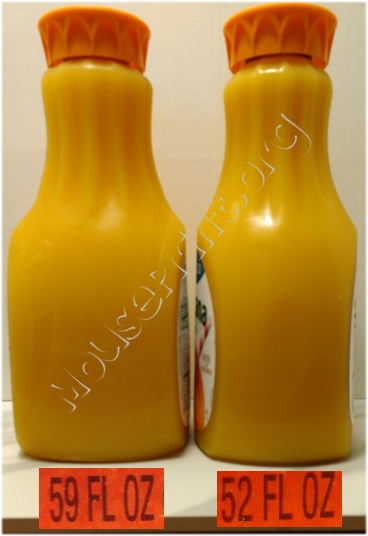
The bottles look identical on store shelves. Same width, same height. So how did they reduce the contents by a full seven ounces so inconspicuously?

*MOUSE PRINT:

Tropicana bottles profile

The bottles aren’t as deep as they were… that’s how they accomplished this clever sleight-of-hand.

On the Tropicana website, they explain why they downsized the product:

Tropicana downsize explained

We consider this one of the sneakiest downsizes ever because of both the tiny net contents statement which is often hidden by the shelf rack edge in some supermarkets, and the appearance of the bottles which look identical head-on. What do you think? Add your comments below.

Thanks to eagle-eyed reader, Edward E., for catching the change.

Share this story:


ADV