Updated every Monday!   Subscribe to free weekly newsletter.

Are King’s Hawaiian Sweet Rolls Really Made in Hawaii?

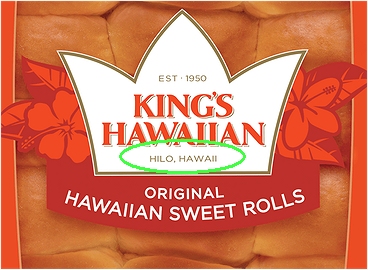
That’s the issue raised in a new lawsuit filed by two consumers who said they were misled into believing that King’s Hawaiian Sweet Rolls were manufactured in Hawaii.

*MOUSE PRINT:
King's Hawaiian

These rolls were first made in Hawaii in the 1950s, and eventually they became so popular that tourists would take them back home, or those on the mainland with friends in Hawaii would ask them to send some.

The consumers who have filed the lawsuit say that it was not only the packaging that gave them the impression that these buns came from Hilo, Hawaii, but language on the website that says the company will send the product to the “mainland” (continental US) for free:

King's mainland claim

There are many local and national brand knockoffs of King’s Hawaiian sweet rolls but these consumers paid a premium price which they would not have done but for the fact that they thought they were getting the real thing from Hawaii.

All is not totally sunny in this case for the plaintiffs, however. There is nothing explicitly on the package or on the website that says these buns are “made in Hawaii.” In fact, when reading the history of the company on their website or looking at the back of the package, one learns that their bakery is in Torrance, California.

So, how do you think a judge will rule? Will he or she side with the consumers or declare their claims to be half-baked?
Share this story:


ADV
Updated every Monday!   Subscribe to free weekly newsletter.

Neuriva Brain Supplement Is Not “Proven”

Remember this commercial for Neuriva, a recently introduced brain supplement?


The claims in it that Neuriva has “clinically proven ingredients that fuel five indicators of brain performance” became part of a class action lawsuit against the company. The complaint asserted that Reckitt Benckiser, the maker of Neuriva, lacked scientific proof that the product really improves brain functioning.

A review of the relevant scientific literature shows that no valid scientific or clinical evidence exists regarding how much, if any, of Neuriva’s key ingredients reaches the brain. Because of this lack of evidence, Defendants’ claims that Neuriva’s ingredients are scientifically and clinically proven to benefit the brain or enhance brain performance are patently false, as well as are Defendants’ claims that Neuriva has been scientifically proven to be effective. Indeed, no publicly available study of Neuriva exists, and Plaintiffs have found no indication that Neuriva’s efficacy has ever been studied or tested.

The company denied the charges but nonetheless subsequently entered into a proposed settlement agreement which calls for full or partial refunds to consumers and a change in the claims the company makes on the packaging and in advertising. [Purchasers can file a claim here, although the settlement is not finalized yet.]

*MOUSE PRINT:

Neuriva old and new

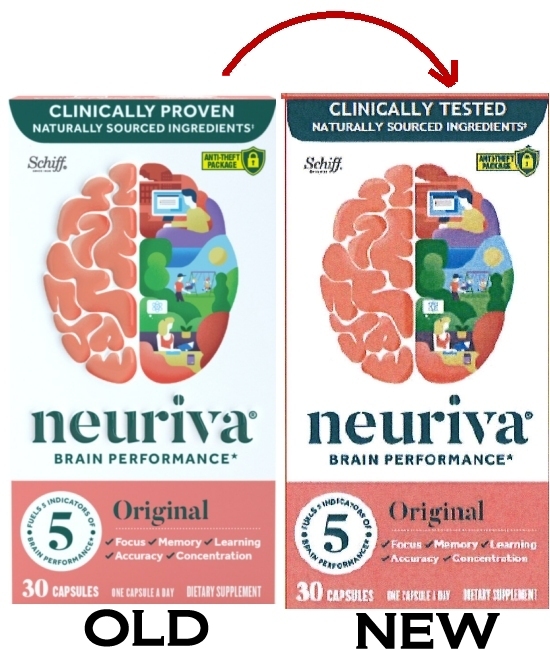
Put simply, the company agreed to change the word “proven” to “tested” along with other minor wording changes, but only for a period of two years. Frankly, whether it says “clinically proven” or “clinically tested” I think most consumers will still come away with the same net impression that there is reliable scientific evidence backing up the brain performance claims. The proposed settlement has also come under fire from other consumer advocates and court watchers.

The product’s TV advertising has changed already. They now have Miyam Bialik, the actress best known for her roles on Blossom and The Big Bang Theory, and as the future host of Jeopardy!, vouching for the product. What qualifies her for this role? She got her doctorate in neuroscience. Now the company uses that fact to also claim that the product is “neuroscientist approved.”


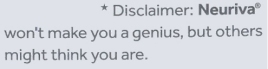
One thing that hasn’t changed is a disclaimer on the side of the Neuriva package.

*MOUSE PRINT:

Neuriva disclaimer

Share this story:


ADV
Updated every Monday!   Subscribe to free weekly newsletter.

Mercedes Promotes New Automatic Valet Parking Feature, But…

Mercedes is introducing a new high-end feature to its luxury vehicles called Intelligent Park Pilot. And just as the name suggests, when you engage the system, the car will find its way to the hotel, airport, or restaurant parking garage on its own.

To introduce the new technology, Mercedes created a commercial capturing something we have always wondered about — what do parking valets really do with your car when you hand them the keys?

This commercial shows them joyriding, speeding, and making daring moves all while you are eating a peaceful dinner somewhere and none the wiser.

The clincher in the commercial is the following disclosure about the automatic parking system.

*MOUSE PRINT:

Mercedes

So we’ll just have to wait until roads and garages get smart enough to safely guide cars with automated valet parking to a parking spot, and driving laws allow unattended systems like this.

Share this story:


ADV